How to use AI in SEO, and when it’s not yet worth it
Everyone is talking about AI SEO. ChatGPT traffic. GEO. AIEO. LLMEO. The acronyms multiply faster than the actual evidence. And underneath the noise is a question that most articles avoid answering directly: does AI traffic actually matter right now, and what should you actually be doing about it?
This is a technical article with real data. Not hype. Not a tutorial on how to prompt ChatGPT to write your meta descriptions. The actual research on how much traffic comes from AI, who it converts, and most importantly — why optimising for AI search before your traditional SEO is in order is a decision you’ll likely regret.
Let’s start with the numbers.
What the Data Actually Says About AI Search Traffic
The loudest voices in the AI SEO conversation tend to skip one critical piece of context: the current scale of AI-referred traffic is tiny. Not tiny as in ‘growing from nothing.’ Tiny as in, statistically, most websites receive almost no referral traffic from LLMs at all.
The raw numbers
Across multiple independent studies published between 2024 and 2025, the findings converge on a consistent range:
| Data point | Finding |
| Previsible (1.96M sessions, 12 months) | AI accounts for 0.13% of total traffic — roughly 1 in 769 sessions [previsible.io/seo-strategy/ai-seo-study-2025] |
| Amsive (54 websites) | LLM traffic contributed 0.24% of sessions vs. 31.9% for organic search |
| Conductor (aggregate data) | Organic traffic = 25% of sessions. AI referral traffic = 1.08% |
| Hamburg/Frankfurt study (973 ecommerce sites) | GEO traffic share ~0.2% of total. ChatGPT = 90% of that. [ssrn.com/abstract=5585812] |
| SparkToro, 2025 | 95% of Americans still use traditional search engines. Google processes ~14B searches/day vs. ~37.5M ChatGPT prompts/day |
The ratio of Google searches to ChatGPT prompts is approximately 373:1. (SparkToro, 2024)
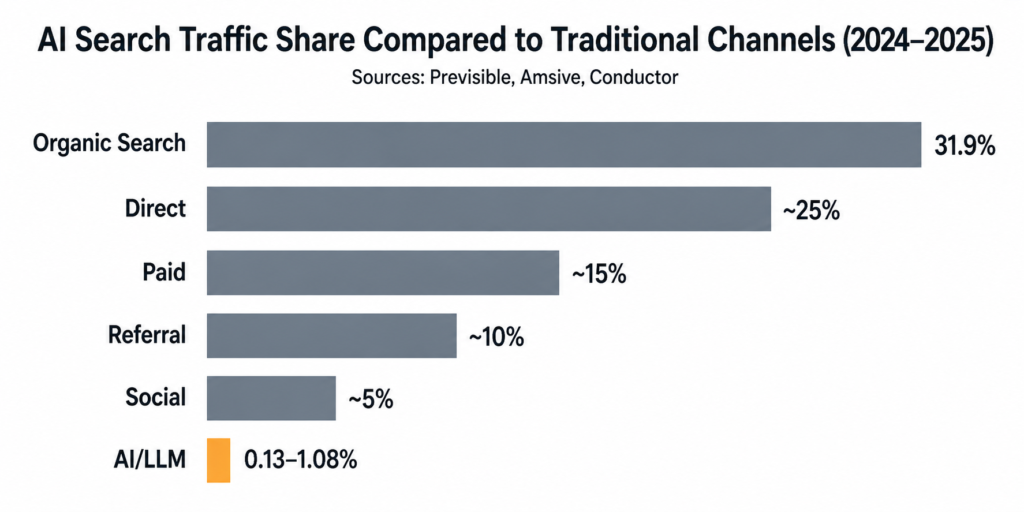
That doesn’t mean AI traffic is irrelevant. It means the conversation about AI search has dramatically outpaced the reality of AI search as a traffic source. And it means anyone telling you to restructure your entire SEO strategy around GEO optimisation right now is selling you something.
Who AI traffic actually converts for
Here’s where the data gets genuinely interesting — and contradictory, depending on which study you’re reading.
- Semrush (July 2025) found LLM visitors convert 4.4x better than organic search visitors
- Further/Search Engine Land (Feb 2026): LLM referrals show an 18% conversion rate — higher than paid search, Google Shopping, and SEO
- Alhena (329 ecommerce brands): LLM traffic converts at 2.47% — outperforming Google Shopping and Meta
- Hamburg/Frankfurt research (973 sites, $20B revenue): revenue per session from GEO traffic is lower than all traditional channels except paid social
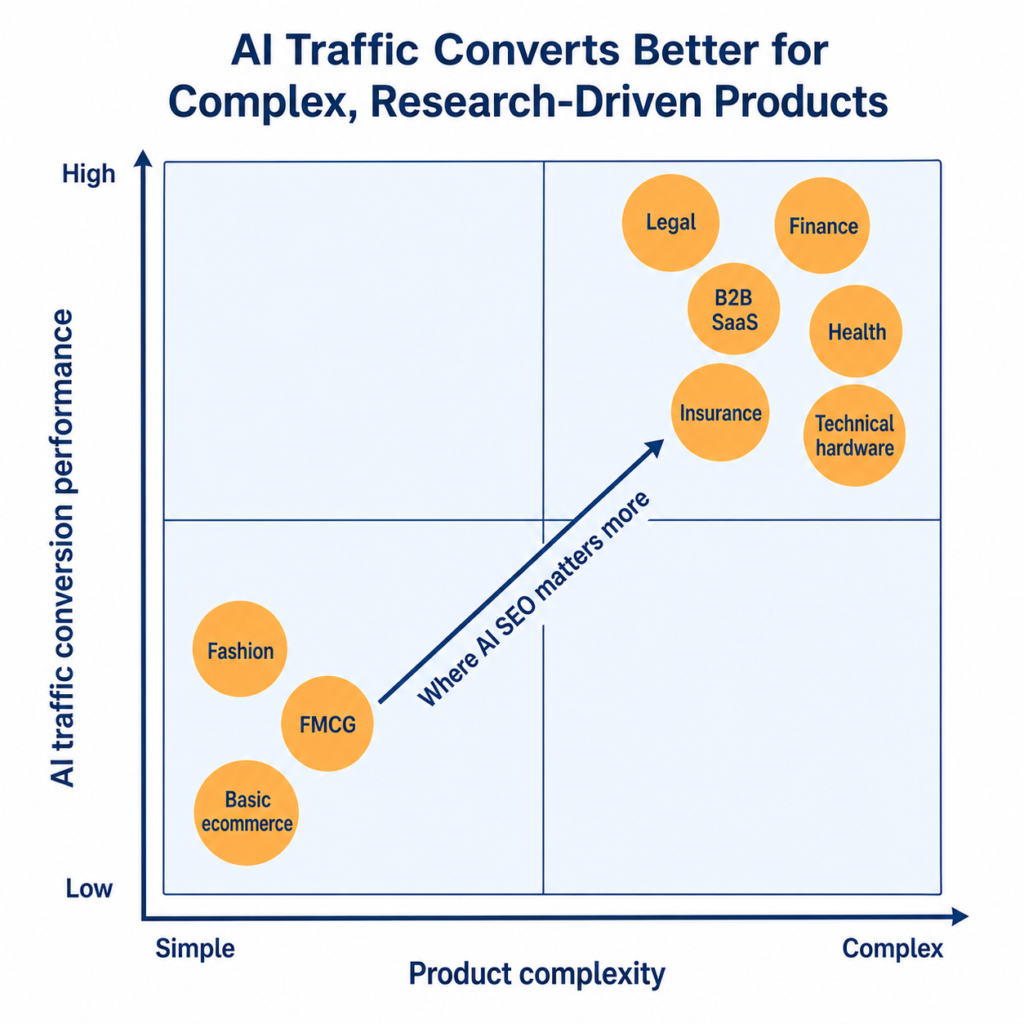
How do you reconcile these? The key is industry and product type. The Hamburg/Frankfurt study was ecommerce focused — simple consumer goods. Other studies included B2B, SaaS, legal, finance, and health sectors — complex, high-consideration purchases.
For complex products with long research cycles, AI traffic converts significantly better. For commodity ecommerce, it underperforms. (Kaiser & Schulze, University of Hamburg, 2025)
The attribution problem
Before treating any of these numbers as definitive, understand that LLM traffic attribution is systematically broken. According to recent analysis, over 70% of AI-referred sessions arrive in GA4 as ‘direct’ with no source attribution at all. Google’s AI Mode had a confirmed tracking bug that removed referral attribution entirely until mid-2025. AI Overview clicks blend into regular organic traffic with no separation.
The Hamburg/Frankfurt research used last-click attribution, which likely undercounts LLM-influenced purchases by 2-3x. (SSRN 5585812)
In other words: the 0.2% figure is almost certainly an undercount. But even tripling it puts AI-sourced traffic at well under 1% of the total. Google still owns search.
What “AI SEO” Actually Means (It’s Three Different Things)
Part of the confusion in this space is that ‘AI SEO’ refers to at least three distinct activities, and most articles conflate them:
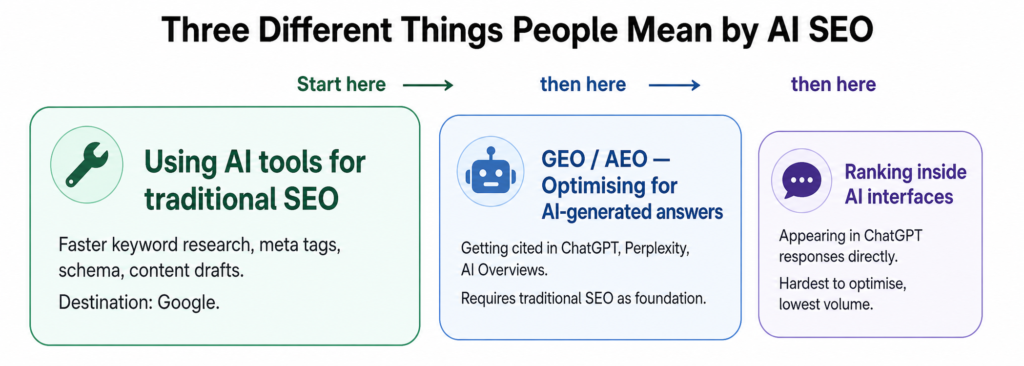
1. Using AI tools to do traditional SEO faster
This is the most mature and most immediately valuable application. AI tools help SEOs move faster on tasks that used to be slow:
- Generating meta title and description variations — what used to take 20 minutes now takes 2
- Drafting content outlines and first-pass copy from a brief
- Writing schema markup (JSON-LD) from a page description
- Analysing log files and crawl data in plain English
- Identifying content gaps by analysing competitor pages at scale
- Summarising monthly reports and writing the analytical narrative
The destination is still Google’s search results. The tools are just faster. This is not a new SEO strategy. It’s the same strategy with better tooling. And critically — it only works if you already have solid traditional SEO foundations.
‘Think of AI SEO as an extension of traditional SEO, partly because in order to do AI SEO well, you’ll need all the traditional fundamentals as a first priority.’ — Will Soprano, Director of Digital Products, Atomic Boxes (via HubSpot, 2026)
2. Optimising for AI-generated answers (GEO/AEO)
This is the newer discipline: structuring your content so that LLMs like ChatGPT, Perplexity, and Google’s AI Overviews cite or surface it in generated responses. Confusingly, it goes by multiple names:
- GEO — Generative Engine Optimisation
- AEO — Answer Engine Optimisation
- LLMEO — Large Language Model Engine Optimisation
- AIEO — AI Engine Optimisation
- SGE optimisation — Search Generative Experience
They all mean roughly the same thing: making your content legible, trustworthy, and structurally clear enough that AI systems choose to cite it. The good news, and the critical nuance that most guides miss, is that the tactics for GEO are almost identical to the tactics for good traditional SEO.
Pages with comprehensive structured data are approximately 33% more likely to be cited in AI-generated answers. (UNU Campus Computing Centre, 2025)
44.2% of all LLM citations come from the first 30% of the text. Front-load your most important claims. (Growth Memo, Feb 2026)
Distributing content to multiple publications can increase AI citations by up to 325% vs. publishing only on your own site. (Stacker, Dec 2025)
3. Ranking inside AI interfaces themselves
This is the least mature and hardest to optimise for: appearing inside AI chatbots when users ask questions, not via a click from an AI overview. ChatGPT’s referral click rate is described by Cloudflare CEO Matthew Prince as ‘750 times more difficult than the traditional web’ — these platforms are architecturally designed to keep users inside the interface, not route them out. This channel exists, it’s growing, but optimising for it directly is currently somewhere between difficult and guesswork.
Why You Should Fix Traditional SEO First — With Evidence
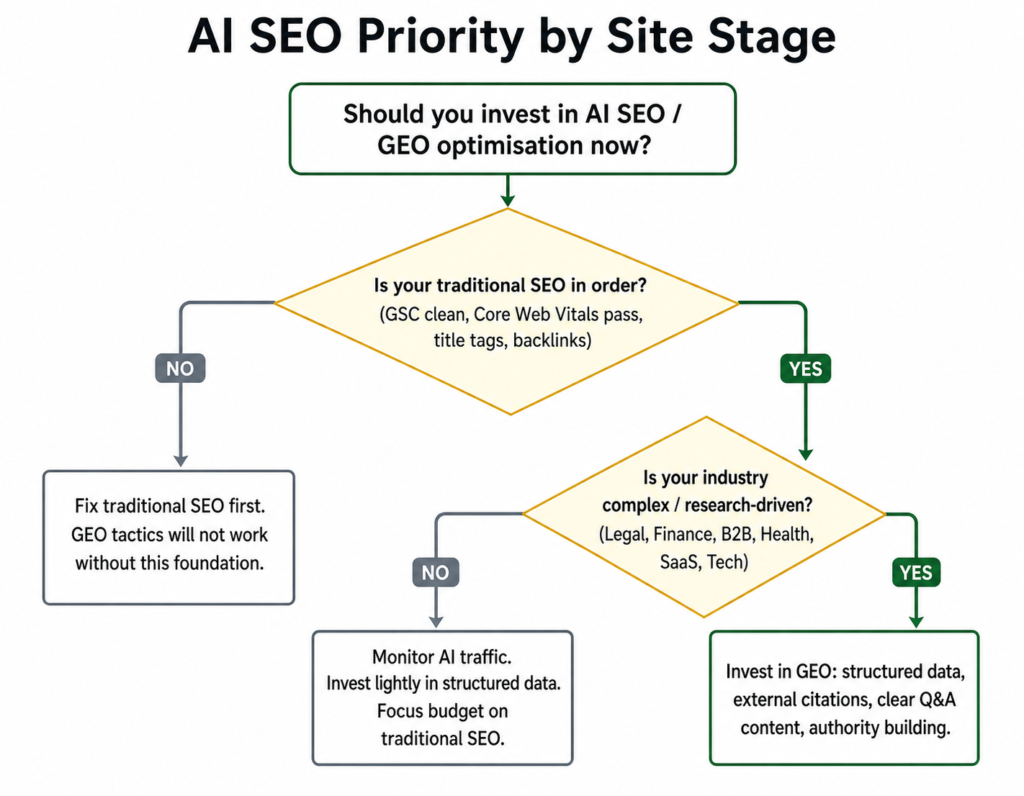
Here is the argument in one sentence: if your traditional SEO is broken, AI search optimisation will not save you — and it may be a distraction that makes things worse.
The reason is structural. The same signals that help you rank in Google also help you get cited by AI systems. They’re not separate stacks. They’re the same foundation.
What LLMs use to decide what to cite
AI systems don’t crawl the web in real time the way Google does. They synthesise information from their training data, from live browsing in tools like Perplexity, and from structured data signals. The top factors that consistently drive LLM citations, according to research:
| Data point | Finding |
| Domain authority | High DA correlates strongly with LLM citations — the same signal Google uses |
| Quality backlinks (DA 60+) | High-authority links are a top-5 citation driver — identical to traditional SEO |
| Mentions in ‘best’ listicles | Being cited in editorial rankings and roundups increases LLM visibility |
| Total backlinks | Volume of referring domains is a consistent predictor |
| Unique referring domains | Link diversity, not just volume — again, traditional SEO metric |
Source: position.digital/blog/ai-seo-statistics — based on aggregated research data, updated April 2026
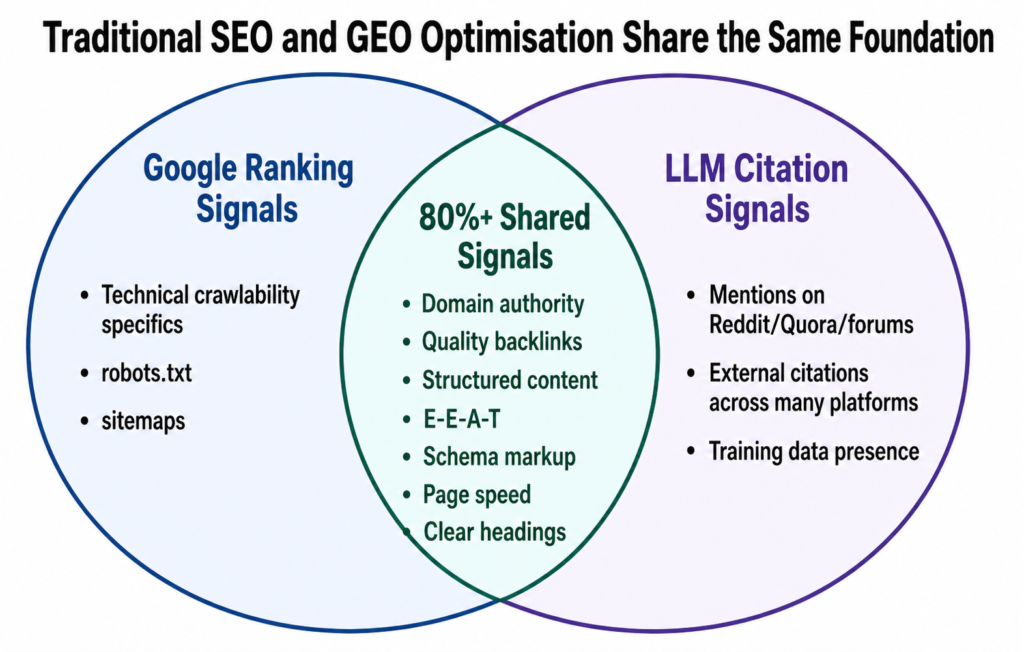
None of these are new signals. They’re the traditional ranking factors Google has used for two decades. Which means that if your backlink profile is weak, your domain authority is low, and your content is thin — AI systems will not cite you, regardless of how well you’ve structured your schema markup.
The Squarespace data point worth remembering
Squarespace’s internal data found that up to 80% of users don’t update their website’s SEO in the first 90 days after launching. The gap between knowing what to do and having the basics in place is enormous for most websites. Before asking how to appear in ChatGPT’s answers, the prior question is whether your pages are correctly indexed, whether your title tags accurately describe your content, and whether your site loads in under three seconds on mobile.
The checklist: what traditional SEO to fix first
Before investing time or budget in GEO tactics, confirm that each of these is in order:
- Google Search Console is connected and showing no critical coverage errors
- Core Web Vitals pass on mobile — especially LCP under 2.5s
- All key pages are indexable — no accidental noindex, no canonical errors, no robots.txt blocks
- Title tags are unique, under 60 characters, and keyword-relevant on every page
- Meta descriptions exist, are unique, and are under 160 characters
- H1 is present exactly once per page with a logical heading hierarchy
- Internal linking connects your key pages — not just the homepage
- Your domain has at least some backlinks from relevant, authoritative sources
- Schema markup is present at minimum on your homepage, contact page, and core service/product pages
- GA4 is configured and tracking conversions — you cannot measure what you cannot see
When AI SEO Actually Matters — and for Whom
With the data and the caveats in place, here is a realistic picture of who should be investing time in GEO optimisation today.
Industries where AI traffic is already material
According to Previsible’s 2025 analysis, legal, finance, health, insurance, and SMB advisory sectors account for 55% of all LLM-driven sessions. These are high-complexity, high-trust queries where users ask AI for guidance the same way they’d ask a professional. If your business operates in any of these sectors and your content is authoritative and well-structured, AI citation is already worth investing in.
Legal, Finance, Health, Insurance, and SMB advisory = 55% of all LLM-sourced sessions. (Previsible, 2025)
Sites with complex, research-driven products
The Hamburg/Frankfurt study found that sites with complex products see GEO traffic shares 4.6x higher than average. Sites with younger or more tech-savvy audiences see 5.5x and 3.8x higher shares respectively. If your product requires comparison, specification research, or professional evaluation before purchase — B2B software, technical hardware, professional services — AI search is a more relevant channel than it is for commodity goods.
Brands that already have strong traditional SEO
AI systems preferentially cite established, authoritative sources. If your domain authority is strong, your content is comprehensive, and your backlink profile is healthy, you’re already partially optimised for AI citation without doing anything new. The additional investment in structured data, clear Q&A formatting, and authoritative link building has a multiplier effect.
Who should wait
If you’re running a new domain with thin content and weak backlinks, no amount of GEO-specific tactics will make a meaningful difference. You’re not in the training data. You’re not being cited by reputable external sources. AI systems have no reason to surface you. Fix the fundamentals first. Then think about AI visibility.
How to Use AI for SEO Properly: A Practical Framework
With that context established, here is how to actually integrate AI into your SEO work in a way that’s grounded in what the data supports.
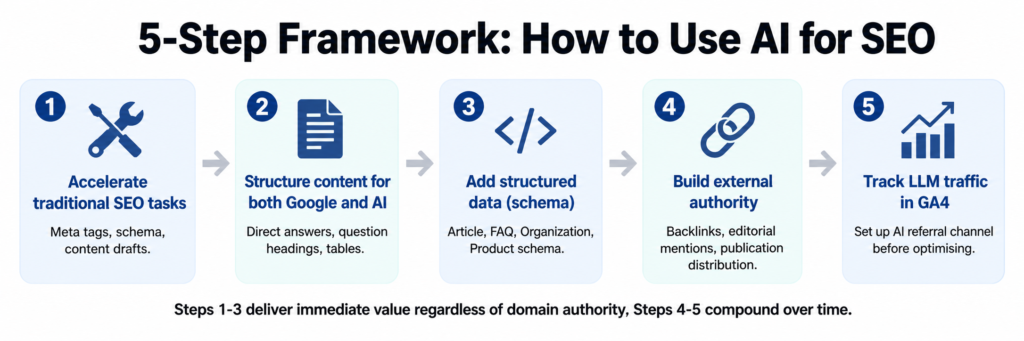
Step 1: Use AI tools to accelerate traditional SEO tasks
This delivers immediate, measurable value regardless of your site’s current authority level. Specific applications:
- Feed your target keyword, page topic, and character limits to Claude or ChatGPT — generate 10 meta title variations in 2 minutes, pick the best, edit for brand voice
- Paste a page that’s dropped in rankings and ask AI to identify potential on-page issues, then verify with GSC data
- Describe your page content and ask AI to generate the appropriate JSON-LD schema markup, then validate in Google’s Rich Results Test
- Use AI to rewrite content sections flagged as thin, then check that the expanded version actually addresses the search intent
- Ask AI to draft the narrative commentary in your monthly report — feed it your key metrics, algorithm updates from the period, and seasonality context
The content AI produces out of the box is average. Your job is to make it good. Reference real data, specific case studies, and your own perspective. Time savings come from not starting from scratch — not from publishing AI output without editing.
Step 2: Structure content for both Google and AI systems
The good news is that structuring content for AI citation and structuring content for Google are nearly identical activities. Both systems reward:
- Clear, direct answers at the start of sections — not buried after three paragraphs of context
- Question-based H2/H3 headings — ‘What is X?’ rather than ‘Overview of X’
- Tables, lists, and structured formats that are easy to parse and extract
- Factual claims backed by specific, citable sources with direct links
- FAQ sections with concise answers — these power both Featured Snippets and AI citations
- Author attribution with verifiable credentials — E-E-A-T matters to both Google and LLMs
AI citations favour content with direct, quotable facts. Start sections with a clear claim: ‘The average LLM traffic share is 0.13%’ rather than building to the conclusion. (UNU Campus Computing Centre, 2026)
Step 3: Add structured data that AI systems can parse
Schema markup is one of the clearest signals you can give both Google and AI crawlers about your content. Priority schema types for most sites:
- Article or BlogPosting — with author, datePublished, and headline
- FAQPage — for any page with question-and-answer content
- Organization or LocalBusiness — with name, url, contactPoint, and sameAs linking to verified profiles
- Product — for ecommerce, with name, description, offers, and aggregateRating
- BreadcrumbList — for site structure clarity
Validate everything in Google’s Rich Results Test before deploying. Schema errors are worse than no schema.
Step 4: Build external authority that AI systems trust
Domain authority and high-quality backlinks are the top-ranked signals for LLM citation. This means traditional link building is simultaneously traditional SEO and GEO optimisation. The tactics overlap completely:
- Earn coverage in authoritative publications relevant to your industry
- Get cited in ‘best of’ and comparison articles — these are among the most-used sources for AI recommendations
- Ensure your brand has a presence on Reddit, Quora, and other discussion platforms AI systems use as source material
- Build a consistent NAP presence across directories and citations for local businesses
Step 5: Track LLM traffic before you optimise for it
Currently, 70%+ of AI-referred sessions arrive in GA4 as direct traffic. Before investing seriously in GEO optimisation, set up proper LLM attribution. Manually create an AI search channel in GA4 using referral source filters for chatgpt.com, perplexity.ai, claude.ai, gemini.google.com, and bing.com/chat. This gives you a baseline. Without it, you are optimising blind.
Frequently Asked Questions
Is AI going to replace Google search?
Not in any near-term timeframe that changes your SEO strategy today. Google processes an estimated 14 billion searches per day. ChatGPT handles approximately 37.5 million prompts. That’s a 373:1 ratio. AI usage is growing fast, but from a very small base relative to traditional search. Importantly, Graphite’s March 2026 data shows total search usage (search engines plus LLMs combined) has grown 26% worldwide — the pie is getting bigger, not being redistributed.
How will AI change SEO?
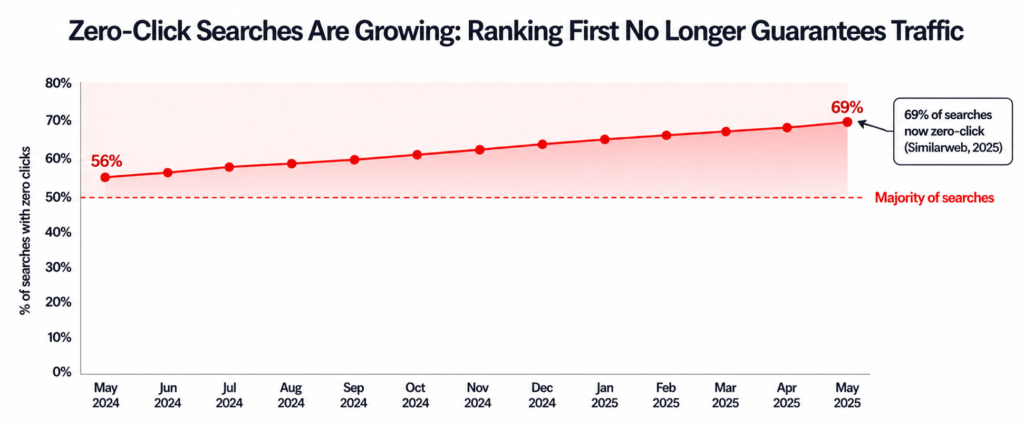
The most significant near-term change is zero-click search. AI Overviews intercept informational queries that previously sent traffic to publisher pages. Zero-click searches increased from 56% to 69% between May 2024 and May 2025 according to Similarweb. This makes ranking first no longer sufficient for traffic — your content needs to be the source cited in the AI summary, not just the result below it.
Should I stop traditional SEO and focus on AI SEO?
No. The data is unambiguous: traditional organic search still accounts for approximately 25-31% of website sessions. AI referral traffic accounts for 0.13-1.08%. The practical recommendation from researchers and practitioners across the board is the same: fix traditional SEO first, then layer in AI-specific tactics using the same content and authority signals.
How can AI improve your SEO right now?
The highest-ROI application is using AI tools to accelerate the work you were already doing: faster meta tag generation, quicker schema markup, faster first drafts of content, and faster analysis of GSC and crawl data. These deliver immediate value. Optimising specifically for AI citation is worth doing alongside traditional SEO work, not instead of it.
What is GEO and how is it different from SEO?
GEO (Generative Engine Optimisation) is the practice of structuring content so AI systems cite or surface it in generated responses. Traditional SEO is the practice of ranking in Google’s blue-link results. The tactics overlap significantly — both reward authoritative content, strong backlinks, clear structure, and accurate schema. The key difference is that GEO also values external citations across diverse platforms (Reddit, Quora, publications), because LLMs train on and reference a much broader content graph than Google’s index.
So, what we have
AI search is real, it’s growing, and for specific industries and product types it’s already producing measurable results. The traffic data from 2024-2025 shows consistent growth: a 527% year-over-year increase in AI-referred sessions, ChatGPT growing from 600 to 22,000 monthly visits in a year for some SaaS brands, and conversion rates that genuinely outperform traditional channels in high-complexity categories.
But the volume is still small. The attribution is still broken. The vast majority of websites are still getting more SEO value from fixing their title tags than from optimising for AI citation. And the sites that win in AI search are, almost without exception, the sites that also do traditional SEO well.
Use AI tools to move faster on traditional SEO tasks. Structure your content to be legible to both Google and AI systems — which turns out to be the same thing. Build external authority that both types of search reward. And measure LLM traffic before you invest heavily in optimising for it.
Do that, and you’re already ahead of 90% of the market — which is still guessing.