
How Law Firms Should Do SEO, and Why They Need It
Most people looking for a lawyer search online first. They type something like “personal injury attorney Chicago” or “divorce lawyer near me” and click one of the first results. If your firm isn’t there, those clients go to someone else.
That’s what SEO for law firms is about: making sure your website shows up when the right people are searching.
This article explains what law firm SEO actually involves, what makes it different from general SEO, and what realistic expectations look like.
What Is SEO for a Law Firm?
SEO — search engine optimization — is the process of making your website more visible in Google search results without paying for ads.
For law firms, this means optimizing your site so it shows up when potential clients search for legal services in your area and practice areas. The goal is not traffic for its own sake — it’s qualified visitors who are actively looking for the kind of help your firm provides.
Unlike paid ads, SEO builds over time. It takes longer to see results, but it also doesn’t stop the moment you stop paying.
Why Law Firm SEO Is Different From General SEO
Legal is one of the most competitive verticals in organic search. A few reasons why it requires specific attention:
- YMYL classification. Google treats legal content as “Your Money or Your Life” — meaning it holds it to higher quality and trustworthiness standards. Generic, thin content won’t rank.
- Local intent dominates. Most legal searches include a city or region. “Family lawyer” is abstract. “Family lawyer in Austin TX” is what people actually search.
- High CPC means high competition. Legal keywords are among the most expensive in paid search. That same competition extends to organic rankings.
- E-E-A-T matters here. Google rewards content that demonstrates real experience and expertise. Law firm content needs to show credibility, not just keyword coverage.
What Law Firm SEO Actually Includes
A proper SEO strategy for a law firm is not just “write some blog posts.” It covers several interconnected areas:
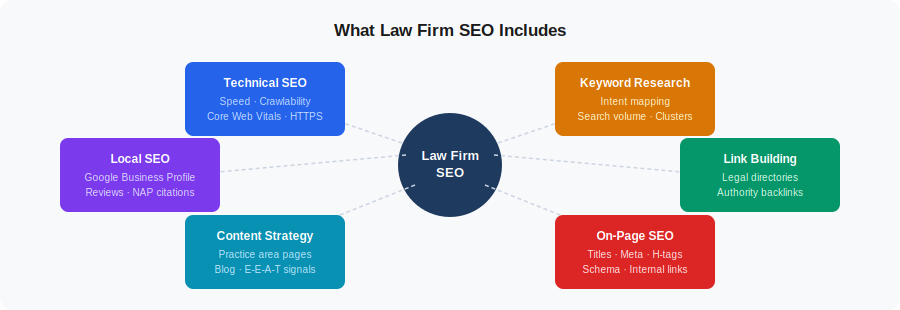
The six core areas of law firm SEO. Each supports the others — skipping one limits the whole strategy.
Technical SEO
Your website needs to be technically sound before anything else. This includes page speed (especially on mobile), clean site structure, proper indexing, working internal links, and HTTPS security. If Google can’t crawl and understand your site, none of the content work matters. A technical SEO audit is usually the right first step.
Core Web Vitals — Google’s set of performance metrics — are particularly important. A slow site with layout shifts will lose rankings even with strong content.
Keyword Research and Practice Area Pages
Keyword research for law firms is about understanding what your prospective clients actually search for — at different stages of their decision process.
Someone searching “what to do after a DUI” is still figuring out their situation. Someone searching “DUI attorney Denver free consultation” is ready to contact a lawyer. Both are valuable, and both require different pages.
Each practice area should have its own dedicated page: personal injury, family law, criminal defense, estate planning, and so on. Generic “all services” pages don’t rank well.
Local SEO
For most law firms, local SEO is the highest-value channel. It means showing up in the Google Map Pack — the three business listings that appear at the top of local search results.
The main levers are: an optimized Google Business Profile, consistent NAP (name, address, phone) across directories, client reviews, and location-specific pages if you serve multiple cities.
Local pack rankings often improve faster than organic. For competitive markets, you may see movement within 3–4 months.
Content That Builds Authority
Beyond practice area pages, informational content helps law firms rank for research-stage queries. Blog posts that answer real legal questions — “Can I sue my employer for unpaid overtime?” — attract people earlier in their search journey. A clear SEO content strategy maps which topics to cover and in what order.
This content also supports E-E-A-T signals. A blog written by an actual attorney, with accurate legal information, builds trust in ways that templated agency content cannot.
Link Building
Backlinks — links from other websites pointing to yours — are one of Google’s strongest ranking signals. For law firms, the most valuable links come from legal directories (Avvo, Justia, FindLaw), local business listings, bar association websites, and relevant industry publications. A focused link building campaign builds that authority over time.
The goal is authority, not volume. Ten relevant, high-quality links are worth more than a hundred low-quality ones.
How Long Does Law Firm SEO Take?
SEO is not a quick fix. Here’s what a realistic timeline looks like:
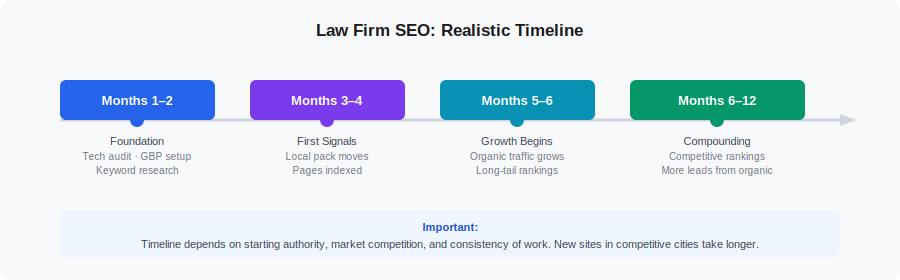
Typical law firm SEO timeline. Results vary depending on market competition, site history, and how consistently work is executed.
- Months 1–2: Technical audit and fixes, keyword research, content audit, Google Business Profile setup.
- Months 3–4: Initial movement in local pack. Google begins indexing new and optimized pages.
- Months 5–6: Organic traffic starts to grow. Practice area pages may rank for long-tail queries.
- Months 6–12: More competitive keyword rankings improve. Content compounds. Lead volume increases.
The timeline depends on your starting point, market competition, and how consistently the work is done. A brand new website in a competitive city will take longer than an established firm site with existing authority.
How to Measure Whether Law Firm SEO Is Working
Rankings and traffic are directional signals, but they’re not the end goal. For a law firm, SEO success means more qualified inquiries — calls, contact form submissions, consultation bookings.
Metrics that actually matter:
- Organic traffic to practice area and contact pages
- Call and form conversion rate from organic sessions
- Google Business Profile actions (calls, direction requests, website clicks)
- Rankings for core practice area + city keywords
- New keywords indexed over time
Track these in Google Search Console, Google Analytics 4, and your Google Business Profile dashboard. If an SEO partner can’t connect their work to lead generation, that’s a problem.
Common SEO Mistakes Law Firms Make
- One page for all services. A single “Our Services” page can’t compete with dedicated pages for each practice area.
- Ignoring technical issues. Slow load times, broken links, and poor mobile performance limit rankings regardless of content quality.
- Generic content. Blog posts that restate basic legal definitions without any real depth or expertise don’t rank — and don’t convert.
- No local SEO setup. An unclaimed or incomplete Google Business Profile is one of the easiest opportunities to miss.
- Expecting fast results. Law firm SEO takes 6–12 months for meaningful organic growth. Anyone promising faster guarantees isn’t being honest.
Is SEO Worth It for a Law Firm?
It depends on your situation. SEO makes sense when you’re in a market with enough search demand for your practice areas, when you have the patience for a 6–12 month runway, and when your website can handle the traffic it receives.
It makes less sense if you need clients this week, if your practice area has very low search volume, or if your site has fundamental technical issues that haven’t been addressed.
A good SEO partner should tell you honestly whether SEO is the right channel for your firm before selling you a retainer.
FAQ
How much does SEO for a law firm cost?
It varies widely. Local SEO campaigns for smaller firms typically start at $1,000–$2,500/month. Competitive markets with multiple practice areas can require $3,000–$8,000+/month. The cost should be evaluated against the lifetime value of one new client — for many practice areas, a single case more than covers monthly SEO spend.
Do law firms need a blog for SEO?
Not strictly required, but it helps. A blog lets you target informational queries from people early in their search — before they’re ready to contact a firm. It also supports E-E-A-T signals when written by actual attorneys. Consistency matters more than volume: a few well-researched articles per month is more effective than weekly generic posts.
How is law firm SEO different from running Google Ads?
Google Ads (PPC) shows your firm at the top immediately, but stops the moment your budget does. SEO builds organic rankings that persist over time. Most firms benefit from both — ads for immediate visibility while SEO builds long-term authority.
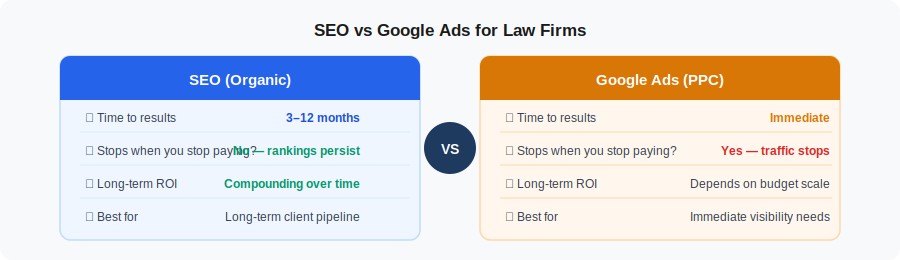
SEO and PPC serve different goals. SEO compounds over time; PPC delivers immediate visibility but stops when budget does.
Can a small law firm compete in SEO with large firms?
Yes, with the right approach. Large firms often target broad competitive terms. Smaller firms can win by focusing on specific practice areas, geographic niches, and long-tail queries where competition is lower. Local SEO also levels the playing field significantly — proximity matters more than firm size in the Map Pack.
How do I know if my law firm’s SEO is working?
Track it through Google Search Console (which keywords bring impressions and clicks), Google Analytics 4 (organic sessions and contact form conversions), and your Google Business Profile insights (calls and direction requests from search). If organic traffic is growing and generating more inquiries, the strategy is working.
Not sure if SEO is the right move for your firm?
MarTraff is an SEO-only agency. Before we recommend anything, we look at your website, your market, and your competition to understand whether organic search can actually generate leads for you — and at what cost and timeline.
Send us your website and we’ll give you a practical assessment. No commitment needed.
→ Contact MarTraff: martraff.com/contact