
On-Page SEO for Ecommerce Stores: More Traffic, More Sales
Getting people to your store starts long before they click. It starts with whether Google even knows what your pages are about — and right now, most ecommerce stores are leaving that to chance.
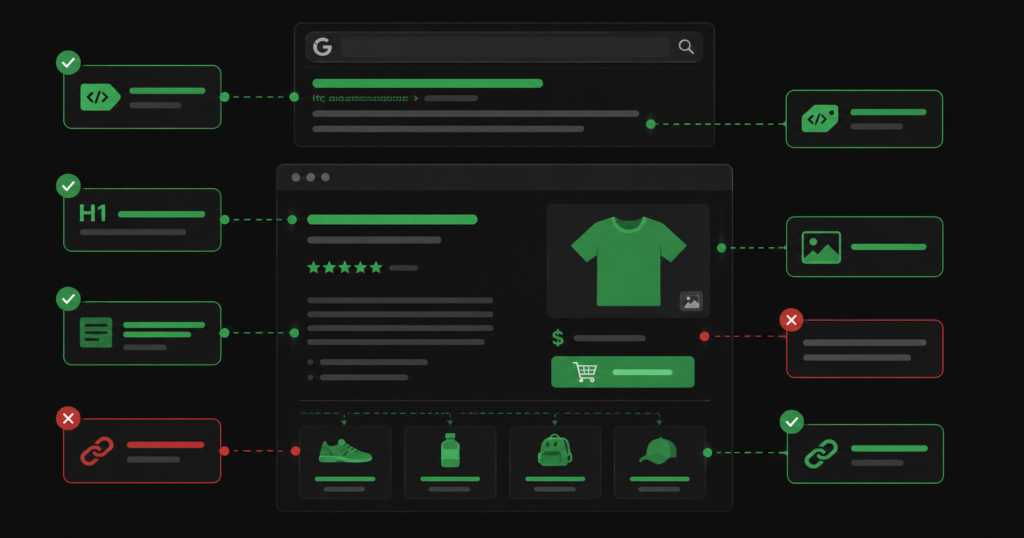
Why Most Ecommerce Stores Lose Rankings on the Page Itself
The most common reason ecommerce stores underperform in search is not a lack of backlinks or a technical issue — it is on-page. Specifically:
| Generic title tags that do not match buyer intent — “Blue Shirt” instead of “Men’s Blue Oxford Shirt — Free Shipping SA”Category pages with no content — just a grid of products and a pagination chainProduct pages where the description is copied from the manufacturer and duplicated across dozens of variantsNo internal linking strategy, so link equity stays stuck at the homepageImages with no alt text, meaning Google cannot interpret half the page |
| “Each of these is fixable. And fixing them consistently across a store can move rankings significantly — without a single new backlink.” |
What Our On-Page SEO Service Covers
We work through your store systematically, starting with the highest-traffic and highest-potential pages.
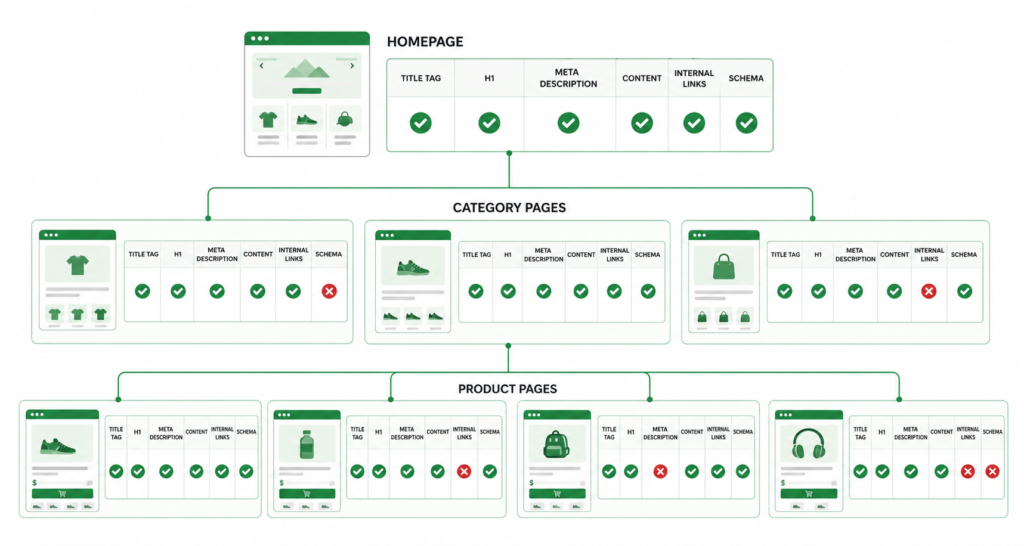
Keyword Mapping and Semantic Core
Before we touch a single page, we build a keyword map — a document that assigns the right primary and secondary keywords to every page in your store. This prevents cannibalisation (two pages competing for the same keyword) and ensures every page is targeting something specific and achievable.
Title Tags and Meta Descriptions
We rewrite title tags and meta descriptions for your key pages with the right keyword placement, compelling copy that improves click-through rate, and consistent formatting across the store. For large catalogues, we create templates that can be applied programmatically.
Heading Structure H1 to H6
Every page should have exactly one H1 that matches search intent, followed by a logical heading hierarchy. We audit and fix the heading structure across your category and product pages — something that is particularly important for Shopify and WooCommerce stores where themes can generate inconsistent headings.
Product and Category Page Optimisation
This is where ecommerce on-page SEO differs from standard SEO. Product pages need unique, keyword-rich descriptions that go beyond manufacturer copy. Category pages need introductory content that helps Google understand what the page is about. We write and structure both.
Internal Linking Strategy
Internal links distribute authority across your site and help users and Google navigate your content. We map out a linking structure that connects categories, products, and blog content in a way that boosts the pages that matter most.
Image Optimisation and Alt Text
Every image on your store is an SEO opportunity. We ensure images are properly named, compressed for speed, and tagged with descriptive alt text that helps both accessibility and Google Image search.
How We Optimise Your Store
| 01 | Discovery call to understand your store, goals, current performance, and platform |
| 02 | Full keyword mapping and priority page identification — which pages to fix first and why |
| 03 | On-page changes delivered as a structured optimisation document or implemented directly in your CMS |
| 04 | Review and sign-off before any changes go live — nothing is pushed without your approval |
| 05 | Reporting on ranking changes and organic traffic movement following implementation |
Frequently Asked Questions
| Question | Answer |
| How many pages do you optimise? | It depends on the scope of the project. We typically start with the 20-50 highest-priority pages — usually homepage, main category pages, and top product pages — and expand from there. |
| Do you write the content or just make recommendations? | Both options are available. We can deliver a detailed optimisation brief for your team to implement, or we can write and optimise content directly. |
| How long until I see results? | On-page changes typically start showing results within 4-8 weeks, though this depends on your domain authority and how competitive the keywords are. |
| Is on-page SEO different for Shopify vs WooCommerce? | Yes — the platforms have different structural constraints and default behaviours. Our approach is tailored to your specific platform. See dedicated pages for Shopify SEO and WooCommerce SEO. |
| What is the difference between on-page SEO and technical SEO? | On-page SEO covers the content layer — title tags, headings, copy, internal links, and images. Technical SEO covers the infrastructure layer — crawlability, site speed, canonicals, and indexation. Both are necessary; technical SEO creates the foundation that on-page SEO builds on. |