
Keyword Research That Tells You What to Target — and Where to Put It
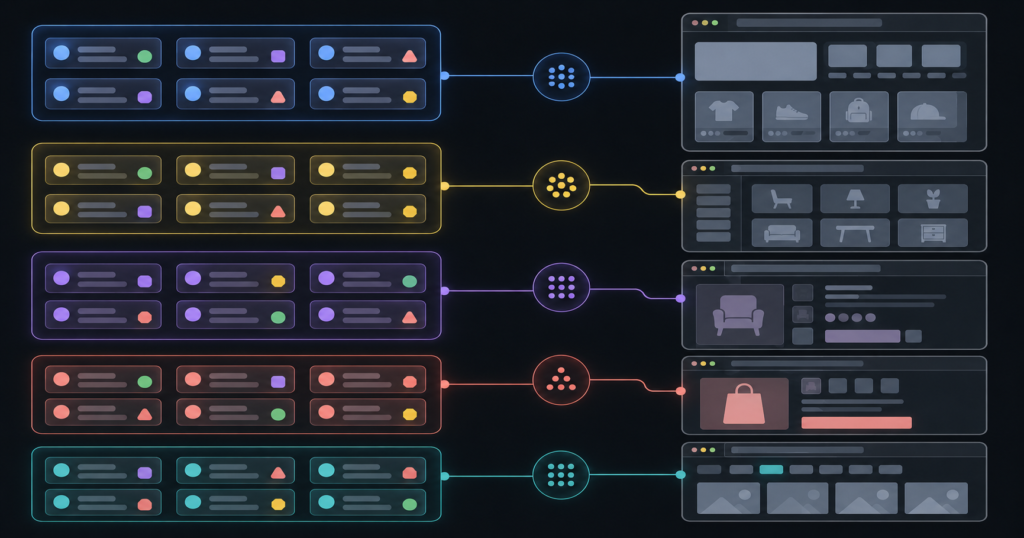
Most keyword research deliverables are a spreadsheet with volume and difficulty scores. That tells you what people search for. It does not tell you which page on your site should rank for it, what the searcher actually wants, or whether the query is even worth targeting. We do it differently.
What You Actually Get (Not What Most Agencies Deliver)
| What most agencies deliver | What we deliver |
| A spreadsheet with keywords, volume, and difficulty | Keywords organised into topic clusters — each cluster maps to one specific page |
| No distinction between search intents | Every keyword classified: Transactional, Commercial, Informational, Navigational |
| Keywords listed without context | Each cluster includes a recommended page URL and content direction |
| Generic research not adjusted for your market | Geo-targeted where relevant — local or country-level data, not global averages |
| Delivered once, never explained | Walkthrough included — you understand what to do with it |
How We Do Keyword Research
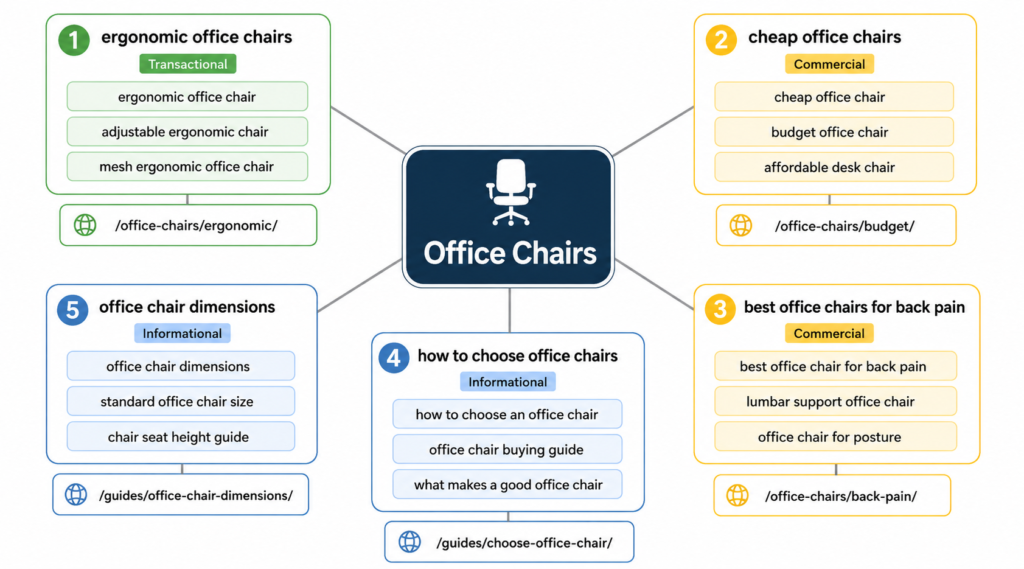
Our keyword research process follows four steps — each one building on the previous. The result is not a list of keywords. It is a strategic map of what to target, in what order, and on which pages.
Step 1: Market and Competitor Analysis
We start by mapping the competitive landscape — who is ranking for the queries that matter in your category, what content they are using to rank, and where the gaps are. This shapes the entire keyword strategy. There is no point targeting queries where the competition is 10x your domain authority, and no point ignoring queries where you can realistically compete.
Step 2: Keyword Collection by Topic Cluster
We collect keywords by topic cluster, not by volume. Every keyword belongs to a cluster — a group of related queries that map to the same search intent and the same destination page. This means the research is immediately usable: you know which cluster belongs to which page, and which pages need new content vs optimisation of existing content.
Step 3: Intent Classification
Every keyword is classified by search intent:
- Transactional — the searcher is ready to buy: “buy ergonomic office chair”, “office chair under £200”
- Commercial investigation — the searcher is comparing options: “best ergonomic office chairs 2024”, “ergonomic vs gaming chair”
- Informational — the searcher wants to learn: “how to set up an ergonomic workstation”, “office chair buying guide”
- Navigational — the searcher is looking for a specific brand or site
Intent classification determines what kind of page should rank — a category page, a product page, a comparison page, or a blog post. Targeting a transactional query with an informational blog post is a common mistake that produces rankings with no conversions.
Step 4: Page Mapping
Every cluster gets a destination page. We map each cluster to either an existing page (which we recommend optimising) or a new page (which needs to be created). The output is a clear action plan: this page targets these keywords, these pages need to be built, these queries are not worth targeting yet.
| “Keyword research without page mapping is just data. The value is in knowing which page should rank for which query — and what that page needs to say to rank for it. That’s the gap most keyword research deliverables leave unfilled.” |
What You Get — The Deliverable
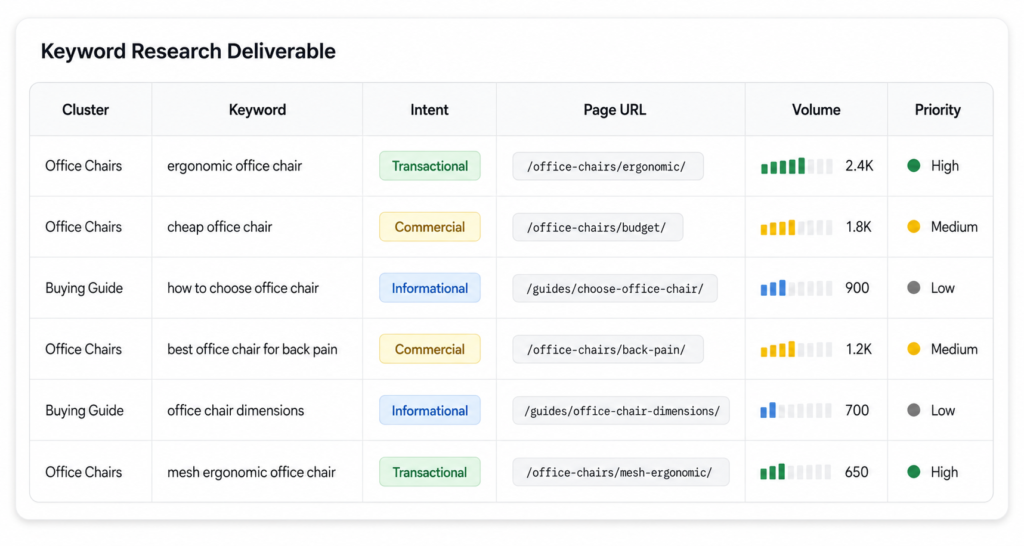
Keyword research from MarTraff is delivered as a structured document — not a raw spreadsheet export.
| Keyword clusters | All keywords organised by topic — each cluster clearly defined and separated from others |
| Intent classification | Every keyword tagged: Transactional, Commercial, Informational, or Navigational |
| Search volume data | Monthly search volume by target market — geo-adjusted where relevant |
| Keyword difficulty scores | Realistic difficulty assessment — not just tool scores but competitive context |
| Page mapping | Each cluster mapped to a specific URL — existing page to optimise or new page to create |
| Priority order | Clusters ordered by opportunity: where to start, what to build next |
| Competitor keyword gaps | Queries your competitors rank for that you are currently missing |
| Walkthrough session | Optional: 30-minute call to walk through the deliverable and answer questions |
Who This Is For
| Store Ecommerce Store Owners You have a catalogue but no clear map of what to rank for. You want to know which category pages, product pages, and blog posts to focus on — and in what order. | Agency Dev Agencies and Freelancers You are building or redesigning a client’s store and need keyword research to inform the site architecture, URL structure, and page content before launch. | Marketer In-House Marketing Teams You have internal writers and developers but no SEO research process. You need a structured keyword foundation you can hand off to the team to execute against. |
Frequently Asked Questions
| Question | Answer |
| How is this different from using a keyword tool myself? | Tools like Ahrefs or Semrush give you data — volume, difficulty, related keywords. They do not give you a strategy. The difference is the clustering, intent classification, and page mapping layer on top of the data. That is where the research becomes usable. |
| How many keywords will I get? | It depends on the size of your catalogue and the scope of the research. A focused project on 3-5 product categories typically produces 200-500 keywords across 15-30 clusters. A full site audit covering all categories can produce 1,000-3,000 keywords across 80-150 clusters. We scope the project before starting. |
| Do you do keyword research for a specific country or market? | Yes. All keyword research is geo-targeted to your market — search volumes and competition levels vary significantly by country. We collect data for your specific target market, not global averages. |
| Can you do keyword research for a non-ecommerce site? | Yes. The methodology is the same — clusters, intent, page mapping. We have done keyword research for healthcare, SaaS, professional services, and other verticals. The output format and intent distribution differ, but the approach is identical. |
| What happens after the keyword research is delivered? | The research becomes the foundation for everything else — on-page optimisation, technical SEO, content creation, and internal linking strategy. If you want us to handle implementation, we can scope a full engagement. If you prefer to take the research and implement it in-house, the deliverable is structured to make that straightforward. |
| How long does keyword research take? | A focused project (3-5 categories) takes 5-7 business days. A full site keyword research project takes 10-15 business days. We confirm the timeline before starting. |