
WooCommerce SEO: Solve the Problems That Generic Agencies Leave Behind
WooCommerce is the most widely used ecommerce platform in the world. It is also the one with the most platform-specific SEO problems — filter pages, plugin conflicts, crawl budget waste, and duplicate content from product variations. We have worked inside enough WooCommerce stores to know exactly where the problems are.
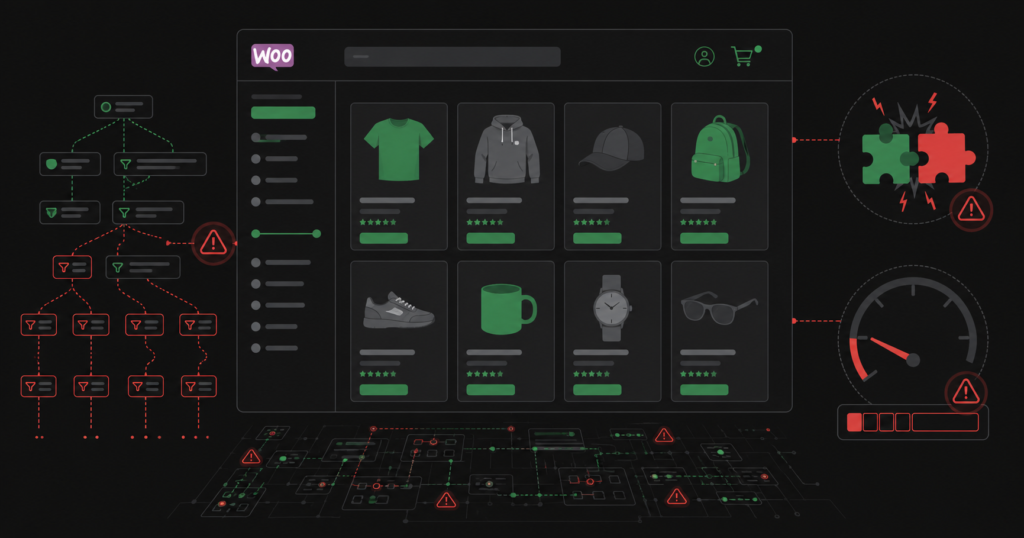
Why WooCommerce SEO Is a Different Problem
WooCommerce runs on WordPress, which means you have complete control — and complete responsibility. Every plugin, every theme update, every configuration choice affects your SEO. Unlike Shopify or BigCommerce, there is no platform safety net. If something breaks your SEO setup, no one tells you.
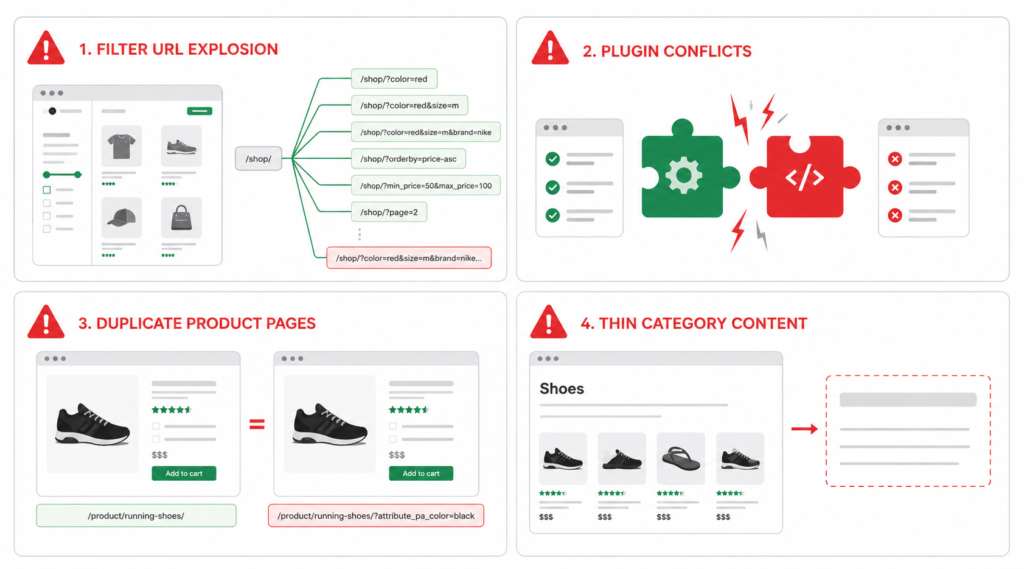
| Filter Filter Pages Eating Crawl Budget WooCommerce generates a separate URL for every filter combination. On a large store, this creates thousands of low-value pages that consume Google’s crawl allocation — leaving your core category pages crawled less frequently. | Plugin Plugin Conflicts Breaking SEO Yoast, Rank Math, caching plugins, page builders — each one can override or break another’s SEO output. We regularly find stores where two plugins are fighting over canonical tags, or a caching plugin is serving outdated meta to Googlebot. |
| Variant Product Variation Duplication WooCommerce product variations can generate separate indexable URLs depending on how they are configured. The same product in different colours or sizes competing with itself for rankings, fragmenting link equity. | Category Category Page Thin Content Category pages are the highest-value SEO real estate on any ecommerce store. On most WooCommerce stores, they contain almost no text — just a title and a product grid. Not enough to rank competitively for commercial queries. |
| “We’ve written a detailed technical guide on the filter page problem specifically — it’s the most impactful WooCommerce SEO issue we encounter. Read: WooCommerce Filter Pages Are Wasting Your Crawl Budget |
What We Do for WooCommerce Stores
We cover the full scope of WooCommerce SEO — from the platform-specific technical foundation through to keyword strategy, on-page implementation, and link building. Everything is built around how WooCommerce actually works.
| Audit Technical SEO Audit Full crawl of your WooCommerce store. Filter page configuration, plugin conflicts, crawl budget analysis, Core Web Vitals, canonical tags, and indexation review — all documented and prioritised. | Filter Filter Page Strategy Canonical and robots configuration for faceted navigation. Preventing Google from indexing thousands of zero-value filter combinations while keeping high-demand filter pages accessible and rankable. | Category Category Page Optimisation Category pages are your highest-value commercial landing pages. We add keyword-relevant content, fix H-tag structure, implement schema, and build internal linking to pass authority from product pages up. |
| Key Keyword Research Geo-targeted semantic core for your market. Clustered by product category and mapped to specific pages — not just a list of keywords in a spreadsheet. | OnPage On-Page Optimisation Title tags, meta descriptions, H1-H3 structure, product page copy, image alt text, and internal linking — implemented across your full catalogue with WooCommerce-native tools and custom development where needed. | Link Link Building High-quality backlinks based on competitor analysis and a custom anchor plan. No PBNs, no spam. Links that build authority over time without penalty risk. |
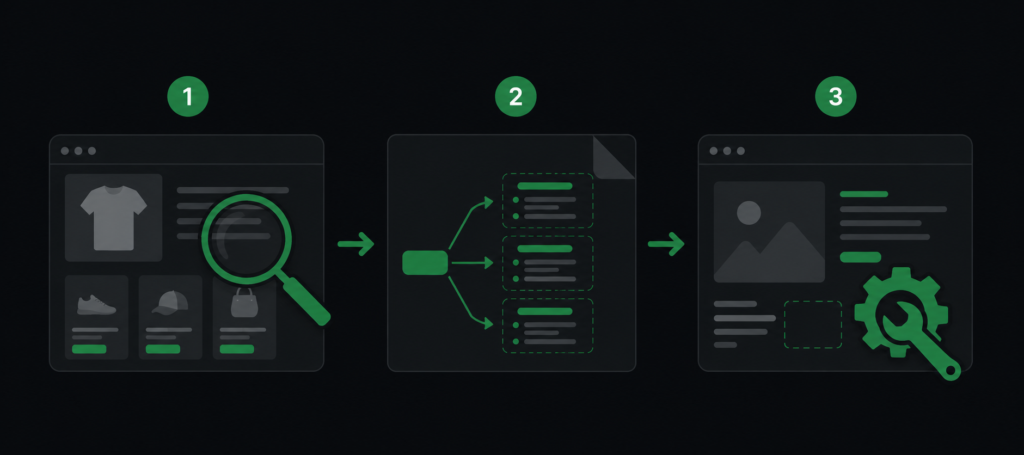
How We Work
| 01 SEO Audit Full technical and on-page audit of your WooCommerce store. Every issue documented, categorised by severity, and tied to a specific fix. | 02 Strategy and Research Keyword research, competitor analysis, content gap mapping. A prioritised plan specific to your store and your market. | 03 Implementation We implement. Our development team executes all technical and on-page recommendations directly — no handoff delays, no translation loss. |
What You Get
Every WooCommerce SEO engagement at MarTraff starts with a full audit and produces a concrete set of deliverables.
| WooCommerce SEO Audit | Full crawl: filter page configuration, plugin conflicts, canonical issues, Core Web Vitals, indexation — prioritised by impact. |
| Filter Page Strategy | Canonical and robots configuration for all faceted navigation. Prevents crawl budget waste and duplicate content issues at scale. |
| Competitor Analysis | Backlink profiles, keyword gaps, and category page benchmarks vs your top 3-5 organic competitors. |
| Keyword Research | Geo-targeted semantic core for your product categories. Intent-classified, mapped to specific category and product pages. |
| On-Page Implementation | Title tags, meta descriptions, H-tag structure, image alt text, product and category copy — applied across your full catalogue. |
| Internal Linking Audit | Link equity flow mapping. Identifying orphaned pages, shallow crawl paths, and category hierarchy improvements. |
| Schema Markup | Product schema on product pages, BreadcrumbList on categories, Organisation on homepage. |
| Monthly Reporting | Rankings, organic traffic, technical health, link building progress, and next month plan — in one clear monthly report. |
Frequently Asked Questions
| Question | Answer |
| Does Yoast SEO handle all these issues? | Yoast handles the basics well — title and meta management, XML sitemap generation, breadcrumb schema. It does not resolve filter page crawl budget issues, does not prevent plugin conflicts with other installed tools, and does not do keyword research, competitor analysis, or link building. It is a solid foundation, not a complete strategy. |
| How is WooCommerce SEO different from Shopify SEO? | WooCommerce’s main challenges are filter pages, crawl budget, and plugin ecosystem complexity. Shopify’s main challenges are duplicate product URLs from collections and limited robots.txt control. Both are platform-specific problems — the fixes are different. We have dedicated service pages and blog content for both platforms. |
| We have hundreds of product variations. Is that a problem? | It can be. WooCommerce handles product variations differently depending on your theme and configuration. In some setups, variations generate separate indexable URLs that compete with the parent product page and fragment link equity. An audit will tell you whether your variation setup is creating this problem and how to resolve it. |
| How long before we see results? | Technical fixes — crawl improvements, filter page configuration, indexation corrections — are typically visible in Google Search Console within 4-8 weeks. Ranking changes on targeted category and product pages usually follow within 3-5 months, depending on competition and domain authority. |
| Do you work with WooCommerce stores on managed WordPress hosts? | Yes. We work with WooCommerce stores on all hosting environments — WP Engine, Kinsta, Flywheel, SiteGround, and self-managed servers. Some technical implementations vary by host, but the SEO strategy and audit approach are the same. |
| We already have an SEO plugin. Do we still need an audit? | An SEO plugin automates some on-page tasks but cannot tell you what your crawl budget looks like, whether your filter pages are being indexed, or whether your plugin stack has conflicts. An audit gives you the full picture — what the plugin is handling correctly and what it is missing. |
Work With MarTraff
| If your WooCommerce store has been running for more than a year and organic search is not contributing meaningfully to revenue — the platform-level issues are almost certainly part of the reason.We will audit your store, identify what is holding it back, and give you a clear picture of what is fixable — before you commit to anything.Get a Free WooCommerce SEO Review → No commitment. No generic report. |