
Technical SEO for Ecommerce: Fix the Foundation, Unlock Your Rankings
You can have the best products, the strongest content, and a growing backlink profile — and still not rank. If Google cannot crawl your store efficiently, or if it is finding thousands of duplicate pages from your filter system, your SEO investment is leaking.
Why Technical SEO Matters More for Ecommerce
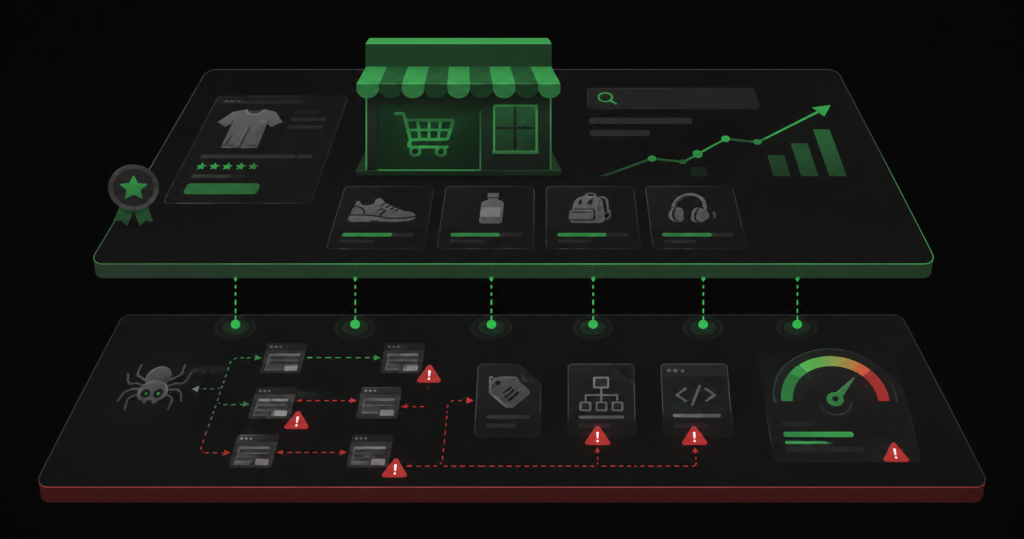
| A standard business website might have 20-50 pages. An ecommerce store might have 5,000. Every product, every category, every filtered URL is a page that Google has to crawl, evaluate, and decide whether to index.Without proper technical structure, you are forcing Google to waste its crawl budget on pages that should not exist — and potentially missing the ones that should rank.“Technical SEO for ecommerce is not optional. It is the foundation that all other SEO work is built on.” |
The Most Common Technical Issues in Ecommerce
These are the issues we find most consistently across ecommerce stores — regardless of platform, size, or how long the store has been live.
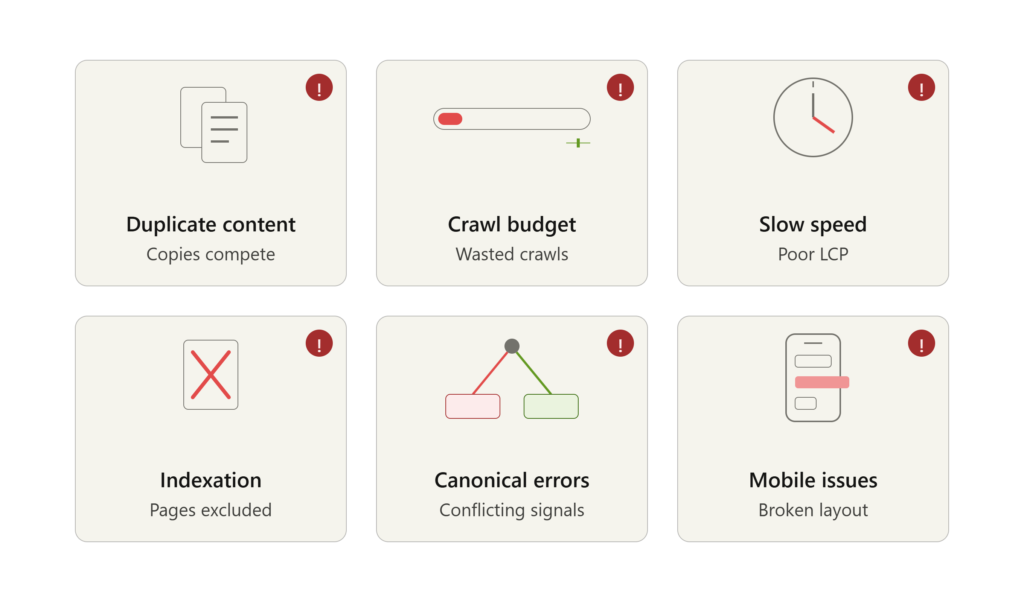
| Duplicate Duplicate Content from Filters | Crawl Crawl Budget Waste | Speed Site Speed and Core Web Vitals LCP, FID, CLS — direct ranking factors. Ecommerce stores are particularly vulnerable because of large product image files, third-party scripts, and heavy theme frameworks. We diagnose and fix the specific issues dragging your score down. |
| Index Indexation Issues Not all of your pages should be indexed — and some that should be indexed are not. We review your robots.txt, XML sitemap, and meta robots tags to ensure Google is crawling exactly the right pages. | Canonical Canonical Tags and URL Structure For stores with product variants, canonical tags tell Google which URL is the main version. When these are misconfigured — or absent — you split ranking signals across multiple URLs and weaken all of them. | Mobile Mobile Optimisation Google uses mobile-first indexing. Ecommerce stores often have mobile usability issues around tap targets, font sizes, and layout shifts that affect both rankings and conversion rates. |
Our Technical SEO Process
Every technical SEO engagement follows the same structured process — starting with a full picture of the site before making any recommendations.
| 01 | Full site crawl using Screaming Frog and Google Search Console data — every URL, every status code, every redirect chain |
| 02 | Core Web Vitals assessment and PageSpeed analysis on mobile and desktop — per page, not just the homepage |
| 03 | Indexation and canonicalisation audit — what Google is crawling, what it is indexing, and what it should be |
| 04 | Structured data review — product schema, breadcrumbs, review markup, Organisation schema |
| 05 | Prioritised issue list with fix recommendations — ordered by impact, not by category |
| 06 | Implementation support or developer handoff — we can implement fixes directly or provide detailed specifications for your team |
Tools We Use
| Screaming Frog | Full site crawls — every URL, status code, redirect, canonical, H-tag, and meta tag across your entire catalogue |
| Google Search Console | Real-world indexation and coverage data direct from Google — the most authoritative source for crawl and index status |
| PageSpeed Insights and Lighthouse | Core Web Vitals measurement and performance diagnostics — both lab and field data |
| Ahrefs or Serpstat | Competitive benchmarking and backlink data for context on technical priorities |
Frequently Asked Questions
| Question | Answer |
| Do I need to give you access to my hosting or CMS? | We need access to Google Search Console. Depending on the issues found, we may also need CMS access to implement fixes, or we can provide detailed instructions for your developer. |
| How is technical SEO different from regular SEO? | Technical SEO focuses on the infrastructure — how your site is built and crawled — rather than the content or links. Think of it as fixing the roads before you put up signposts. |
| My store is on Shopify — is there still a technical SEO problem? | Yes. Shopify handles some technical basics automatically, but it also creates specific issues — particularly around duplicate URLs from collection filters, canonical tag limitations, and JavaScript rendering. See our dedicated Shopify SEO service for a full breakdown. |
| My store is on WooCommerce — what are the typical issues? | WooCommerce’s main technical SEO problems are filter page indexation, crawl budget waste from parameter URLs, and plugin conflicts affecting canonical tags. See our dedicated WooCommerce SEO service for details. |
| How long do technical fixes take to impact rankings? | Once fixes are indexed by Google, you can typically see impact within 4-12 weeks. Some improvements — like Core Web Vitals — can show faster movement. Crawl budget fixes tend to have the widest effect but take longer to compound. |