
SEO for Pawn Shops: How to Get Found by Local Customers
Most people searching for a pawn shop type something simple into their phone — “pawn shop near me,” “sell gold for cash,” “buy used iPhone in [city].” They want an answer fast, and they are ready to act. If your shop does not appear in those results, you are invisible to them — and they are walking into a competitor’s door instead.
| I spent time working inside a pawn shop, and one thing became clear quickly: the businesses that consistently attract customers are not always the ones with the best prices or the largest inventory. They are the ones that show up when someone searches. That comes down to SEO — and for pawn shops specifically, there are a few areas that matter far more than most guides ever cover.“This is not a generic local SEO checklist. It is a guide built around how pawn shops actually operate — the inventory challenges, the fast-moving stock, the specific categories buyers search for, and the reasons why a strong online presence is more important in this industry than almost any other.” |
Why SEO Matters More for Pawn Shops Than Most Local Businesses
Pawn shops face a challenge that most local businesses do not: significant restrictions on paid advertising. Google and Facebook have strict policies around financial services, firearms, and certain categories of items commonly bought and sold in pawn shops. This limits how much you can rely on ads to drive traffic.
That makes organic search — ranking in Google’s results and Google Maps without paying per click — not just useful, but essential. It is often the only scalable, cost-effective channel available. And the customers you reach through organic search are highly motivated. They are not browsing. They are searching with a specific intent: to sell something, buy something, or get cash quickly.
The other factor is speed. In pawn shops, inventory turns over fast. Someone searching for a specific item — a Fender guitar, a Rolex, a PS5 — may visit your site, see it in stock, and come in that same afternoon. Or they might not find you at all and go elsewhere. SEO is what determines which of those two things happens.
Start With Your Google Business Profile
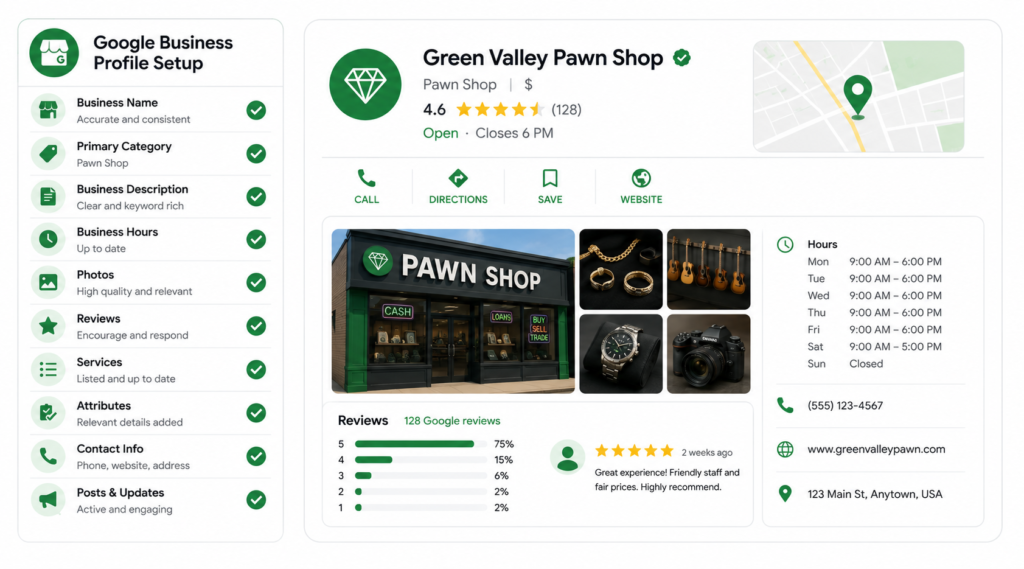
For local SEO, your Google Business Profile (GBP) is the single most important asset you have. It is what appears in Google Maps and the local pack — the top three results Google shows for searches like “pawn shop near me.” If it is not set up properly, nothing else matters as much.
What to optimise in your Google Business Profile
| ✓ | Business category: select “Pawn Shop” as the primary category |
| ✓ | Business name, address, and phone number — must be identical to what appears on your website |
| ✓ | Opening hours, including holiday hours — keep these updated |
| ✓ | Photos: add real photos of your store interior, exterior, and inventory. Not stock images. |
| ✓ | Services: list what you actually do — buy, sell, pawn, loans, specific item categories |
| ✓ | Description: include your city, your key services, and the types of items you deal in |
| “Reviews are one of the most powerful signals for local ranking. Respond to every review — positive and negative. A shop with 80 reviews and active responses will consistently outrank a competitor with 200 reviews and no engagement.” |
Ask satisfied customers to leave a review after a transaction. Make it easy by sharing a direct link.
If you have multiple locations, each needs its own verified Google Business Profile. The same address and phone number cannot be shared across two profiles.
Inventory SEO: The Part Most Guides Skip
Here is where pawn shop SEO gets genuinely different from other local businesses. You have physical inventory that changes constantly — items come in and sell within days or even hours. If your website shows items that are no longer available, or does not show items that are in the store, you have a serious problem: customers arrive expecting something that is gone, or they never find you because the item they searched for was not on your site.
Sync Your Physical Inventory With Your Website
The first priority is real-time or near-real-time synchronisation between your point-of-sale system and your website. If an item sells in-store, it should disappear from your online listings quickly. If a new item comes in, it should be listed online the same day if possible. Most modern POS systems used in pawn shops — Pawnmate, Bravo, and similar platforms — have integrations for this. Set it up and treat it as a non-negotiable operational standard.
Product Photos and Alt Text
Every item listed on your website needs a quality photograph — not a blurry phone snapshot, but a clear, well-lit image that shows the actual condition of the item. This matters for two reasons. First, buyers need to see what they are getting before they make the trip. Second, Google reads image alt text to understand what is on your page.
| ✓ Good: “Used iPhone 14 Pro 128GB Space Black — good condition” | ✗ Bad: “IMG_4821.jpg” |
For a shop with hundreds of items, this needs to be systematised — set up a template or auto-generation process that pulls from the item’s attributes.
Product Descriptions That Work for SEO and Buyers
Each listed item needs a description that gives both Google and potential buyers the information they need. For high-value items especially, include: the brand, model, condition rating, any accessories included, and your assessment of the item’s functionality. A buyer searching for “used Canon EOS R5 mirrorless camera for sale” will find your listing if those words are in the description. A generic listing titled “Camera — good condition” will not.
For shops with large or constantly changing inventory, auto-generating descriptions from item attributes is a legitimate approach — especially if the template is well-built. Just ensure the output is specific enough to be useful, not just a string of generic filler text.
Condition and Availability Ratings
One of the most common frustrations for online shoppers browsing pawn shop inventory is unclear or outdated availability information. Be explicit about condition — use consistent ratings (Excellent / Good / Fair / Parts Only or similar) and apply them consistently across all listings. Make availability status prominent and keep it accurate. A sold tag is better than a missing listing; an accurate “In Stock” label drives visits.
Brand Names Are SEO Signals — Use Them
In a pawn shop, brand matters — sometimes more than condition. An iPhone in fair condition sells faster than a no-name Android in perfect condition. The same logic applies online. Buyers search by brand, and if your listings do not include brand names prominently, you are missing a significant source of search traffic.
| ✓ Good: “Apple MacBook Pro 13-inch M1 2020” | ✗ Bad: “Laptop” |
This applies to electronics, musical instruments, watches, jewellery, tools, cameras, and any other category where brand is a relevant signal to buyers.
Think beyond the obvious brands too. Items that seem niche — a vintage Fender amplifier, a specific Swiss watch reference, a professional-grade camera lens — are often searched for specifically by collectors and specialists who know exactly what they want. These buyers are highly motivated, and if your listing is one of the only places that item appears online, you have almost no competition for that search.
Target the Right Keywords for Pawn Shop Searches
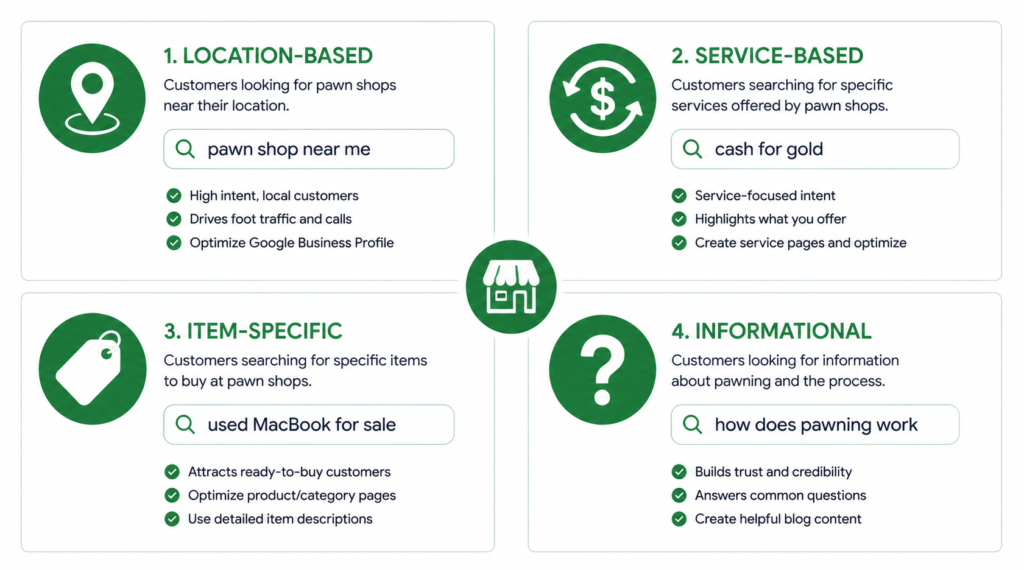
Pawn shop search queries fall into a few distinct categories, and you need to be visible in all of them.
Location-Based Searches
The highest-volume queries are simple and local: “pawn shop near me,” “pawn shop [city],” “buy and sell pawn shop [neighbourhood].” These are dominated by Google Maps results and your Google Business Profile. Ranking here comes from having a complete, verified profile with positive reviews and consistent NAP (name, address, phone) information across the web.
Service-Based Searches
The second category is service intent: “cash for gold [city],” “sell jewellery for cash,” “pawn loan [city],” “buy used electronics near me.” Create dedicated pages on your website for each major service you offer. A single page that lists everything is less effective than separate, well-written pages for each service category.
Item-Specific Searches
The third category is where your product listings earn their keep: “used MacBook Pro for sale,” “second hand guitar [city],” “buy gold chain near me.” These are lower volume individually but higher intent — someone searching this specific is very close to making a purchase. Well-written listings with accurate brand, model, and condition information will capture this traffic.
Informational Searches
Finally, there are the “how does this work” searches: “how much will a pawn shop pay for a PlayStation,” “what items do pawn shops accept,” “how does pawning work.” FAQ pages and blog content that answer these questions build trust, attract traffic from people who have not visited yet, and improve your overall site authority.
Real-Time Availability and Manager Responsiveness
Here is something that does not appear in most SEO guides but matters enormously in practice: inventory that sells fast creates a trust problem online.
| A customer sees a guitar listed on your website. They click through, they are interested, maybe they are ready to buy. But that guitar sold three hours ago and the listing was not updated. They show up at the store — or they try to call and no one answers — and they leave disappointed. That is not just a lost sale. It is a damaged reputation. |
The solution is twofold. First, keep your inventory sync as close to real-time as possible. Items that sell should come off the website the same day, ideally the same hour. Second, make sure someone is monitoring messages and enquiries during business hours. A customer who reaches out about an item and gets a response within minutes is far more likely to make the trip. One who waits a day for a reply has already found something elsewhere.
Add a Google Maps embed to your website and your contact page. Make your address, phone number, and hours impossible to miss. The goal is to eliminate every possible barrier between a customer finding you online and walking through your door.
Multiple Locations: How to Handle SEO at Scale
If you operate more than one pawn shop, your SEO approach needs to scale accordingly — and this is where most multi-location shops make significant mistakes.
One Google Business Profile Per Location
Each physical location needs its own verified Google Business Profile with its own unique address, phone number, and hours. Do not share contact information between profiles. Google treats each location as a separate entity, and your profile needs to reflect that accurately.
Dedicated Location Pages on Your Website
Create a separate page on your website for each location. The page should include: the location’s address, phone number, hours, a Google Maps embed, and content that is specific to that location — not copied from your other pages. If one location specialises in musical instruments and another in electronics, that should be reflected in the page content.
Automated Meta Tags and Descriptions for Inventory
With multiple locations and large inventory volumes, manually writing meta titles and descriptions for every product is not realistic. Set up templates that auto-generate these from product attributes — brand, model, condition, location.
| Used Sony PlayStation 5 – Good Condition | [City] Pawn Shop |
A meta title like this is something a template can generate reliably and it is far more effective than a blank or generic tag. The same logic applies to structured data markup, which helps Google understand the details of each product listing.
Technical Foundations That Cannot Be Ignored
None of the above works well if the technical foundation of your website is poor. For a pawn shop with a product catalogue, a few things are non-negotiable.
| ✓ | Mobile speed: the majority of “near me” searches happen on phones. A slow site loses customers before they even see your inventory. |
| ✓ | SSL certificate: your site must be HTTPS. Google treats non-secure sites as a negative signal, and customers will see a browser warning. |
| ✓ | Clean URL structure: product pages should have readable URLs — /inventory/apple-iphone-14-pro — not /product?id=48293&cat=7. |
| ✓ | Structured data: use schema markup for local business and product listings. This gives Google richer information about your items. |
| ✓ | Sitemap: an automatically updating XML sitemap ensures Google finds new listings as they are added. |
Building Local Authority Through Citations and Backlinks
Your NAP — name, address, phone number — needs to be consistent everywhere it appears online. Inconsistencies between your website, Google Business Profile, Yelp, Yellow Pages, and other directories send conflicting signals to Google and can suppress your local rankings.
Audit your listings across major directories and correct any inaccuracies. For a pawn shop, priority directories include Google Business Profile, Yelp, Facebook, BBB (Better Business Bureau), and any local business directories specific to your city or region.
For backlinks, focus on local relevance. A link from a local news outlet, a community organisation, or a neighbourhood business association is more valuable for local SEO than a link from a high-authority national site with no local connection. Sponsor local events, partner with nearby businesses, and look for opportunities to be mentioned in local publications.
What to Focus on First
If you are starting from scratch or doing a serious overhaul, here is the order that makes the most practical sense for a pawn shop:
- Get your Google Business Profile fully filled out and verified — this is the fastest path to local map pack visibility
- Set up inventory synchronisation between your POS and your website — outdated listings actively hurt you
- Ensure every product listing has quality photos with proper alt text and a complete, brand-specific description
- Create dedicated service pages for each major category you offer
- Fix the technical basics — SSL, mobile speed, clean URLs
- Build out location pages if you have multiple shops
- Start collecting reviews consistently
- Add FAQ content and informational pages to capture research-stage traffic
| “SEO for pawn shops is not complicated, but it requires consistency. The shops that show up first when customers search are not necessarily the biggest or the oldest — they are the ones that have done the work to make their online presence match the quality of what they offer in person.” |
Work With MarTraff
| If customers searching for what you sell are not finding your shop — there is a fixable reason, and it usually starts with the basics above.We will review your Google Business Profile, your website, and your inventory setup — and tell you exactly what to fix first. Get a Free SEO Review for Your Pawn Shop → No commitment. No generic report. |