
How to Write Product Descriptions That Convert and Rank
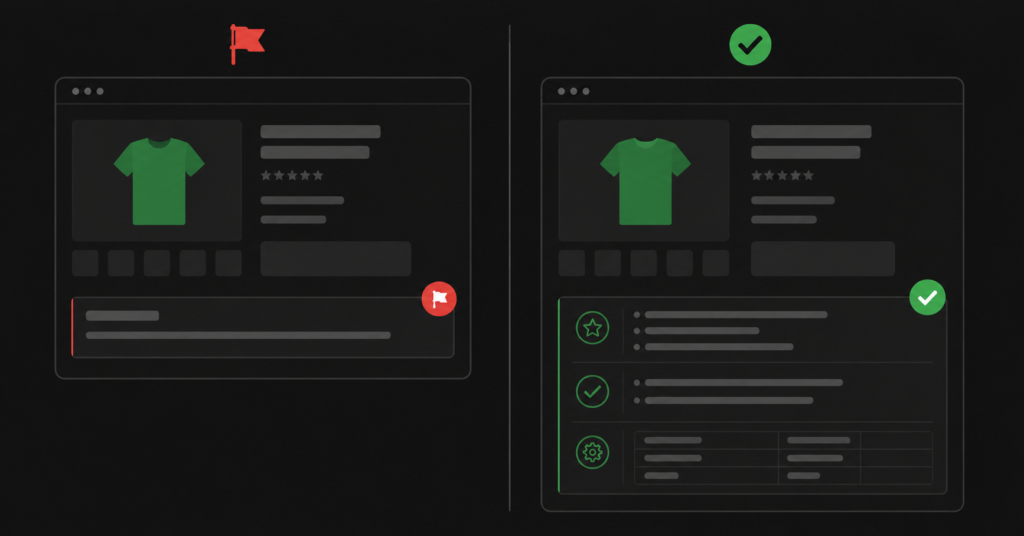
Most product descriptions fall into one of two categories: copied directly from the manufacturer, or a single generic sentence that could apply to almost any product in the same category. Neither helps you rank, and neither helps a buyer decide to purchase.
A product description has exactly one job, done two ways at once: give Google enough specific, unique content to understand and rank the page, and give the buyer enough information to feel confident clicking “add to cart.” This guide covers how to do both — with a structure you can apply to every product on your site, not just your flagship items.
Why Most Product Descriptions Fail
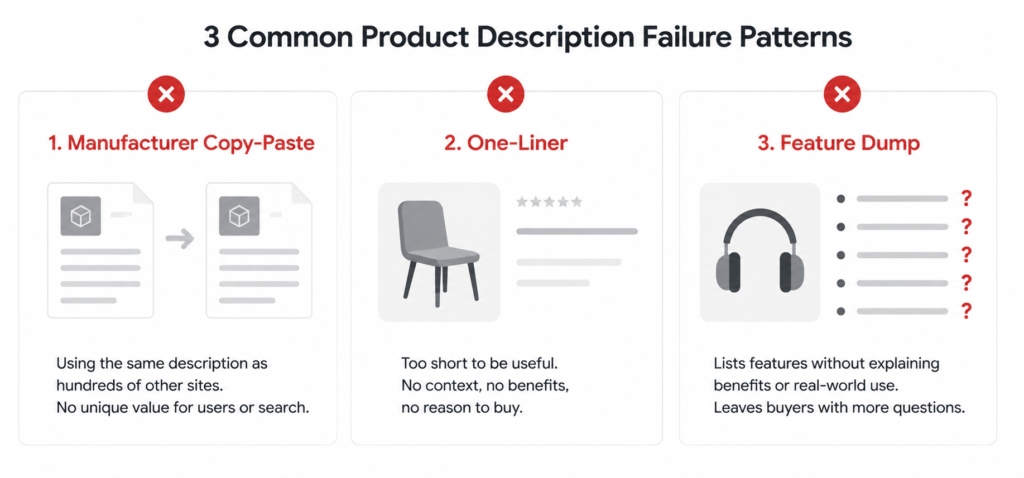
Three patterns show up again and again across ecommerce stores, and all three create the same problem: thin or duplicate content that gives Google nothing to differentiate your page from every other store selling the same product.
- Manufacturer copy-paste. The exact same paragraph that appears on the manufacturer’s site and on every competitor selling the same item. Google sees this as duplicate content across the web — your page has no unique signal to rank on.
- The one-liner. “High-quality cotton t-shirt, available in multiple colours.” This tells Google almost nothing specific and gives a buyer no reason to choose this product over a near-identical one.
- Feature dumps with no context. A bullet list of specs with no explanation of what they mean for the buyer. “400GSM. 100% cotton. Pre-shrunk.” Technically accurate, but it answers no actual question a buyer has.
| “A good product description does not need to be long. It needs to be specific. Specificity is what separates a page Google can rank from a page that blends into the noise of every other store selling the same item.” |
The Structure That Works
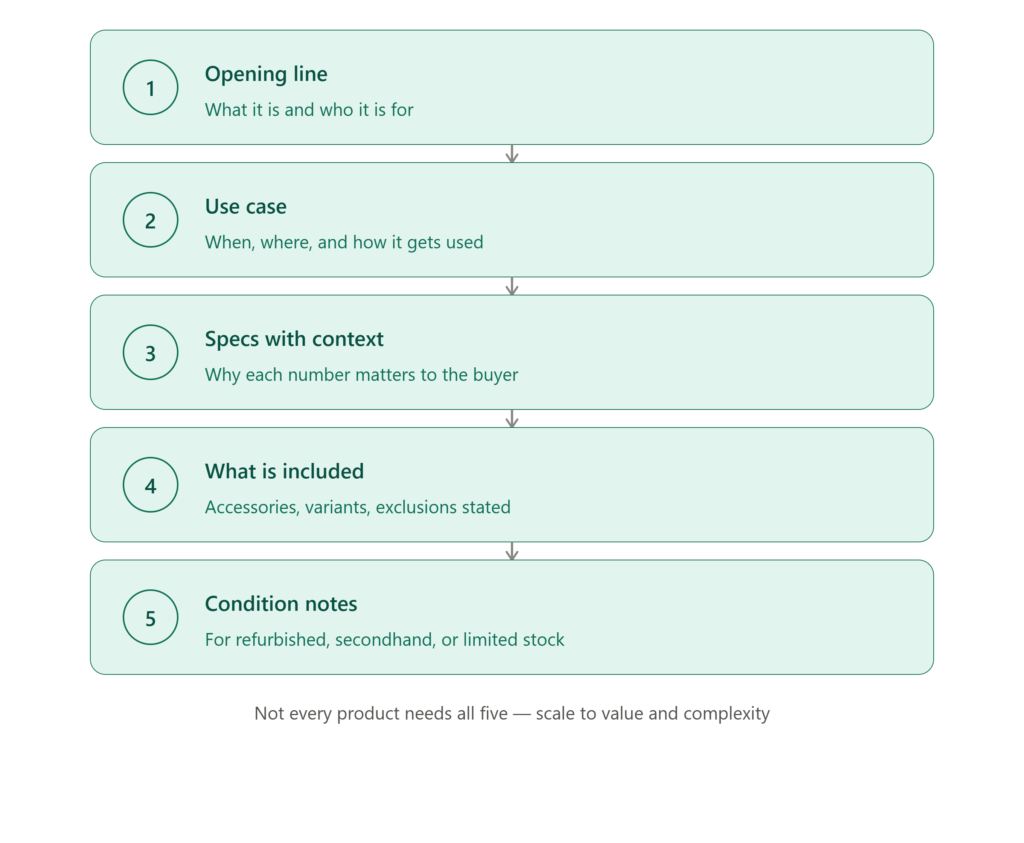
A product description that works for both SEO and conversion follows a predictable structure. Not every product needs every element — a £15 phone case does not need the same depth as a £2,000 camera — but the structure scales up or down depending on the value and complexity of what you are selling.
1. The opening line — what it is and who it is for
The first sentence should state what the product is and immediately signal who it is for or what problem it solves. This is the line Google is most likely to use as a snippet, and the line a buyer reads before deciding whether to keep reading.
| ✓ Good A lightweight running jacket built for cold-weather training — windproof front panel, breathable mesh back, reflective detailing for low-light visibility. | ✗ Weak This jacket is great for running and other outdoor activities. |
2. The specific use case — when and how it gets used
After the opening line, describe the specific situations where this product earns its place. This is where keyword variations occur naturally — different use cases use different language, and covering them gives Google more legitimate ways to match your page to a search query.
| ✓ Good Designed for runs in temperatures between -5°C and 10°C. The front panel blocks wind on exposed stretches, while the back mesh prevents overheating on climbs. Packs down into its own pocket for races where you need to shed a layer mid-run. | ✗ Weak Perfect for all your outdoor adventures, whatever the weather. |
3. Specs with context, not specs alone
Every spec should answer the unspoken question “why does this matter to me?” A number alone rarely answers that. The context is what makes a feature dump into something a buyer can actually use to decide.
| ✓ Good 400GSM cotton — heavier than the 180-220GSM used in most fast-fashion t-shirts, which is why this one holds its shape after repeated washes instead of going thin and stretched. | ✗ Weak 400GSM. 100% cotton. |
4. What is included and what is not
For anything with accessories, variants, or potential ambiguity, state explicitly what is and is not included. This reduces returns (a major hidden cost for ecommerce) and answers a question that otherwise generates customer service tickets or — worse — an abandoned cart from someone who could not find the answer and left to check a competitor.
5. A note on condition or limitations, if relevant
For refurbished, secondhand, or imperfect-stock items, this section is essential — see our guide on SEO for recommerce stores for the full treatment of condition-specific content. For new products, this might just be a sizing note or a care instruction.
Using Keywords Without Stuffing
Every product description should be built around a primary keyword and 2-4 natural variations — but the goal is coverage of how real buyers search, not repetition of one exact phrase.
Before writing, check what keyword research tells you about how this specific product is searched. A “running jacket” might also be searched as “lightweight running jacket,” “windproof running jacket,” or “cold weather running jacket.” Use the variations that genuinely apply to your product naturally across the description — in the opening line, the use case section, and the specs — rather than forcing the same three words into every sentence.
| Keyword stuffing is self-defeating: “Buy this running jacket. Our running jacket is the best running jacket for runners who run.” Beyond looking obviously manipulative to a human reader, Google’s language models recognise unnatural repetition and treat it as a quality signal against the page, not for it. |
Writing for Variants Without Duplicating Content
The hardest part of product description writing at scale is handling variants — the same product in different colours, sizes, or configurations. Three approaches work, depending on how different the variants actually are.
| Variant type | Approach |
| Colour only — same product | One description, with the colour mentioned naturally in the opening line (“available in forest green, navy, and black”). Use canonical tags so Google treats colour variants as one page, not duplicates. |
| Size only — same product | Same as colour — one description. Sizing details belong in a separate size guide, not duplicated per variant. |
| Material or functional variants | Each variant gets a distinct description if the functional difference is meaningful — a waterproof version vs. a standard version of the same jacket are different enough to warrant unique copy and unique target keywords. |
Writing at Scale: Templates Without Sounding Templated
For catalogues with hundreds or thousands of products, writing fully unique prose for every single item is not realistic. The solution is a structured template with mandatory unique fields — not a fully generic paragraph with one word swapped out.
A working template for, say, a furniture store might require: one unique sentence about the specific piece (not reused across products), the dimensions and materials with context, and a use-case sentence specific to that item’s size or style. The structure repeats; the content inside it does not.
| The test: read five product descriptions from your catalogue back to back. If you could swap the product name in any of them and the description would still make sense, the content is too generic. Each one should contain at least one detail that only applies to that specific item. |
Using AI to Help — Without Creating Thin Content
AI tools can speed up product description writing significantly, particularly for large catalogues. The risk is the same one that affects manual templates at scale: if every AI-generated description follows the identical structure with only the product name and a few attributes swapped, Google increasingly recognises this pattern and treats it as thin, low-value content.
The fix is the same principle as the template approach above: use AI to draft the structure and the spec explanations, but ensure a human adds or verifies at least one genuinely specific detail per product — something pulled from the product’s actual attributes, your own testing, or customer feedback, not generated from a generic prompt.
A Practical Checklist
| ✓ | Opening line states what the product is and who it is for — not a generic category statement |
| ✓ | At least one specific use case described — when, where, or how this product gets used |
| ✓ | Specs are paired with context explaining why each one matters to the buyer |
| ✓ | What is included (and excluded) is stated explicitly if there is any ambiguity |
| ✓ | Primary keyword and 2-4 natural variations appear across the description, not repeated identically |
| ✓ | Variant handling follows the right approach — shared description with canonical tags, or unique copy where functionally justified |
| ✓ | No sentence could be copy-pasted into a different product’s description without sounding wrong |
| ✓ | Description is unique — not copied from the manufacturer or matching what competitors publish |
FAQ
How long should a product description be?
There is no fixed word count. A simple, low-consideration product (a phone charger, a basic t-shirt) might only need 60-100 words. A complex or high-value product (a camera, furniture, professional equipment) often benefits from 200-400 words covering use cases, specs with context, and what is included. Length should follow from what genuinely needs explaining — not a target you are writing to hit.
Should I write different descriptions for every size and colour variant?
Generally no, if the variants are genuinely the same product. Use one description with canonical tags pointing to a single primary URL, and mention the available variants naturally in the copy. Write distinct descriptions only when the variants are functionally different enough to justify it — different materials, different use cases, or different target keywords.
Can I use the same description structure across my whole catalogue?
Yes — and you should. A consistent structure (opening line, use case, specs with context, what is included) makes writing at scale manageable and gives buyers a predictable, easy-to-scan format. What should not repeat is the actual content inside that structure. The template is reusable; the specifics are not.
Does AI-written product copy hurt SEO?
AI-generated content itself is not penalised by Google. Thin, repetitive, low-value content is — regardless of whether a human or an AI wrote it. The risk with AI at scale is producing hundreds of descriptions that are structurally identical with only the product name swapped. As long as each description contains genuinely product-specific detail, the writing method does not matter to Google.
| Need your product pages rewritten at scale? We build content strategies and write product, category, and guide copy for ecommerce stores — prioritised by traffic potential, not random product order. See Our Content Strategy Service → No commitment. martraff.com |