
How We Built a High-Load Drupal Website for Kyivstar, Ukraine’s Largest Mobile Operator
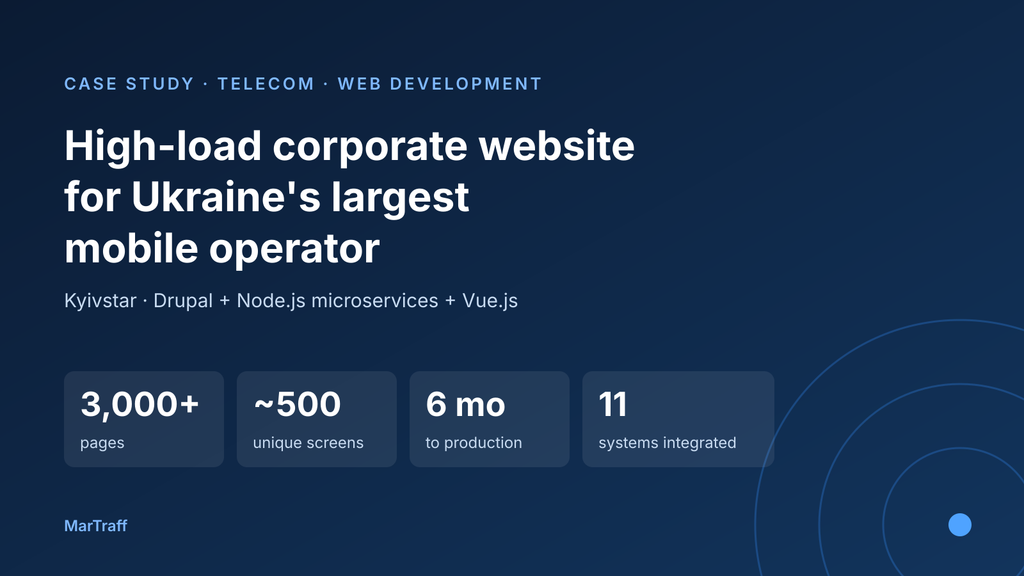
We built the corporate website of Kyivstar, the largest mobile operator in Ukraine, on Drupal with a Vue.js front end and a layer of Node.js microservices for integrations. The site went from business requirements to production in six months, launched with 3,000+ pages and around 500 unique screens, and connected the website to 1C, Bitrix24, Mailchimp, an SMS gateway, PrivatBank payments, a GIS-powered address search and Kyivstar’s network coverage map. It ran on 8 identical production instances, our team shipped releases every day, and by 2019 the platform had grown to nearly 6,000 pages. Kyivstar kept working with our team until 2022 and almost tripled the team and the budget along the way.
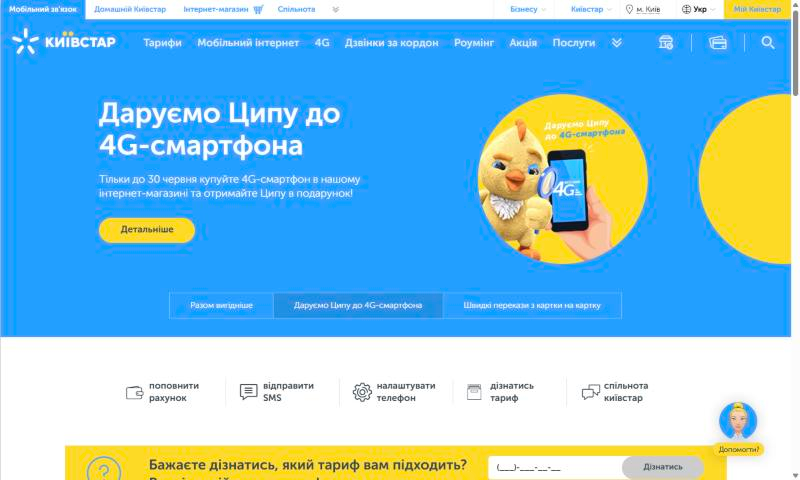
kyivstar.ua home page in June 2018, on the platform described in this case (Wayback Machine archive).
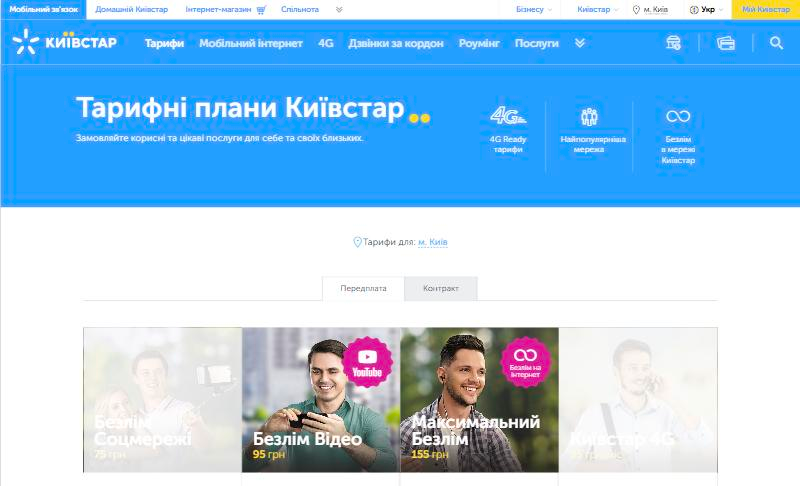
Tariffs page with prices for the visitor’s city (“Тарифи для: м. Київ”), April 2018 (Wayback Machine archive).
Project at a glance
| Client | Kyivstar, the largest mobile operator in Ukraine (Nasdaq: KYIV) |
| Industry | Telecommunications |
| Project | Corporate multifunctional website kyivstar.ua |
| Launch | 2016 |
| Time to launch | 6 months from business requirements to production |
| Scale at launch | 3,000+ pages, around 500 unique screens |
| Scale by 2019 | Nearly 6,000 pages on the platform (per Kyivstar’s interview in Strapi’s user story) |
| Status | Launched in 2016. Our team developed and supported the platform (Drupal core, Node.js microservices, Vue.js front end) until 2022. From 2019 Kyivstar also built a new main website with an in-house team on another stack (Strapi); nearly 5,000 pages stayed on the Drupal platform |
| Audience | Over 4 million users a day on kyivstar.ua when the project started |
| Tech stack | Drupal, Node.js microservices, Vue.js, Elasticsearch; Git flow and CI/CD; 8 identical production instances |
| Integrations | 1C, Bitrix24, Mailchimp, SMS gateway, PrivatBank payment widgets, GIS API, network coverage map, Google search, Lever job boards, push notifications to browsers and apps, product catalog, REST and SOAP services |
| Team | Our team grew from 4 to 12 people, led by a project manager and tech lead; joint Scrum team with Kyivstar’s analysts and product owners |
| Process | Classic Scrum; releases every day, two major releases a year (spring and autumn); separate test environments |
Key numbers
| 6 months from requirements to production | 3,000+ pages at launch | ~6,000 pages on the platform by 2019 |
| ~500 unique screens designed and built | 11 external systems and services connected | 4 → 12 people on our team |
| 8 identical production instances | Daily releases, plus 2 major ones a year | ~3× growth of the team and the budget |
Two numbers describe how the platform was run. Releases went to production every day, without exceptions, plus two major releases a year in spring and autumn. Production ran on 8 identical instances, so the site could carry peak load and stay up if one or two instances failed.
About the client
Kyivstar is Ukraine’s largest mobile operator and the first Ukrainian company listed on a US stock exchange. Its website is not a brochure: millions of people use it to compare tariffs, check coverage, pay for services and contact support. That is why performance, regional accuracy and integrations mattered more here than on a typical corporate site.
| Kyivstar today | Value | Source |
| Mobile subscribers | 21.7 million (30 September 2026) | Kyivstar Q3 2026 results |
| Fixed broadband subscribers | ~1.3 million (Q3 2026) | Kyivstar Q3 2026 results |
| Stock listing | Nasdaq (KYIV) since 15 August 2025; first Ukrainian company on a US exchange | Kyivstar / VEON press release |
These figures describe Kyivstar today, not the period of our project. They show the scale of the business the platform was built for.
The request
In 2016 Kyivstar needed a new corporate website that could carry the full weight of a national operator: thousands of pages, a large editorial team, regional offers and a long list of business systems that had to talk to the site. The new website had to:
- handle millions of visitors without slowing down;
- show every visitor the tariffs and special offers for their own region;
- let people check whether mobile internet is available at a specific address before they connect;
- accept payments and send SMS directly from the site;
- exchange data with Kyivstar’s business systems (1C, Bitrix24, Mailchimp) without manual exports;
- bring all company vacancies into one place for candidates;
- give a large content team one place to manage thousands of pages.
Here is how each requirement turned into a part of the platform:
| Business requirement | What we built | Technology |
| Survive high traffic | Decoupled architecture: content core, separate integration services and a fast front end | Drupal, Node.js, Vue.js |
| Regional tariffs and offers | Regionalisation module that detects location by IP and swaps regional content | Custom Drupal module |
| “Can I connect at my address?” | Coverage check against Kyivstar’s coverage map and nearest settlements | Geodata, coverage map API |
| Find an address even with typos | Autocomplete for cities, streets and settlements with typo correction | Elasticsearch + GIS API |
| Pay and get SMS on the site | Embedded payment widgets and SMS sending | PrivatBank widgets, SMS gateway |
| No manual data exports | Two-way data exchange with business systems | 1C, Bitrix24, Mailchimp via Node.js services |
| One place for all vacancies | Careers module: vacancies pulled in from job boards, one application sent to all of them | Custom Drupal module + Lever |
| Search that actually finds things | Site search with Google results inside Kyivstar’s design | Custom Drupal module + Google |
| Thousands of pages, many editors | One CMS with editorial roles and content import from other CMSs | Drupal |
Where we started
- Technical requirements. We translated Kyivstar’s business requirements into technical requirements for a large corporate website with many integrations, thousands of pages and high traffic.
- Backlog and UX. Before writing code, we described the functionality of every part of the site as a backlog and designed the UX, so estimates and priorities were based on real screens and flows, not on assumptions.
- Choosing the stack. The number of business requirements and integrations decided the architecture: Drupal for content, Node.js microservices for integrations and Vue.js for the front end.
- Team and process. We sized the team, estimated the work and set up a classic Scrum process with sprints, regular meetings, separate test environments and daily releases.
The project followed these phases:
| Phase | What happened | Result |
| 1. Analysis | Business requirements turned into technical requirements; integrations listed and scoped | Technical specification |
| 2. Backlog and UX | Functionality of every section described; UX of key flows designed | Prioritised backlog, UX prototypes |
| 3. Architecture | Stack chosen; integration layer separated from the CMS | Architecture and estimates |
| 4. Development | Iterative sprints: analysis → development → QA → verification by Kyivstar | Working releases on test environments |
| 5. Launch | Production release six months after the start of requirements work | kyivstar.ua live in 2016 with 3,000+ pages |
| 6. Evolution | 2016–2022: daily releases, two major releases a year, new modules, content and integrations | Platform grew to nearly 6,000 pages by 2019 |
Our team stayed on the project from the 2016 launch until 2022.
Why Drupal, Node.js and Vue.js
A website of this kind usually ends up on one of three paths. We compared them against Kyivstar’s requirements:
| Criterion | Drupal + Node.js + Vue.js (chosen) | WordPress | Fully custom build |
| Thousands of structured pages and editorial roles | Strong: built for large structured content and permissions | Possible, but needs many plugins to manage roles and content types at this scale | Everything has to be built from scratch |
| Many integrations | Isolated in Node.js services; the CMS stays clean | Usually handled by plugins inside the CMS | Flexible, but all built and maintained by hand |
| Interactive front end (search, coverage, payments) | Vue.js components on top of the CMS | Theme-based, interactive parts are added on top | Any framework |
| Time to production | 6 months: CMS features out of the box, custom work only where needed | Fast for simple sites, slower as custom logic grows | Longest: CMS features must be written too |
| Changing one integration | Change one service without touching the rest | Plugin updates can affect the whole site | Depends on how the code is structured |
The comparison reflects the typical trade-offs for this type of project, not a ranking of the platforms in general.
How we built it
The platform has three layers, each with its own job:
- Drupal, the content core. It stores and manages the pages, editorial roles and the custom modules for regional content, careers and site search.
- Node.js microservices, the integration layer. Every external connection (REST and SOAP services, 1C, Bitrix24, Mailchimp, SMS, push notifications) runs as a separate service. The CMS does not carry integration logic, so a new integration can be added or changed without touching the rest of the platform.
- Vue.js, the front end. Around 500 unique screens with interactive elements: address autocomplete, coverage check, payment widgets and search.
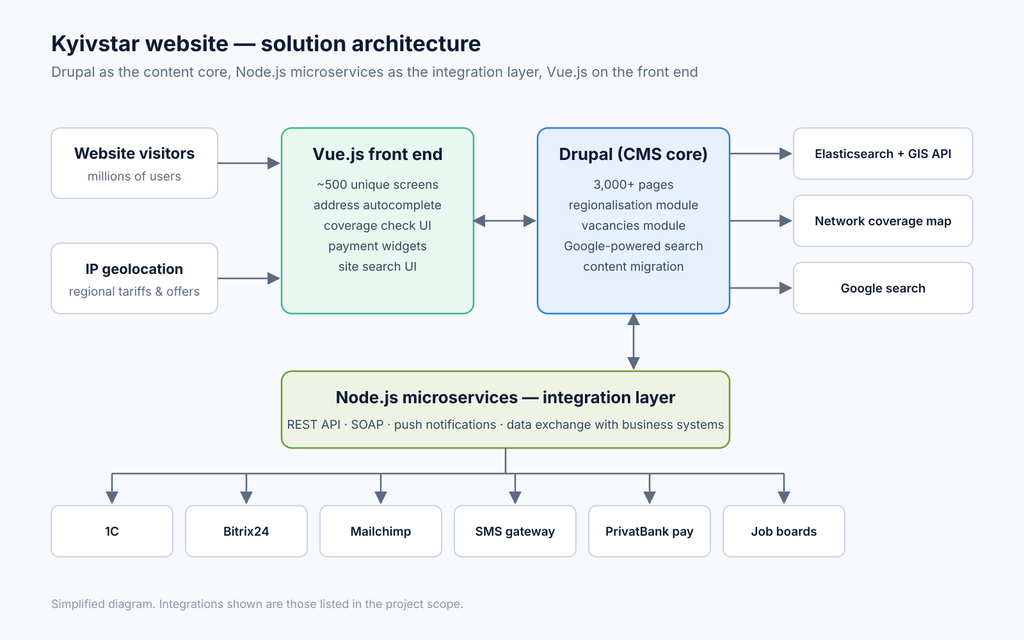
Simplified architecture of the Kyivstar website
To carry the load, production ran on 8 identical instances of the platform. If one or two of them went down, the others kept serving visitors, so a single failure did not take the site offline.
Integration map
| Integration | What it does for users and the business | How it connects |
| 1C | Business data flows between the site and accounting without manual exports | Node.js service |
| Bitrix24 | Leads and requests from the site land in the CRM | Node.js service |
| Mailchimp | Subscribers and segments sync for email campaigns | Node.js service |
| SMS gateway | SMS can be sent directly from the website | Node.js service |
| PrivatBank | Visitors pay without leaving the site | Embedded payment widgets |
| Elasticsearch + GIS API | Address autocomplete that corrects typos | Search service + GIS API |
| Coverage map | Checks if mobile internet is available at an address | Geodata and coverage map API |
| Google search | Accurate site search inside Kyivstar’s design | Custom Drupal module |
| Lever / job boards | All vacancies in one place; one application reaches every board | Custom Drupal module |
| Push notifications | Notifications to browsers and Kyivstar apps | Node.js service |
| REST and SOAP services | Data exchange with Kyivstar’s internal systems | Node.js services |
Key features
Regional content by IP address
A regionalisation module detects the visitor’s location by IP address and shows content for that region, such as regional tariffs and special offers for local residents. Why it matters: a visitor from Lviv and a visitor from Kharkiv see the offers that actually apply to them, without choosing a region by hand.
Address search that forgives typos
We integrated Elasticsearch with a GIS API for autocomplete of cities, districts, streets and even individual buildings. If a user makes a typo, the system recognises the intended street or city and suggests the correct one. Why it matters: Ukrainian addresses come in several spellings, and a search that fails on one letter loses a customer at the first step.
Network coverage check
The site worked with geodata and Kyivstar’s coverage map: it found the nearest settlements and checked whether mobile internet can be connected at a specific location. Why it matters: people get an answer before they buy, which means fewer disappointed customers and fewer support calls.
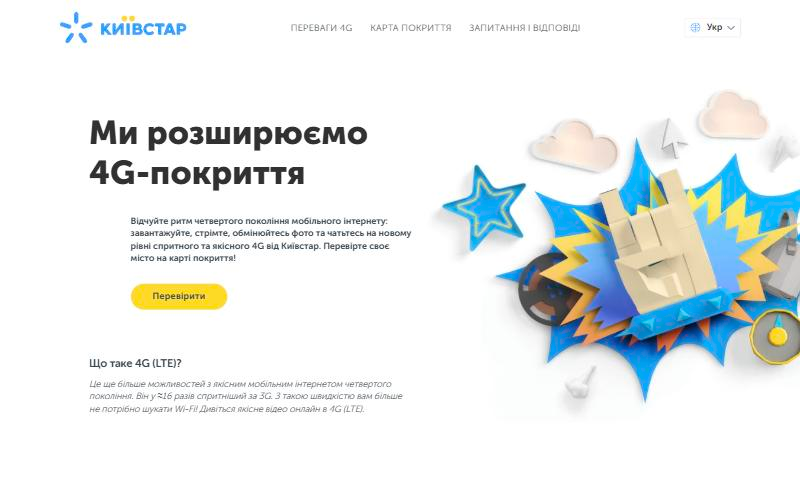
The 4G page on kyivstar.ua with the coverage check, July 2018 (Wayback Machine archive).

4G coverage map on the same page, July 2018 (Wayback Machine archive).
Payments and SMS on the site
PrivatBank payment widgets are integrated into the site, and SMS can be sent directly from it. Why it matters: one of the most common reasons to visit an operator’s site is to top up or pay, and doing it without leaving the page shortens that path.
Integrations with business systems
Through the microservices layer, Drupal exchanges data with REST and SOAP services, 1C, Bitrix24 and Mailchimp, and sends push notifications to browsers and apps. Why it matters: data from the website reaches sales, accounting and marketing on its own, without exports and copy-paste.
Site search powered by Google
We built a Drupal search module integrated with Google: visitors get Google search results for the site, displayed in Kyivstar’s own design. Why it matters: on a site with thousands of pages, people search instead of browsing, and the quality of that search decides whether they find a tariff or leave.
One place for all vacancies
A custom Drupal module integrates with job sites through the Lever service. All Kyivstar vacancies published elsewhere appear on the corporate site, and an application filled in on kyivstar.ua is also sent to the job sites where the vacancy is posted. Why it matters: candidates apply once, and HR does not have to collect applications from several platforms.
Content import from other CMSs
The platform can import content such as news from other CMSs (WordPress, Joomla, Symfony-based sites and others). Why it matters: existing content did not have to be recreated by hand, and new sources can be connected later.
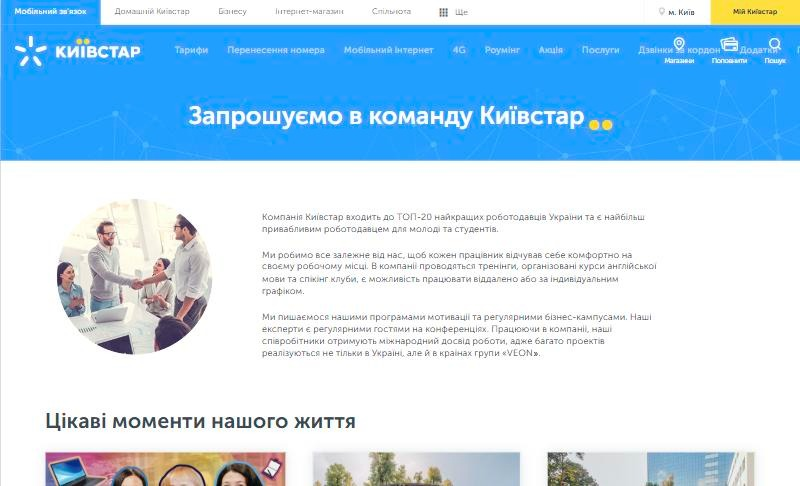
Careers section on kyivstar.ua, January 2020 (Wayback Machine archive).
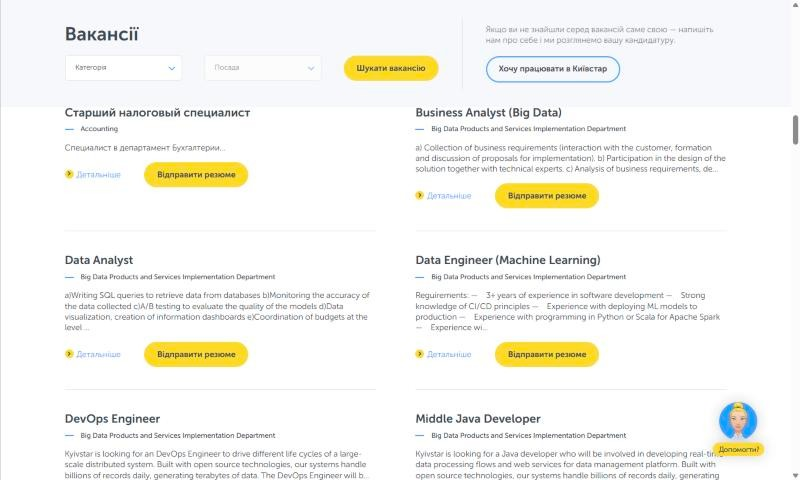
The vacancies list on the same page: every Kyivstar vacancy in one place, with a “Send CV” button on each card. January 2020 (Wayback Machine archive).
How the delivery process worked
With a joint team of more than 20 people on two sides, the process mattered as much as the code. The backlog was broken down into technical tasks, and every task passed the same route:
| Stage | Who | What comes out |
| Analysis | Kyivstar business analysts + our team | Clear technical task with acceptance criteria |
| Development | Drupal, Node.js and Vue.js developers | Feature on a separate test environment |
| QA | Manual QA + QA automation | Tested feature, regression checked |
| Verification | Kyivstar product owners | Feature approved for release |
| Release | Our team + Kyivstar technical lead | Feature live on kyivstar.ua |
Releases went to production every day, without exceptions, plus two major releases a year, in spring and autumn. To make daily releases safe, the team set up Git flow branching, CI/CD and a fixed release routine, so a release was a normal working step and each change stayed small.
How the project turned around
At one point Kyivstar was reviewing whether to continue the cooperation. After we rebuilt the delivery process (classic Scrum, daily releases, Git flow and CI/CD), Kyivstar grew our team from 4 to 12 people and almost tripled the monthly budget.
Kyivstar’s Agile lead told the team that the processes were finally in order and the mistakes fixed, and that Kyivstar was ready to expand the team.
The team
Our team grew from 4 to 12 people over the life of the project. The table shows the team in 2018–2021, together with the people on Kyivstar’s side:
| Role | People | Side |
| Project manager and tech lead | 1 | Our team |
| Vue.js front-end developers | 4 | Our team |
| Node.js developers (microservices) | 2 | Our team |
| Drupal back-end developers | 4 | Our team |
| Manual QA engineers | 2 | Our team |
| QA automation engineer | 1 | Our team |
| Content manager | 1 | Our team |
| Business analysts | 4 | Kyivstar |
| Product owners | 4 | Kyivstar |
| Scrum master | 1 | Kyivstar |
| Technical lead | 1 | Kyivstar |
| Total | 25 | 15 our team + 10 Kyivstar |
What Kyivstar got
Kyivstar got a platform that can:
| The platform can… | What it means for the business |
| Run 3,000+ pages and ~500 screens from one CMS, and grow to nearly 6,000 pages | One place for all content and all editors |
| Adapt tariffs and offers to the visitor’s region automatically | Relevant offers for every region without separate sites |
| Tell people whether they can connect at their address before they buy | Fewer failed connections and support calls |
| Find addresses even when users make typos | Fewer drop-offs at the first step |
| Take payments and send SMS without leaving the site | Shorter path to the most common action |
| Send website data to 1C, Bitrix24 and Mailchimp automatically | No manual exports between teams |
| Show every vacancy in one place and send one application to several job boards | Easier hiring for a company with thousands of employees |
| Add a new integration as a separate service | Changes without rewriting the core |
| Go live in six months and ship releases every day for six years | Fast start and a product that keeps up with the business |
The clearest measurable result is the client’s own decision: during the project Kyivstar grew our team from 4 to 12 people and almost tripled the monthly budget.
What happened next
Our team developed and supported the platform from its launch in 2016 until 2022. In 2019–2020 project management moved to Kyivstar’s side, while our development team stayed on the project. From 2019 Kyivstar also began building a new main website with its own in-house team on a JavaScript stack. According to Kyivstar’s interview in Strapi’s public user story, the company moved about 1,000 of the most visited pages to the new stack and kept nearly 5,000 pages on the Drupal platform, with the same links. By 2022 Kyivstar chose to continue with an in-house team.
For us this is a normal lifecycle of a large corporate platform: it carried the website through its growth years, and its content stayed in use after the client changed its strategy.
What this project shows for similar websites
- Keep integrations out of the CMS. When 1C, CRM, payments and SMS live in separate services, one change does not put the whole site at risk.
- Design the backlog and UX before the estimate. With ~500 screens, estimates based on real screens are the only ones that hold.
- Treat regional content as a product feature. For a national brand, the right offer for the right region is worth more than another landing page.
- Make search tolerant to typos. Address and site search are where large sites lose people quietly.
- Plan for the next platform. A clean content structure keeps content usable even when the business later changes its stack.
- Ship small releases every day. Daily releases with Git flow and CI/CD keep each change small and easy to roll back.
FAQ
How long does it take to build a corporate website of this scale?
For Kyivstar, it took six months from business requirements to production for a site with 3,000+ pages and around 500 unique screens. After launch, our team kept developing it until 2022, with releases every day.
Why Drupal for a telecom website?
The project had thousands of pages, many editorial roles and a long list of business requirements. Drupal handles this volume of structured content and custom modules (regional content, careers, search), while heavy integration logic lives in separate Node.js microservices.
Can a Drupal website integrate with 1C and Bitrix24?
Yes. In this project, Drupal exchanges data with 1C, Bitrix24 and Mailchimp through a Node.js microservices layer, together with SMS, push notifications, REST and SOAP services.
How do you show different tariffs to different regions?
A regionalisation module detects the visitor’s location by IP address and replaces regional content such as tariffs and local offers. Editors manage regional versions in the same CMS.
How does an address coverage check work on a website?
The address is entered with autocomplete (Elasticsearch and a GIS API correct typos), then the system checks the location against the operator’s coverage map and nearby settlements and tells the visitor whether mobile internet is available there.
What team does a project like this need?
On our side: a project manager and tech lead, 4 Vue.js, 2 Node.js and 4 Drupal developers, 2 manual QA engineers, 1 QA automation engineer and a content manager. On the client side: business analysts, product owners, a Scrum master and a technical lead. Our part of the team grew from 4 to 12 people as the project expanded.
Can you rebuild a large website without losing search traffic?
Yes, if SEO is part of the project from the start: URL mapping, redirects, metadata and content migration are planned before launch, not after. MarTraff started as an SEO agency, so this is built into every website we deliver.
How do you keep a high-load website stable?
For Kyivstar, production ran on 8 identical instances, so peak traffic was spread across them and the site stayed up if one or two failed. Releases went out every day through Git flow and CI/CD, which kept each change small and easy to check.
Related services
- Drupal Development
- Corporate Website Development
- Web Development
- CRM, 1C and Bitrix24 Integration
- Website Migration without Traffic Loss
| Need a high-load corporate website like this? Tell us what your site has to handle: traffic peaks, regions, integrations, the size of your content team. We will come back with an architecture, a team and a timeline, and we build with SEO in from day one so a relaunch does not cost you search traffic. Talk to MarTraff → |
Sources
Public facts about Kyivstar in this case come from: Kyivstar Q3 2026 results (6 November 2026); Kyivstar / VEON press release on the Nasdaq listing (15 August 2025); Strapi user story “Kyivstar uses Strapi for a website and mobile app” (pages on the Drupal platform and the 2019 move in-house).