GEO Is SEO in 2026: What Generative Engine Optimization Actually Means for Your Rankings
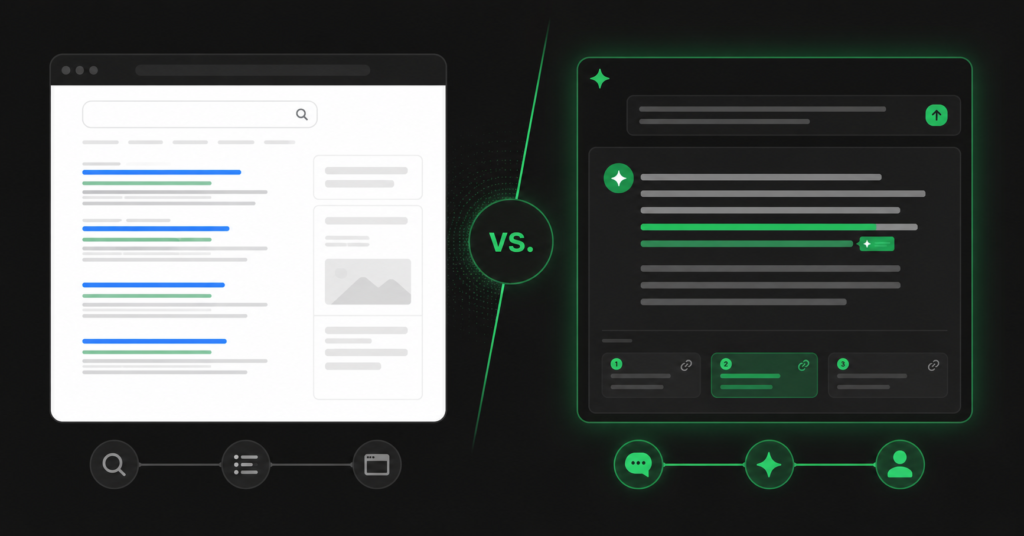
Search is not broken. It is just in the middle of becoming something different.
In 2024, a Princeton-led research team published the paper that formally defined Generative Engine Optimization — GEO — as a discipline. In 2025, the numbers started to validate the concept at scale. In 2026, the conversation has shifted from “is this real?” to “how do we measure it?”
This article covers what GEO actually is, what the current data shows, where it overlaps with traditional SEO, where it diverges, and what it means practically for a business trying to build organic visibility. No hype, no vague predictions. Just what the evidence says.
The Numbers First — What Is Actually Happening With AI Search
Before getting into strategy, it is worth grounding the conversation in data. A lot of the GEO discussion has been speculative. The 2025 numbers are no longer speculative.
| 527% AI-referred sessions YoY Previsible, first 5 months 2025 | 63% Websites with AI search traffic Ahrefs, 2025 | 25% Enterprise queries bypassing Google Gartner estimate, 2026 | 65% Google searches ending without a click Industry research, 2025 |
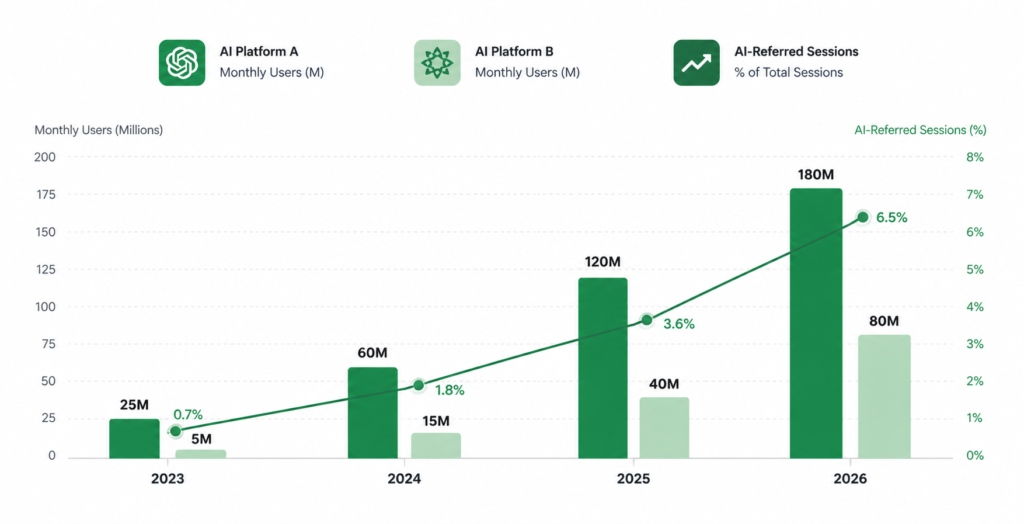
These numbers are not about a niche audience of early adopters. ChatGPT reached 800-900 million weekly active users by early 2026. Perplexity handles 780 million monthly queries. Google AI Overviews now appears across 200+ countries in 40+ languages. McKinsey reported that by October 2025, 50% of consumers were using AI-powered search intentionally — not experimentally — as their primary way to find information.
The shift is real. The question is what it means for how you build organic visibility.
What GEO Actually Is — and What It Is Not
GEO — Generative Engine Optimization — is the practice of structuring content so that AI systems cite it as a source in their generated responses. When someone asks ChatGPT or Perplexity a question, the system retrieves content from the web, synthesizes it, and surfaces an answer. GEO is the work of making your content the thing being cited.
The term was introduced in Princeton research in 2023 and formalized at the KDD 2024 academic conference. The peer-reviewed study tested optimization strategies across 10,000 queries in 25 domains. The key finding: specific content strategies measurably increased visibility in AI-generated responses.
| Traditional SEO | GEO |
| Optimises for ranking in a list of links | Optimises for inclusion in an AI-generated answer |
| User sees your link and may or may not click | AI cites your content — user absorbs it without necessarily visiting |
| Success metric: click-through rate, position | Success metric: citation share, AI mention frequency |
| Algorithm: Google PageRank and 200+ signals | Algorithm: LLM retrieval, authority signals, content extractability |
| Content goal: rank for keywords | Content goal: be the source AI uses to answer questions |
| What GEO is NOT: It is not a replacement for SEO. It is not a separate discipline that requires abandoning everything you know about search. The Brandlight research found that overlap between top Google-ranked pages and AI-cited sources dropped from 70% to below 20% between 2023 and 2025 — which means GEO and SEO are increasingly different games. But the foundations — authority, structured content, clear answers — are shared. |
What Content Actually Gets Cited by AI Systems
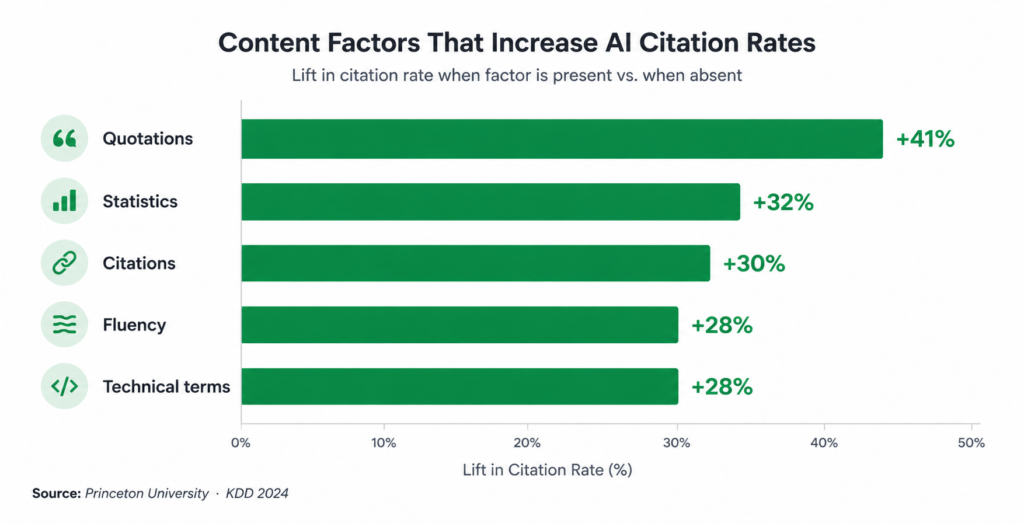
The Princeton/KDD 2024 research quantified which content strategies improved AI citation rates. These are not guesses or best practices inherited from traditional SEO. They are measured results from 10,000 queries.
| Content strategy | Visibility lift | Notes |
| Including quotations from authoritative sources | +41% | Most impactful single factor |
| Adding statistics with source attribution | +32% | Data points with clear provenance |
| Citing external sources within content | +30% | Third-party references, not just internal claims |
| Fluency and readability optimisation | +28% | Clear, structured prose that AI can parse and extract |
| Precise technical terminology | +28% | Industry-standard language signals expertise to LLMs |
Additional patterns from Seer Interactive’s 2025 analysis: 85% of content cited in AI Overviews was published within the last two years, and recently updated content appeared 4.3 times more often in AI answers than older material. Freshness is a stronger signal in AI search than in traditional SEO.
Where GEO and SEO Are the Same Thing
The most important thing to understand about GEO is that the majority of what makes content citation-worthy in AI systems is the same thing that makes it rank well in traditional search: authority, structure, specificity, and genuine usefulness.
| “The Conductor 2026 benchmarks found that ChatGPT drives 87.4% of AI referral traffic to websites. That traffic converts. AI search visitors convert at 4.4x the rate of organic search visitors according to multiple sources. The question is not whether AI traffic matters — it is whether your content is structured to earn it.” |
E-E-A-T signals carry over directly
Google’s Experience, Expertise, Authoritativeness, Trustworthiness framework — the same one that has mattered for traditional SEO — is essentially what LLMs use to evaluate source credibility. Content from recognised experts with verifiable credentials, published on authoritative domains, with external citations and structured data, is favoured by both Google’s algorithms and AI retrieval systems.
Structured, extractable content is critical for both
AI systems need to extract and synthesize information. The content that gets cited is the content that AI can parse cleanly: clear H2/H3 structure, direct answers to specific questions, short definitive paragraphs, FAQ sections with question-answer pairs. This is also what generates featured snippets and position-zero results in traditional search.
If you are already doing good on-page SEO — proper heading structure, clear introductory paragraphs that define topics directly, FAQ sections — you are already doing the structural work that GEO requires.
Backlinks and domain authority still matter
Brandlight research showed that AI systems exhibit systematic bias toward earned media over brand-owned content. A brand mentioned positively in third-party publications, reviewed on authoritative review platforms, cited in industry content — that is the brand that gets included in AI responses. Link building, PR, and third-party visibility remain relevant, arguably more so in an AI search environment than in traditional search.
Where GEO and SEO Diverge
Despite the overlaps, there are real differences between optimising for traditional search and optimising for AI citation. Ignoring them is a mistake.
Zero-click is now the norm, not the exception
Bain research found that 80% of consumers rely on zero-click results in at least 40% of their searches. Pew Research found 58% of users were less likely to click through when AI summaries appeared. The traditional metric of click-through rate is becoming less meaningful for a significant portion of queries.
What replaces it as a success metric is harder to measure but more valuable: brand mention frequency in AI responses, citation share within a topic area, and whether your brand appears on a buyer’s consideration list before they ever search for a vendor. Bain’s 2025 research found that 77% of B2B purchase decisions go to vendors already on the buyer’s “Day One List” — a list that is increasingly formed by AI interactions, not website visits.
The overlap between Google rankings and AI citations is shrinking
This is the most important data point for traditional SEO practitioners. Brandlight research found the overlap between top Google-ranked pages and AI-cited sources dropped from 70% in 2023 to below 20% by 2025. You can rank on page one of Google and still be absent from AI-generated answers on the same topic. These are increasingly different sets of results, optimised by increasingly different signals.
Measurement is different and harder
Traditional SEO metrics — rankings, impressions, CTR — are tracked automatically. AI citation measurement is still evolving. Current approaches include: monitoring referral traffic from ChatGPT and Perplexity in GA4, server log analysis for AI crawler activity, manual citation audits (asking AI platforms the relevant questions and tracking whether your brand appears), and emerging tools purpose-built for AI visibility tracking.
What This Means Practically in 2026
The question most businesses have is not whether GEO matters — it clearly does. It is what to do differently.
Keep doing SEO — it is still the foundation
Gartner estimates that 25% of enterprise search queries bypass Google in 2026. That means 75% still do not. Traditional search is not going away. A page that does not rank on Google is also unlikely to be well-cited by AI systems that still use Google as a primary retrieval source. The foundation of technical SEO, on-page optimisation, and link building remains necessary.
Adapt your content to be extractable
This is the most actionable near-term change. Review your highest-traffic and highest-value pages and ask: can an AI system extract a clear, direct answer to a specific question from this page? If the answer is buried in five paragraphs of context without a direct statement, restructure it.
- Every important claim should have a direct, quotable sentence — the kind of sentence that could stand alone as the answer to a question
- Add FAQ sections to content that targets informational queries — these are highly extractable by AI systems
- Include statistics and data points with source attribution — the KDD research shows this is the second-highest citation lift factor
- Update content regularly — AI systems favour recent content significantly over evergreen content that has not been refreshed
For ecommerce specifically: informational content — buying guides, comparison pages, “how to choose” articles — is where GEO is most valuable. Transactional pages (product pages, category pages) benefit less directly, because AI systems are less likely to answer “buy this product” with a citation from your store. The content strategy work that builds topical authority for your category is the same work that builds AI citation presence.
Build entity presence, not just keyword presence
AI systems build models of the world based on entities — brands, people, organisations — and their relationships. A brand that is consistently mentioned in context with relevant topics, by credible third-party sources, in structured formats, becomes associated with those topics in the AI’s model. This is what “entity SEO” has been pointing toward for years. In an AI search environment, it is no longer optional.
Measure what you can now
Set up GA4 to track sessions from AI referral sources. Monitor the referrals from chat.openai.com and perplexity.ai in your traffic data. Run regular manual citation checks — ask the major AI platforms your most important category questions and see whether your brand appears. The data is imperfect but it is available and it is directionally useful.
FAQ
Should I stop doing traditional SEO and focus on GEO instead?
No. The majority of search traffic still goes through traditional search engines. 75% of enterprise queries still use Google in 2026 according to Gartner. GEO and SEO are complementary — the content strategies that make you citation-worthy in AI systems are largely the same strategies that improve your traditional search visibility. The adjustment is in how you structure and present content, not in abandoning the foundational work.
Does GEO work for ecommerce specifically?
GEO has the most direct impact on informational content — content that answers questions. For ecommerce, this means buying guides, comparison pages, category-level educational content, and FAQ pages. Product pages and transactional pages are less directly affected because AI systems are not typically surfacing specific product purchase recommendations. The strategic play for ecommerce is to use informational content to build category authority, which then influences both traditional rankings and AI citation patterns.
How do I know if my content is being cited by AI?
The most practical approach is manual citation auditing: periodically ask ChatGPT, Perplexity, and Gemini the questions your target customers are asking, and check whether your brand or your content appears. For referral traffic measurement, check GA4 for sessions originating from chat.openai.com and similar domains. Purpose-built AI visibility tracking tools are also emerging, though the space is still maturing.
How long does it take to see results from GEO optimisation?
Research from Brandlight and others suggests that brands building proper GEO infrastructure — entity signals, structured extractable content, third-party citations — see measurable citation increases within 8-10 weeks. This is faster than traditional SEO in some respects, because AI systems update their retrieval more frequently than Google reindexes and reranks content.
| Not sure whether your current SEO is set up for the way search is changing? An audit will tell you what the actual state of your organic visibility is — and where the gaps are, in both traditional and AI search. Get an SEO Audit → |