
BigCommerce SEO: Built for Stores That Have Outgrown Generic Agencies
Most SEO agencies know how to handle a basic Shopify or WooCommerce store. BigCommerce is different — and at scale, those differences matter. We have worked inside large BigCommerce catalogues. We know what breaks, why it breaks, and how to fix it.
Why BigCommerce SEO Is a Different Problem
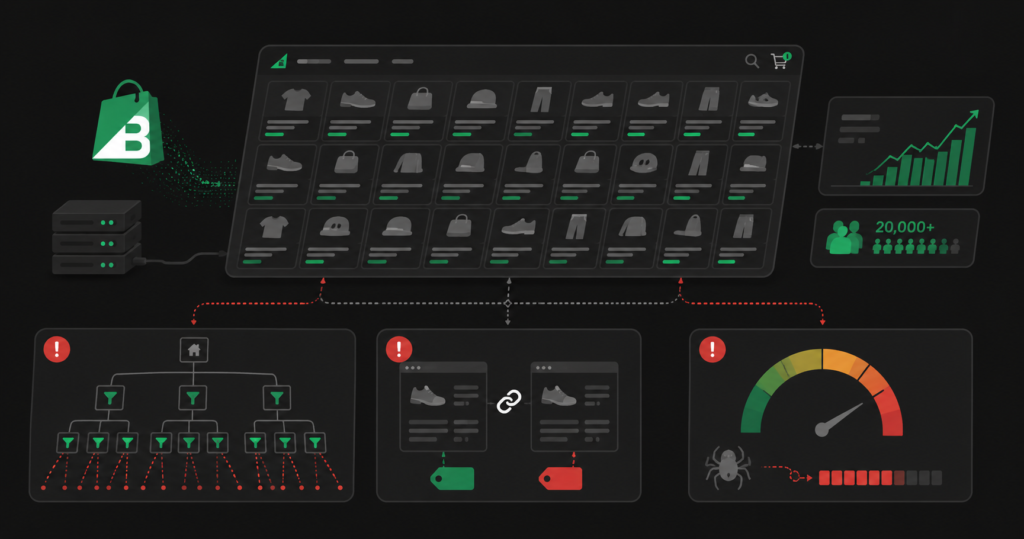
BigCommerce is a capable platform. But it makes specific architectural decisions that create specific SEO problems — especially for stores with large catalogues, many product variants, or complex filter structures. Generic SEO advice does not account for any of this.
Filter Pages and Canonical Conflicts
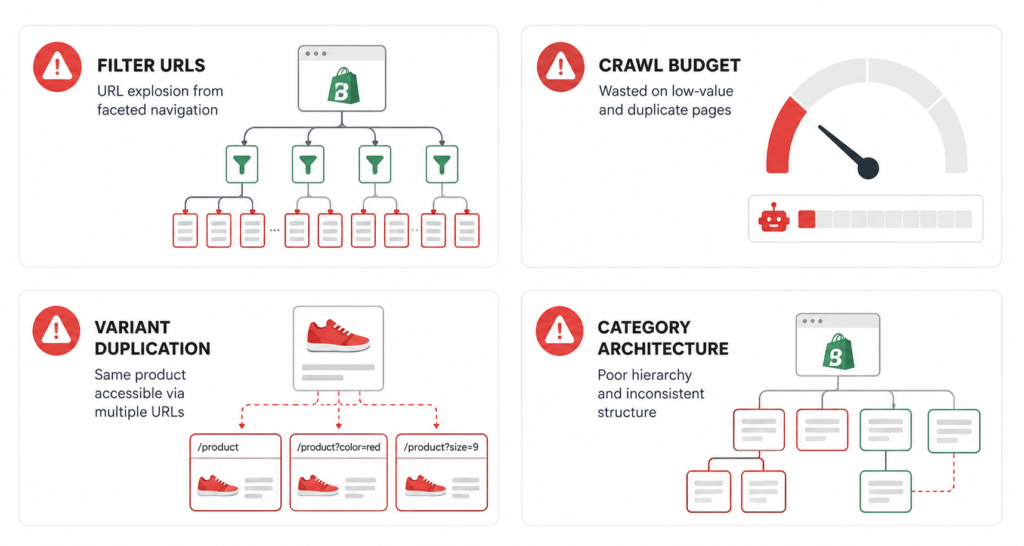
BigCommerce generates URLs for every filter combination a user applies. On a catalogue with 20,000+ products, that can mean thousands of additional URLs — many of which Google will attempt to crawl. Without a proper canonical strategy, these pages consume crawl budget, create duplicate content issues, and can suppress rankings on the category pages that actually matter.
We have seen stores where filter-generated URLs were accidentally indexable, canonical tags pointed to the wrong pages, and Google was spending the majority of its crawl budget on zero-value filter combinations.
See our detailed breakdown of BigCommerce filter page problems →
Crawl Budget at Scale
A store with 500 products has a different crawl budget problem than a store with 20,000. BigCommerce’s default URL structure — combined with variant pages, filter URLs, and brand and collection combinations — can produce a catalogue that is many times larger than the actual product count. Google sees this and starts making decisions about which pages are worth indexing. Often, those decisions do not favour your core category pages.
Product Variant Duplication
BigCommerce handles product variants differently from Shopify. Depending on the theme and configuration, variants can generate separate URLs, appear in search results independently, and compete with the parent product page. Left unaddressed, this fragments ranking signals and reduces the authority of any single page.
Category Architecture and Internal Linking
How categories, subcategories, and brand pages are structured in BigCommerce has a direct impact on how Google distributes authority across the catalogue. Flat structures, orphaned brand pages, and inconsistent internal linking are common — and consistently underestimated as ranking factors.
What We Do
We cover the full scope of BigCommerce SEO — from the technical foundation through to keyword strategy, on-page implementation, and link building. Everything is specific to how BigCommerce works, not adapted from a generic ecommerce playbook.
| Audit Technical SEO Audit Full crawl of your BigCommerce store. Every canonical conflict, redirect chain, crawl budget issue, and indexation problem — documented, prioritised, and fed into a fix list. | Filter Filter and Faceted Navigation Canonical strategy for filter-generated URLs. Crawl budget controls. Preventing Google from indexing thousands of zero-value filter combinations while keeping high-demand filter pages accessible. | Arch Catalogue Architecture Category structure, brand page setup, internal linking patterns, and breadcrumb schema — built to move authority to the pages that matter most. |
| Key Keyword Research Geo-targeted semantic core for your market. Clustered by product category and mapped to specific pages — not just a list of keywords in a spreadsheet. | OnPage On-Page Optimisation Title tags, meta descriptions, H1-H3 structure, product and category page copy, image alt text — implemented across the full catalogue with BigCommerce’s native tools and custom dev where needed. | Link Link Building High-quality backlinks based on competitor analysis and a custom anchor plan. No PBNs. No spam. Links that build authority over time. |
| BLOK: CASE STUDY . OfficeGear block. Kept verbatim — metrics and description. Link to full case study. |
| Dev: Grey bg card. 3 metrics in a row. Description kept exactly from original. Link to case study. |
What BigCommerce SEO Looks Like in Practice
| OfficeGear — Office Supplies Retailer, South Africa BigCommerce store with 20,000+ SKUs. Canonical conflicts, redirect chains, zero structured data, and a mobile PageSpeed score of 44/100. We ran a full technical audit, built a geo-targeted keyword strategy, cleaned up 312 toxic backlinks, and implemented everything in parallel with our development team. +67% Organic Sessions 6 months 140+ Tech Issues Fixed Critical and high 44→71 Mobile PageSpeed Lighthouse score Read the full case study → |
What You Get
Every BigCommerce SEO engagement at MarTraff starts with a full audit and produces a clear set of deliverables — not a vague “strategy document”.
| Technical SEO Audit | Full crawl report with every issue documented, categorised by severity, and tied to a specific fix. Canonical strategy, crawl budget analysis, PageSpeed benchmarks. |
| Competitor Analysis | Backlink profiles, keyword gaps, and category architecture benchmarks against your top 3-5 organic competitors. |
| Semantic Core | Geo-targeted keyword research for your priority categories. Clustered, intent-classified, and mapped to specific pages. |
| On-Page Implementation | Title tags, meta descriptions, H-tag structure, schema markup — applied across your full catalogue with documentation. |
| Filter Page Strategy | Canonical and robots configuration for filter-generated URLs. Prevents crawl budget waste and duplicate content issues. |
| Backlink Audit and Cleanup | Toxic link identification and disavowal. Anchor text distribution analysis. Outreach strategy for link building. |
| Monthly Reporting | Ranking movement, organic traffic, conversions, technical health updates, and next month plan — in one clear report. |
| Dev Implementation | Our development team implements every SEO recommendation directly. No handoff delays, no translation loss. |
Frequently Asked Questions
| Question | Answer |
| Do you work with BigCommerce stores only? | No. We work with BigCommerce, Shopify, WooCommerce, and custom-built ecommerce stores. BigCommerce SEO is a dedicated service because it has distinct technical requirements — but our methodology applies across platforms. |
| How long before we see results? | First measurable changes — crawl improvements, indexation corrections, early ranking movements — typically appear within 8-12 weeks of implementation. Organic traffic growth compounds over 3-6 months as more of the work takes effect. |
| Do you handle the development side too? | Yes. Our development team implements SEO recommendations directly. We do not produce a report and hand it off to your dev team — we execute. This eliminates the delay and quality loss that happens in most SEO and dev handoffs. |
| What is the minimum catalogue size you work with? | We work with stores of all sizes, but BigCommerce-specific SEO — particularly filter management and crawl budget optimisation — becomes critical from around 500-1,000 SKUs upward. Below that threshold, standard ecommerce SEO approaches are usually sufficient. |
| We already have an SEO agency. Can you audit what they have done? | Yes. We offer standalone audits as a separate engagement. If you want an independent review of your current SEO setup — what has been done correctly, what has been missed, and what should be prioritised — we can provide that. |
| Do you work with BigCommerce stores outside South Africa? | Yes. We work with BigCommerce stores globally. The OfficeGear case was South Africa-based, but our technical and keyword methodology applies to any market. |
| BLOK: CTA . Dark bg #1A1A1A, white text, green button. FIXED: /contact/ not Telegram. |
| Dev: bg #1A1A1A. Centered. Button -> /contact/ — NOT Telegram link. |
Work With MarTraff
| If your BigCommerce store has been live for more than a year and organic search is not contributing meaningfully to revenue — there is almost certainly a fixable reason. We will audit your store, tell you what is holding it back, and give you a clear picture of what is realistic — before you commit to anything. Get a Free BigCommerce SEO Review → No commitment. No generic report. |