How Long Does Ecommerce SEO Take? An Honest Timeline
This is the question every store owner asks before signing an SEO contract, and the one most agencies answer with a shrug and a vague “it depends.” It does depend — but not on nothing. It depends on specific, knowable factors, and the ranges are far more predictable than the industry’s evasiveness suggests.
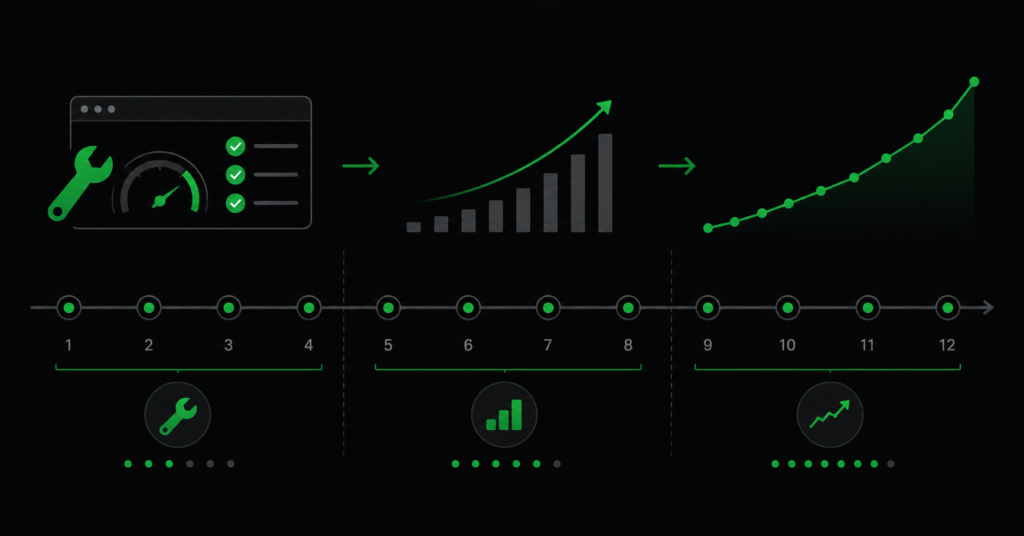
The honest answer: first measurable signals within 8 to 12 weeks. Meaningful ranking movement on target keywords between months three and six. Compounding organic revenue growth from month six onward, accelerating rather than plateauing.
That is not a promise — nobody can promise rankings, and any agency that does is either lying or gambling with your money. It is a realistic expectation based on how Google’s crawl, index, and ranking systems actually work, and on what implementation at each stage produces.
Why SEO Cannot Be Fast (and Why That Is Fine)
Three mechanical realities set the floor on how quickly SEO can work. None of them are agency excuses — they are properties of the system.
| Reality | What it means for the timeline |
| Crawl and index cycles | Google has to revisit a page to see your changes. For a mid-sized store, that is days to weeks per page — and it re-evaluates rankings only after recrawling. |
| Ranking systems are lagging | Google needs evidence a page deserves its position: click behaviour, dwell signals, links, freshness. Evidence accumulates over weeks, not hours. |
| Authority compounds | Backlinks and topical authority build slowly. Each new signal adds to a base — which is why month 12 produces far more than month 3 from the same monthly effort. |
| “SEO is not a sprint — it is a compounding investment. Each improvement builds on the last. The businesses that commit to the process consistently outperform those that treat SEO as a one-time fix.” |
The Realistic Timeline, Stage by Stage
Here is what actually happens, and when. These stages assume implementation begins promptly — a store where fixes sit in a developer backlog for two months will see everything shift right accordingly.
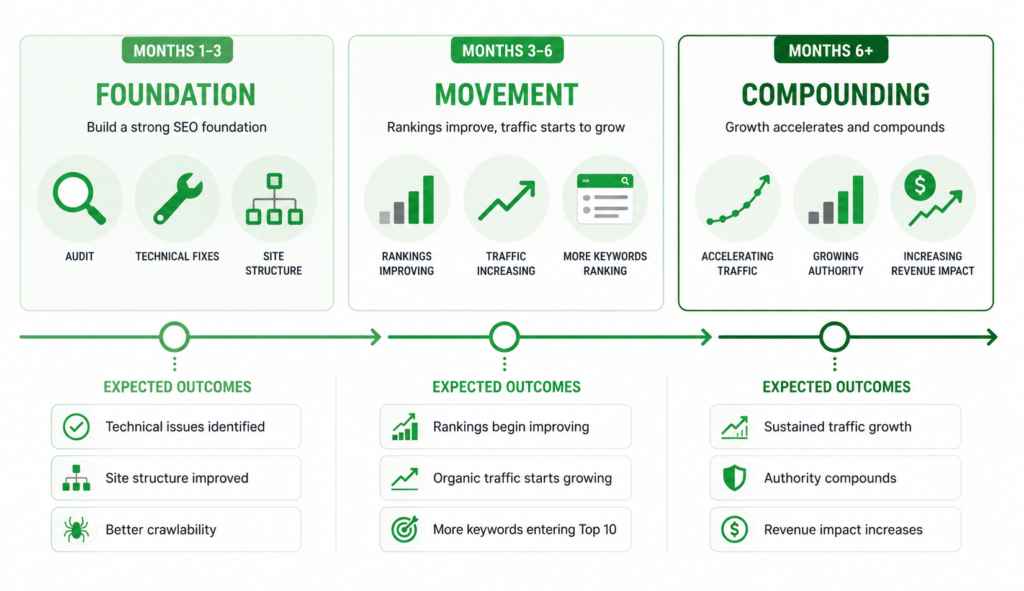
Months 1–3: Foundation (you will not see traffic yet)
The first phase is diagnosis and repair. Nothing here produces a traffic spike, and expecting one is the fastest route to abandoning SEO before it works.
What happens: a full SEO audit establishes what is actually broken — crawl errors, duplicate content, page speed, indexation gaps. Competitor analysis maps who outranks you and why. Keyword research produces the semantic core the entire strategy is built on. Then technical SEO fixes begin landing.
What you can expect by month 3:
- Resolved technical errors that were previously holding the site back
- Cleaner, faster pages that load better on mobile and desktop
- A prioritised keyword strategy with clear direction for content and categories
- Improved crawl coverage — Google finding and indexing pages it was previously missing
- Early keyword ranking movements, typically first visible in Search Console around weeks 8–12
| What you will not see: a revenue increase. Almost nothing in months 1–3 produces immediate sales. What it produces is a site that can actually rank — which is the precondition for everything that follows. Judging SEO by month-3 revenue is like judging a building by how it looks when the foundation is poured. |
Months 3–6: Movement (rankings and traffic begin responding)
This is where the work from phase one starts showing up in the data. Pages that were fixed get recrawled and reassessed. Content targeting your priority keywords goes live and begins accumulating signals. The first links land and start passing authority.
What you can expect by month 6:
- Keyword rankings appearing and improving for targeted product categories
- Increased organic traffic to priority product and category pages
- Stronger internal linking structure supporting site authority
- A clean backlink profile, with toxic links disavowed where necessary
- First meaningful organic conversions attributable to newly ranking pages
Rankings in this phase are volatile — a keyword moves from position 34 to 19 to 26 to 14. That is normal. Google is testing your page against alternatives. The trend line matters; individual weeks do not.
Months 6+: Compounding (this is where the return arrives)
The distinguishing feature of SEO as a channel is that month 12 costs the same as month 3 and produces substantially more. Nothing about paid advertising works this way.
What you can expect from month 6 onward:
- Compounding organic traffic growth as more categories are optimised
- Established domain authority in your product category and market
- Reduced reliance on paid advertising for category-level visibility
- A scalable SEO framework that grows alongside the business
- Organic revenue that continues arriving whether or not you spend more this month
| “The reason SEO looks expensive at month three and cheap at month eighteen is that the traffic keeps arriving after you stop paying for that month’s work. Every optimised page, every earned link, every ranking position keeps producing. This is the entire business case — and it only exists if you get past month six.” |
What Actually Changes Your Timeline
“It depends” is only useless if nobody tells you what it depends on. Here is what genuinely moves the dates.
| Factor | Direction | Why |
| Existing domain authority | Faster if strong | An established store with existing backlinks ranks new pages far quicker than a new domain with none. |
| Competition in your category | Slower if high | Ranking for “office chairs” against national retailers takes years. Ranking for “ergonomic chairs Cape Town” can take months. |
| Technical debt at the start | Slower if severe | A store with thousands of indexed filter URLs and a 4-second LCP spends months on repairs before optimisation begins. |
| Speed of implementation | Faster if quick | The single biggest variable within your control. Recommendations sitting in a dev backlog produce zero results. |
| Content production capacity | Faster if consistent | Rankings need pages. A store publishing one strong page a month outpaces one publishing none. |
| Existing penalties or toxic links | Slower if present | Cleanup has to happen before growth. Disavow and recovery add months. |
Note which one is entirely in your hands. Speed of implementation is the variable that most often separates a store seeing results at month five from one seeing them at month nine — and it has nothing to do with the agency.
Why Link Building Runs on Its Own Clock
Link building is the slowest component and worth understanding separately, because it is where impatience does the most damage.
A newly earned link has to be crawled before it counts. Its effect on the target page’s authority accumulates over weeks as Google reassesses. Realistically, a steady link building effort produces visible ranking movement on competitive commercial pages in three to six months — and compounds from there.
| This is exactly where stores get sold shortcuts. Anyone promising hundreds of links in weeks is selling the kind of links that get sites penalised. The slowness is not a failure of the method — it is the method. A handful of relevant, authoritative links a month, built steadily, outperforms a thousand toxic ones and does not put the domain at risk. |
How to Tell It Is Working Before the Revenue Arrives
The hardest part of months 1–4 is that the leading indicators are invisible unless you know where to look. These are the signals that tell you the work is landing, months before organic revenue confirms it.
| Leading indicator | Appears around | Where to check |
| Crawl coverage improving — more pages indexed | Weeks 4–8 | Search Console → Indexing → Pages |
| Impressions rising before clicks do | Weeks 6–12 | Search Console → Performance |
| Average position improving on target queries | Weeks 8–14 | Search Console → Performance → Queries |
| Core Web Vitals moving from Poor to Good | Weeks 4–10 | Search Console → Core Web Vitals |
| Referring domains increasing | Months 2–6 | Ahrefs / Semrush / Search Console Links |
| Organic clicks and conversions rising | Months 4–8 | Search Console + GA4 |
Impressions rising while clicks stay flat is the single most encouraging early signal — it means Google has started showing your pages for more searches, and the click-through will follow once positions improve. Our guide to reading Google Search Console covers how to read each of these reports.
When to Actually Worry
Patience is not the same as passivity. There are points where a lack of movement is genuinely a problem, not a normal part of the curve.
- Month 3, no change in crawl coverage or indexed pages. Technical fixes should show here. If Search Console looks identical to month zero, either the fixes were not implemented or they were the wrong fixes.
- Month 4, impressions completely flat on target keywords. Impressions are the earliest ranking signal. Zero movement suggests the keyword targeting is wrong or the pages are not competitive.
- Month 6, no ranking movement whatsoever. Some volatility is normal, total stillness is not. Ask what has actually been implemented versus recommended.
- Any month, an agency reporting on metrics that are not tied to business outcomes. Impressions and rankings are leading indicators, not the goal. If nobody is measuring organic revenue by month six, the strategy is not aimed at revenue.
| The reasonable checkpoint: at month six, you should be able to point to specific keywords that have improved, specific pages receiving organic traffic they did not receive before, and a credible line connecting them to revenue. If none of that exists, something has gone wrong that patience will not fix. |
FAQ
Can SEO ever produce results faster than 8 weeks?
Occasionally, in specific circumstances. A store with strong existing authority that fixes a single blocking technical issue — an accidental noindex tag, a robots.txt disallow on the whole site — can see recovery within days. Low-competition long-tail keywords on an established domain can rank in weeks. But those are recoveries and easy wins, not the growth curve. For a genuine improvement in competitive commercial rankings, 8 to 12 weeks to first signals is the honest floor.
Why do some agencies promise results in 30 days?
Either they are counting something that is not a business result — an impressions bump, a Core Web Vitals score, a handful of long-tail rankings nobody searches for — or they are using tactics that produce fast movement followed by penalties. Google’s systems do not move faster for anyone. An agency that promises what the mechanics of search do not allow is describing something other than sustainable SEO.
If I stop SEO after 6 months, do I lose everything?
No — but you stop compounding. The technical fixes remain fixed. The pages you optimised stay optimised and keep ranking. The links you earned keep passing authority. What stops is the accumulation: no new content, no new links, no response as competitors improve. Rankings typically hold for a period and then erode gradually as the market moves. The work you paid for does not evaporate; it stops growing.
How long until SEO is cheaper than paid ads?
It depends on your paid cost per acquisition and your category competitiveness, but the crossover for most ecommerce stores sits somewhere between months 9 and 18. Before that point, paid delivers traffic faster per pound. After it, organic traffic arrives without a per-click cost and continues arriving. The stores that benefit most run both — paid for immediate volume, SEO for the compounding base underneath it.
| Want a realistic timeline for your specific store? An audit tells you what technical debt exists, how competitive your category is, and how long the work realistically takes — before you commit to anything ongoing. Get an SEO Audit → No commitment. No generic report. martraff.com |