
How to Do a Competitor SEO Analysis — Step by Step
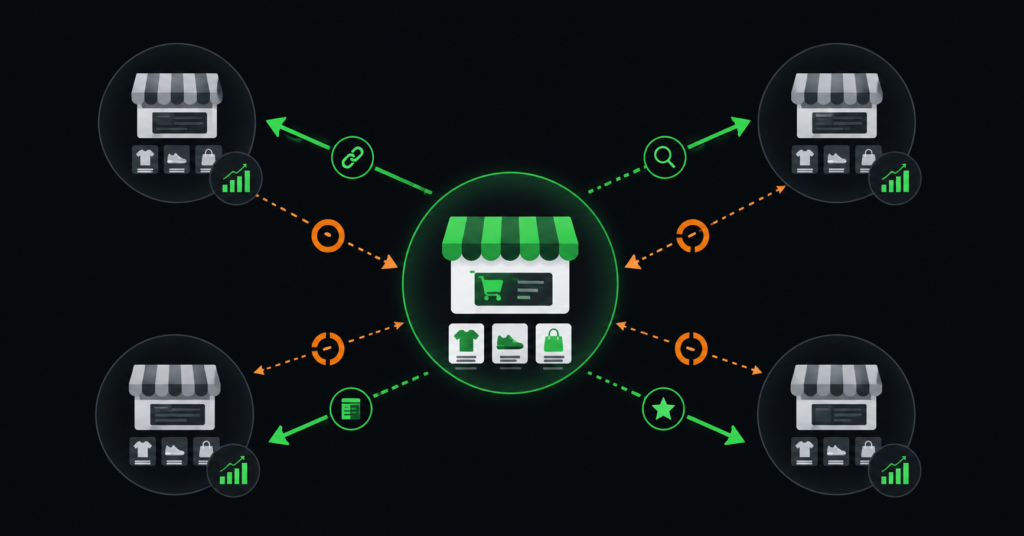
If a competitor consistently outranks you for the searches that matter to your business, there is a reason. It is not luck, and it is rarely just age of domain. It is usually a combination of things you can identify, measure, and close the gap on — if you know where to look.
A competitor SEO analysis is exactly that: a structured look at why specific competitors rank above you, what they are doing that you are not, and where the gaps exist that you can realistically exploit. It is not about copying what they do — it is about understanding the competitive landscape well enough to make better decisions about where to invest your SEO effort.
This guide walks through a six-step process using mostly free tools. You do not need an agency or a £400/month tool subscription to do this. You need about three to four hours and a spreadsheet.
Before You Start: Your SEO Competitors Are Not Always Who You Think
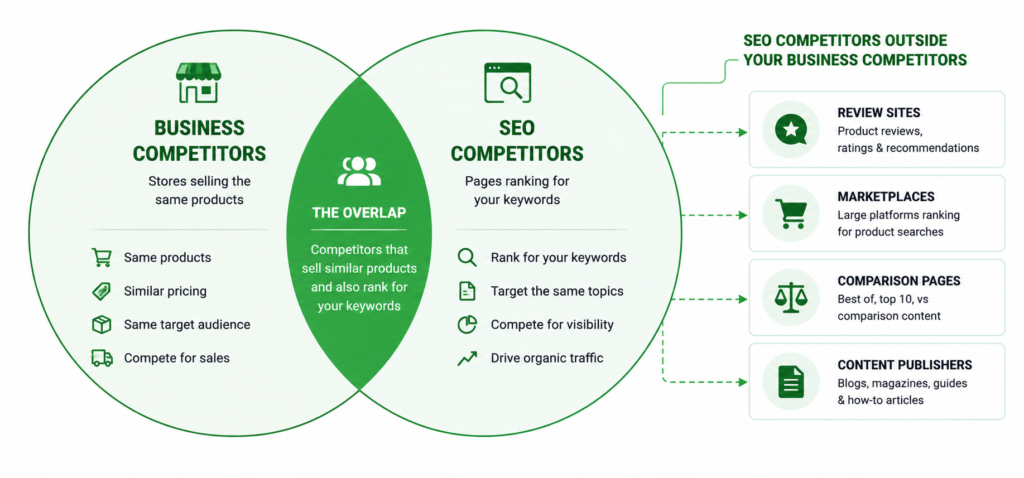
The first question in a competitor analysis is which competitors to analyse. The instinct is to pick your direct business competitors — the stores selling the same products to the same customers. This is usually right, but not always.
Your SEO competitors are the pages that rank above you for your target keywords. Sometimes these are the same as your business competitors. Sometimes they are review sites, content publishers, marketplaces, or comparison pages — none of which sell what you sell, but all of which occupy positions you want.
| How to find your actual SEO competitors: Search Google for your 5 most important product or category keywords. Look at who is on page one. Note which URLs appear most consistently across your different searches. These are your real SEO competitors for this analysis — not necessarily the business you think of as your main competitor. |
Pick three to five competitors that appear repeatedly. More than five makes the analysis unwieldy. Fewer than three does not give you enough to identify patterns.
The Six-Step Process
Work through these in order. Each step builds on the previous one.
| 01 | Find their top-performing pagesWhich pages drive the most organic traffic for each competitor? These are the pages you need to understand. |
| 02 | Identify the keywords they rank for that you do notThe keyword gap — where they are visible and you are invisible. |
| 03 | Analyse their on-page structureHow do they structure content on the pages that rank? What can you learn from their H-tags, content length, and internal linking? |
| 04 | Review their backlink profileHow many backlinks do they have, from what types of sites, and what gaps exist in your own profile? |
| 05 | Check their technical SEO baselineSite speed, Core Web Vitals, mobile usability — are they winning on fundamentals you are failing on? |
| 06 | Build your action listWhat three to five changes would close the most significant gaps? |
Step 1 — Find Their Top-Performing Pages
Start with Ahrefs Webmaster Tools or Semrush (both have free tiers) — enter a competitor’s domain and look at their top pages by estimated organic traffic. You are looking for two things:
- Which category and product pages drive most of their organic traffic? These are the commercial pages you need to compare directly to yours.
- Which blog or informational pages rank well? These reveal what informational keywords they are targeting — and whether they are using content to feed authority to their commercial pages.
If you do not have access to paid tools, use Google Search Console for your own site and compare manually. Search [site:competitor.com] on Google to see which of their pages Google shows first — a rough proxy for their highest-authority content.
Note down the top five to ten pages for each competitor. You will refer back to these throughout the analysis.
Step 2 — Find the Keyword Gap
The keyword gap is the most actionable output of a competitor analysis: keywords your competitors rank for that you do not, where there is a realistic opportunity to close the gap.
Free approach: take each competitor’s top pages (from Step 1), open them, and look at what keywords they appear to be targeting based on their H1, page title, and content. Then search those keywords on Google and check where your store appears. If you are not on page one — or not at all — you have identified a gap.
Tool approach: Ahrefs, Semrush, or Ubersuggest all have a “keyword gap” feature where you enter your domain and up to four competitor domains and it shows which keywords competitors rank for that you do not. Export this list and filter for:
- Keywords where at least two competitors rank in the top 10 — these have proven demand and demonstrated rankability
- Keywords with commercial or transactional intent — category-level and product-level searches, not just informational
- Keywords where your site has some presence but outside the top 10 — these are closer to reach than keywords where you have zero presence
Keyword research produces a clustered, intent-classified map of these gaps — but for the purpose of this analysis, even a manually identified list of 10-20 gap keywords is enough to direct your next content or on-page efforts.
Step 3 — Analyse Their On-Page Structure
Take the top 3-5 ranking pages from each competitor and analyse their on-page structure systematically. You are looking for patterns that distinguish their pages from yours.
| What to check | What you are looking for |
| Title tag | Does it contain the target keyword near the start? Is it specific or generic? |
| H1 heading | Does it match the search intent for the target query? Is it descriptive or vague? |
| Content length | How much written content is on the page — above the product grid, below it, in an FAQ? Compare to your equivalent page. |
| H2/H3 structure | Do they use subheadings to cover related keyword variations? What questions do their headings answer? |
| Internal links | Which pages do they link to from this page? Are they linking to subcategories, related products, or blog content? |
| Images | How many product images do they show? Do images have descriptive file names and alt text? |
| FAQ section | Do they include a FAQ below the main content? What questions do they answer? |
The most common finding: competitors ranking above you have 200-400 words of unique written content on their category pages, a clear buying guide section, and an FAQ. Your equivalent page has a product grid and nothing else. This is a fixable gap that does not require backlinks — just content.
Step 4 — Review Their Backlink Profile
Backlinks remain one of the strongest ranking signals. A competitor with significantly more referring domains from relevant, authoritative sources will generally outrank a site with better on-page SEO but weaker links — in competitive categories.
What to check:
- Total referring domains: How many unique domains link to the competitor? Compare to your own site. A gap of 50-100 referring domains is meaningful; a gap of 500+ tells you that link building needs to be a significant part of your strategy.
- Link quality: Are their links from relevant industry sites, local press, directories, and genuine editorial coverage? Or are they from low-quality link farms and spam sites? Quality matters more than quantity.
- Which pages get the most backlinks: Usually the homepage and a few top category pages. Backlinks concentrated heavily on the homepage and spread thinly to product pages is a common pattern — identifying which product or category pages they have earned links to gives you a link building target list.
- Link types you could replicate: Industry directories they appear in that you do not. Trade associations. Local business press. Suppliers who have linked to them. These are realistic targets.
| “Do not benchmark purely against the most linked competitor in your category — their backlink profile may have taken five years to build. Benchmark against the competitor one or two positions above you. That gap is closable. The gap between you and the market leader is useful context but not your starting target.” |
Step 5 — Check Their Technical SEO Baseline
Technical SEO is a tiebreaker — two stores with comparable content and backlinks, the faster one with cleaner structure wins. Check the following for each competitor:
- PageSpeed Insights score: Run their homepage and a key category page through PageSpeed Insights (free). If their mobile score is 85+ and yours is 45, that is a meaningful technical gap. See our guide on Core Web Vitals for ecommerce for what these scores mean.
- Mobile usability: Open their site on a phone. Is the layout clean and easy to navigate? Are tap targets big enough? Do images fit the screen without horizontal scrolling?
- Site structure: How many clicks does it take to reach a product page from their homepage? Three or fewer is good. More than four suggests structural issues that might also be creating crawl budget problems.
- HTTPS: Are they on HTTPS? Almost certainly yes in 2026 — but check anyway. A non-secure site is a technical disadvantage.
You are not looking to exactly replicate their technical SEO setup — you are looking for cases where they have solved problems you have not. A 90/100 PageSpeed score on their category pages vs 52/100 on yours is a concrete, actionable finding.
Step 6 — Build Your Action List
A competitor analysis that does not end in a prioritised action list is just an interesting document. The output should be 3-7 specific actions ranked by expected impact and effort.
| Finding | Source | Impact | Action |
| Top 3 competitors have 300+ words on category pages, we have none | Step 3 | High | Write category page content for top 5 category pages |
| Competitors rank for 40+ keywords we do not appear for at all | Step 2 | High | Add 3 new content pages targeting the highest-volume gaps |
| Two competitors have 3x our referring domains | Step 4 | Medium | Start link outreach to industry directories they appear in |
| Competitor mobile PageSpeed 88 vs our 54 | Step 5 | Medium | Fix largest image files and defer non-critical scripts |
| Top competitor has FAQ on every category page, we have none | Step 3 | Low-Med | Add FAQ sections to 3 highest-traffic category pages |
| IMAGE 3: Competitor Analysis Output TemplateAI Prompt: Flat mockup of a simple competitor gap analysis spreadsheet — four columns: Finding, Competitor (which one), Impact (High/Medium/Low with colour coding), Action. Five example rows visible. Clean spreadsheet style, white background, green accent on High impact rows.Size: 900x460pxPlacement: Inline after the action list table.Alt text: Competitor SEO analysis action list template with findings, impact rating, and recommended actions |
Tools Summary: Free vs Paid
| Tool | Cost | What it covers in this analysis |
| Google Search (manual) | Free | Step 1: who is on page 1 for your target queries. Step 3: manual on-page review of competitor pages. |
| Google PageSpeed Insights | Free | Step 5: competitor page speed and Core Web Vitals scores. |
| Ahrefs Webmaster Tools | Free (your site only) | Your own keyword rankings and backlink profile — useful as a baseline for comparison. |
| Ubersuggest (free tier) | Free (limited) | Steps 1 and 2: basic competitor top pages and keyword gap with usage limits. |
| Ahrefs / Semrush (paid) | Paid | Steps 1-4 in full: top pages, keyword gap, backlink profiles, and content analysis at scale. |
| Screaming Frog (free up to 500 URLs) | Free | Step 5: crawl competitor site structure, check internal linking depth and URL patterns. |
FAQ
How often should I do a competitor SEO analysis?
A full six-step analysis once or twice a year is usually sufficient. Between full analyses, a lighter monthly check — search your main keywords, see who is ranking where, note any changes — takes 30 minutes and keeps you aware of major shifts. Set a calendar reminder. Competitor SEO landscapes change slowly enough that monthly checks are early warning, not urgent response.
What if my competitor is a large marketplace like Amazon or eBay?
You are unlikely to outrank a major marketplace for generic product queries — they have enormous domain authority and thousands of internal links. The strategy is to find the specific queries where specialists outrank generalists: detailed product comparisons, niche category pages, location-specific searches, and long-tail product queries. These are the positions where a focused independent store can and does outrank Amazon. Your competitor analysis should focus on stores at a similar scale to yours, not on platforms that operate at a fundamentally different level.
I found a big gap — my competitor has 500 backlinks to my 80. Where do I start?
Start with the links you can actually earn, not with the number. Look at the types of sites linking to them: industry directories, supplier pages, local press, trade associations, niche review sites. These are categories of links you can pursue independently of budget. Link building takes time, and a gap of 420 referring domains will not close in a month — but identifying 10-15 realistic link targets from the competitor analysis gives you a starting plan.
Can I do this analysis without any paid tools?
Yes, for the most part. Steps 1 (manual Google search), 3 (manual on-page review), and 5 (PageSpeed Insights) require no paid tools at all. Step 2 is significantly faster with a keyword gap tool but can be done manually by searching your target queries and noting which competitor pages appear. Step 4 is the hardest to do for free — backlink data requires a tool. Ahrefs Webmaster Tools gives you your own backlink data for free, which at least lets you establish your baseline.
| Want us to run a competitor analysis for your store? An SEO audit covers your competitive position — which competitors outrank you, why, and what specific actions would close the gap. Get an SEO Audit → No commitment. martraff.com |