
E-E-A-T for Ecommerce: How to Show Google Your Store Can Be Trusted

E-E-A-T — Experience, Expertise, Authoritativeness, Trustworthiness — is the framework Google uses to evaluate whether a site deserves visibility. It has existed in Google’s quality rater guidelines for years, but in 2026 it matters more than it ever has: community signals, authentic reviews, and third-party brand mentions now influence rankings more directly, and the same signals determine whether AI systems cite your store in their answers.
Most E-E-A-T advice is written for publishers and blogs — author bios, medical reviewers, editorial standards. Almost none of it translates directly to an online store. What does “experience” mean for a shop selling office chairs? Where does “expertise” live on a product page?
This guide answers that: what each letter of E-E-A-T means specifically for ecommerce, and what concrete pages, sections, and signals to build — no slogans, no vague “build trust” advice.
Why E-E-A-T Matters More for Ecommerce Than Most Store Owners Think
Ecommerce sites are automatically classified by Google as YMYL-adjacent — “Your Money or Your Life” pages. Any page that takes payment, stores personal data, or influences a purchasing decision is held to a higher trust standard than a page that just provides information. A blog post with thin trust signals loses some visibility. A checkout page with thin trust signals can be suppressed much more aggressively.
Two developments have raised the stakes further:
- Community and review signals gained ranking weight. Discussions on forums, authentic reviews, and unlinked brand mentions increasingly support rankings — Google is triangulating whether real people vouch for your store, not just whether your on-page SEO is correct.
- AI search uses the same signals. The systems behind AI Overviews, ChatGPT, and Perplexity weigh source credibility when choosing what to cite. A store with strong third-party trust signals is more likely to appear in AI-generated shopping answers. See our GEO guide for the full picture.
| “E-E-A-T is not a checklist you complete once. It is the accumulated evidence — on your site and across the web — that your store is run by real people who know their products and treat customers fairly. Google reads that evidence. So do AI systems. So do your customers.” |
The Four Signals, Translated for Ecommerce
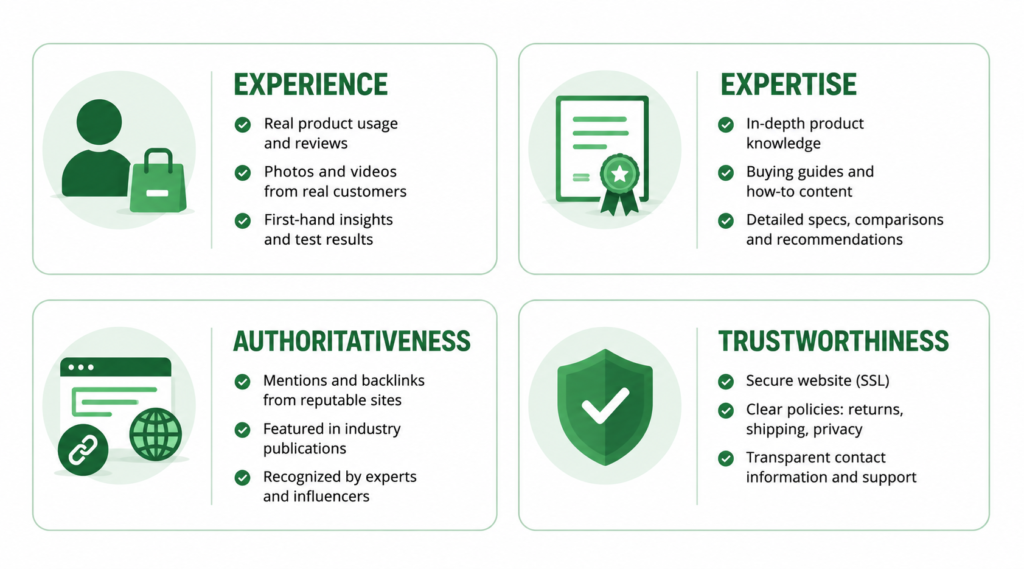
| Signal | What it means for a store | Where it lives |
| Experience | You have actually handled, tested, or used the products you sell — and your content shows it | Product descriptions, buying guides, photos, comparison content |
| Expertise | You know your product category deeply — materials, use cases, common problems | Category content, FAQ answers, guides, staff credentials |
| Authoritativeness | Third parties recognise you as a legitimate player in your niche | Backlinks, press mentions, reviews on external platforms, industry directories |
| Trustworthiness | Buying from you is safe: clear policies, real contact details, honest claims | About page, contact page, returns policy, HTTPS, accurate product data |
Experience: Prove You Have Touched the Products
Experience is the newest letter in the framework — added by Google in December 2022 — and it is the one ecommerce stores are best positioned to demonstrate. You physically handle your products. Most of your competitors’ content does not show it.
What to build
- Original product photography. Manufacturer press photos appear on every store selling the item. Your own photos — the product in hand, in use, from angles the press kit does not cover — are evidence of firsthand experience that duplicate-content stores cannot fake.
- Details only a person who handled the product would know. “The zip pull is small — awkward with gloves on” or “heavier than the spec sheet suggests, closer to a laptop than a tablet.” One sentence like this per product description signals more experience than three paragraphs of rewritten manufacturer copy.
- Comparison content from actual use. “We stocked both models for a year — here is what customers return and why” is content no publisher can write. It is unique to a store.
Expertise: Show Category Knowledge, Not Just Inventory
Expertise for a store means demonstrating that you understand the product category — not just that you list items in it. This is what separates a specialist store from a dropshipping catalogue, and Google’s systems are increasingly good at telling the difference.
What to build
- Buying guides that make real recommendations. Not “there are many factors to consider” — actual guidance: which option for which user, what to avoid, what is overpriced. Taking a position is what expertise looks like. See our content strategy service for how this maps to keywords.
- FAQ answers with substance. “What is the difference between 400GSM and 200GSM cotton?” answered specifically — with the practical consequence for the buyer — reads as expertise. A generic sentence does not.
- A visible team or founder. “Founded by a former physiotherapist” on an ergonomics store changes how every product claim on the site is weighted — by Google’s quality systems and by customers. If there is genuine expertise behind the store, put it on the About page with a name and a face.
| Do not fabricate credentials. Fake author bios, invented “experts,” and stock-photo team pages are detectable and increasingly penalised. If the store has no formal credentials, lean on Experience instead — documented firsthand product knowledge is legitimate expertise for a retailer. |
Authoritativeness: Signals You Cannot Write Yourself
Authority is the one letter you cannot build on your own website. It is what other sites, platforms, and communities say about you. For ecommerce, the highest-value authority signals are:
- Reviews on platforms you do not control. Google Business Profile, Trustpilot, category-specific review sites. Google cross-references these. A store with 4.6 stars across 300 external reviews carries authority no on-site testimonial block can match.
- Mentions in gift guides, roundups, and press. Even unlinked brand mentions contribute — Google’s systems associate your brand name with your category when third parties mention them together.
- Supplier and manufacturer listings. Being listed as an official stockist on a manufacturer’s “where to buy” page is a strong, relevant, and usually free authority link most stores never request.
- Community presence. Genuine participation where your customers gather — answering questions in niche forums or communities as the store, without spamming links. Community-driven signals increasingly influence outcomes, and this is where they come from.
Trustworthiness: The Boring Pages That Decide Everything
Trust is the foundation the other three letters stand on — Google’s guidelines describe it as the most important member of the family. For ecommerce it is mostly about unglamorous pages that many stores treat as an afterthought:
| Page / element | What Google (and buyers) check |
| Contact page | A real address, a working phone number or email, ideally a company registration number. “Contact form only” is a weak signal for a business taking payments. |
| About page | Who runs the store, why it exists, where it operates. Real names and photos beat mission-statement filler. |
| Returns & shipping policy | Findable, specific, honest. Vague or hidden policies are a classic low-trust marker in the quality rater guidelines. |
| Product data accuracy | Prices, availability, and specs that match reality. Schema data that contradicts the visible page is a trust failure, not a technical detail. |
| HTTPS + clean checkout | Table stakes. Mixed-content warnings or third-party redirects at checkout are trust killers. |
| Honest claims | No fake countdown timers, invented “only 2 left” scarcity, or fabricated review counts. These patterns are documented in Google’s guidance as deceptive. |
Most of this table is on-page work a store can complete in a week. It is the highest ratio of impact to effort anywhere in E-E-A-T.
A 30-Day E-E-A-T Plan for a Store
| Week | Actions |
| Week 1 | Fix the trust pages: contact details with address, About page with real people, findable returns policy. Verify schema matches visible data. |
| Week 2 | Add one experience detail to your 20 highest-traffic product descriptions. Replace manufacturer hero photos with original photography on top sellers. |
| Week 3 | Publish or upgrade one buying guide with real recommendations. Add substantive FAQ answers to top 5 category pages. |
| Week 4 | Request stockist listings from your 3 biggest suppliers. Set up or claim external review profiles and start systematically asking customers for reviews. |
| “None of this moves rankings in a week. E-E-A-T is cumulative — every review, every original photo, every honest policy page adds to a body of evidence Google keeps re-reading. Stores that start now compound; stores that wait keep losing tiebreakers to competitors who did.” |
FAQ
Is E-E-A-T a ranking factor?
Not a single, direct one. E-E-A-T is a framework from Google’s quality rater guidelines that describes what its ranking systems are designed to reward. There is no “E-E-A-T score” — but the individual signals it describes (review profiles, brand mentions, accurate data, trust pages) each feed systems that do affect rankings. Treating it as one number misses the point; treating it as a set of concrete signals is actionable.
Does E-E-A-T matter for small stores or only big brands?
It arguably matters more for small stores. A recognised brand carries implicit trust; an unknown store has to prove everything. The advantage: most small-store competitors have done none of this work, so a complete set of trust signals — real contact details, external reviews, original content — is a genuine differentiator rather than table stakes.
Can I improve E-E-A-T with AI-generated content?
AI can help draft, but E-E-A-T is specifically the part of SEO that AI cannot fake for you. Experience requires having handled products. Authority requires third parties vouching for you. AI-generated author personas and fabricated expertise are the exact pattern Google’s spam policies target. Use AI for structure and drafts; the evidence has to be real.
How long until E-E-A-T work shows results?
Trust-page fixes and schema accuracy can influence quality assessment within one or two crawl cycles — weeks. Review accumulation and brand mentions build over months. The realistic frame: measurable movement in three to six months, compounding after that. It is the slowest-acting part of SEO and the hardest for competitors to copy — which is precisely why it holds value.
| Not sure which trust signals your store is missing? An SEO audit covers your E-E-A-T signals alongside technical and content issues — what is missing, what is weak, and what to fix first. Get an SEO Audit → No commitment. martraff.com |