
How to Set Up SEO for a Recommerce or Resale Store
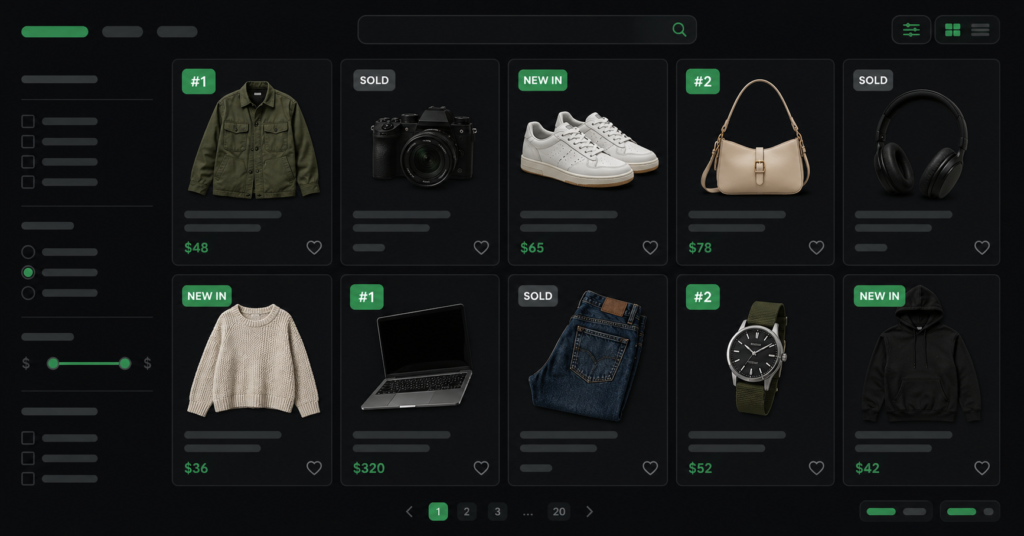
The recommerce market grew 14% in the US in 2024 alone — five times faster than traditional retail. In 2025, 93% of Americans bought something secondhand at least once. The global secondhand market passed $594 billion the same year.
If you run a resale store — whether you are selling vintage clothing, refurbished electronics, pre-owned furniture, or certified pre-owned anything — you are entering a market that is genuinely exploding. The SEO problem is that most guides treat resale stores like they are just slightly unusual ecommerce stores. They are not. They have a completely different set of technical and content challenges that standard SEO advice does not address.
This guide covers the recommerce-specific SEO problems and how to fix them — from constantly changing inventory to duplicate product data to building authority in a market that did not really exist as an SEO niche two years ago.
Why Recommerce Stores Have Unique SEO Problems
| 5x Faster growth than traditional retail ThredUp 2025 Resale Report | 93% Americans bought secondhand in 2025 OfferUp + GlobalData | 14.5% US recommerce CAGR 2024-2030 ResearchAndMarkets | $594B Global secondhand market 2025 Maximize Market Research |
Standard ecommerce SEO assumes a predictable catalogue: products that stay listed for weeks or months, consistent product descriptions, a stable URL structure. Recommerce breaks all of these assumptions:
- Inventory turns over fast — sometimes within hours. A product you listed yesterday might be gone today.
- Items are often one-of-a-kind. You cannot build consistent category pages the same way as a standard retailer.
- Product data often comes from third parties — manufacturer descriptions, scraper data, or user-submitted information — creating duplicate content at scale.
- Condition matters as much as the item itself, and condition data is unique to every listing.
- Search intent in the secondhand market is different: buyers are often searching for specific models, sizes, or eras that they cannot find new.
| “The recommerce SEO opportunity is significant precisely because most resale stores have done very little SEO work. The bar for ranking is lower than in most ecommerce categories — but only if you build the right technical foundation first.” |
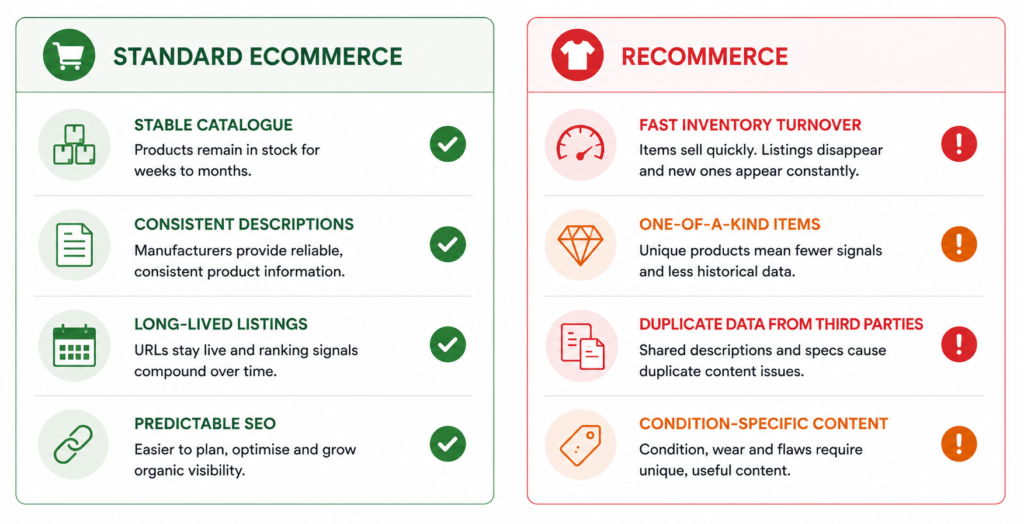
| IMAGE 2: Recommerce vs Standard Ecommerce SEO ChallengesAI Prompt: Clean split diagram. Left: “Standard ecommerce” — stable catalogue, consistent descriptions, long-lived listings (green checkmarks). Right: “Recommerce” — fast inventory turnover (red), one-of-a-kind items (orange), duplicate data from third parties (red), condition-specific content (orange). White background, green/red accents.Size: 900x460pxPlacement: Inline after the bullet list of challenges.Alt text: Recommerce SEO challenges compared to standard ecommerce: fast turnover, unique items, and duplicate data |
Challenge 1: Inventory That Disappears Overnight
The most immediate SEO problem in recommerce is what happens when an item sells. If the product page gets deleted, Google loses the URL — any ranking signals that page accumulated are gone. If the URL stays live but shows an empty or error page, Google may deindex it or treat it as thin content. Either way, you are constantly losing ground.
What to do instead
- Do not delete sold-out product pages — 301 redirect them to the most relevant category page or a similar items page. This preserves the link equity the page accumulated.
- For high-value items with significant backlinks or traffic history, keep the page live with a sold — see similar items message and links to related listings.
- Set up an automated redirect rule in your platform: when a listing expires or is marked sold, it redirects to a relevant category rather than 404ing.
Check your Google Search Console Coverage report monthly for 404 spikes — fast-moving inventory creates 404 chains if redirects are not configured correctly. See our guide on running an ecommerce SEO audit for how to catch these systematically.
Challenge 2: Duplicate Content at Scale
Resale stores that list hundreds or thousands of items face a systematic duplicate content problem. The same item — say, a Canon EOS R5 — may be listed ten times across ten different sellers or ten different intake batches. If the descriptions are identical or near-identical, Google will either pick one version to show or suppress all of them.
The source of the duplicate content is usually product data that comes from manufacturer databases, scraper tools, or copy-pasted descriptions. This is efficient for the store operator but catastrophic for SEO at scale.
How to differentiate listings for the same item
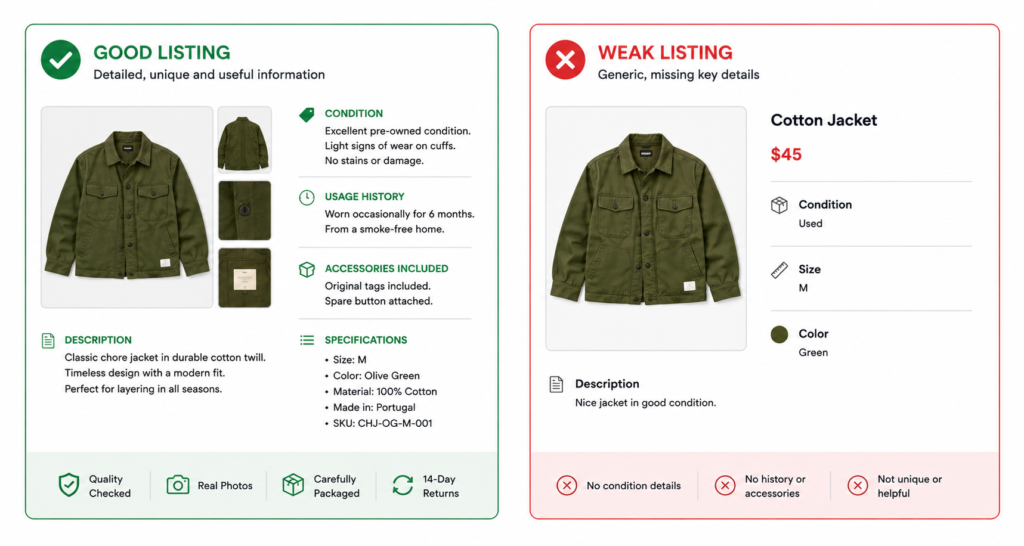
The condition and history of the item is the differentiator that is unique to recommerce. Use it. Every listing should include information that is specific to that individual item:
| ✓ GoodCanon EOS R5 — Near Mint. Purchased July 2024, used for approximately 12 months of light studio work. Sensor clicks: 4,200 (professionally checked). Original box, both batteries, charger included. Minor paint wear on grip. | ✗ WeakCanon EOS R5. Great condition. Includes accessories. Free shipping. Trusted seller. |
The good version is unique — no two listings of the same camera will have identical condition notes, shutter count, included accessories, and usage history. The weak version is indistinguishable from every other listing of the same camera across the internet.
Structured product data for condition
Use schema markup’s “ItemCondition” property to indicate the condition of each listed item. Google understands “NewCondition”, “UsedCondition”, “RefurbishedCondition”, and “DamagedCondition”. This gives Google richer data to distinguish your listings from new-product pages on other sites, and it can enable rich results that show condition directly in the search snippet.
Challenge 3: Category Pages With No Content
This is the same problem that affects all ecommerce stores but it is worse in recommerce, because category pages in a resale store often contain items from multiple brands, multiple eras, and wildly varying conditions. A category page titled “Used Laptops” might contain machines from 2019 and 2024, from Apple and Lenovo, at prices from £200 to £1,200. Google sees a page with a vague title, no descriptive text, and a product grid of apparently unrelated items.
How to write recommerce category content
The intro paragraph for a recommerce category page needs to do three things: define what the category covers, explain the condition range buyers can expect, and tell buyers what to look for when choosing. This is the buying guidance that replaces the category homogeneity that standard ecommerce relies on.
| ✓ GoodOur used laptop selection covers everything from budget Windows machines under £200 to professional-grade MacBooks and ThinkPads. All laptops are graded on our condition scale (Excellent / Good / Fair) and tested before listing. Most include a 90-day return window. Filter by brand, RAM, storage, or condition to find the right fit. | ✗ WeakUsed laptops for sale. We have a great range of second hand laptops at competitive prices. Browse below. |
The good version gives Google specific keywords naturally (budget Windows, MacBook, ThinkPad, condition scale, RAM, storage) and gives buyers the context they need. The weak version could describe any resale category on the internet.
Challenge 4: Keyword Strategy for Resale Search Intent
Buyers in the secondhand market search differently from buyers in the new-product market. Understanding this is the foundation of a recommerce keyword strategy.
The three recommerce search intent types
| Intent type | Example queries | What it means for content |
| Specific item search | used Canon EOS R5 for salebuy secondhand iPhone 14 Pro | Your product listing needs brand + model + condition in title and description |
| Category browse | second hand laptops under £300vintage denim jackets UK | Category pages with buying guidance and condition range |
| Informational pre-purchase | is it safe to buy refurbished electronicshow to check condition of used MacBook | Blog and FAQ content that builds trust and positions you as an authority |
The keyword research for a recommerce store needs to cover all three tiers. Most resale stores only optimise for the first — specific item searches — and leave the category browse and informational traffic entirely to competitors or to Vinted/Depop/eBay.
Challenge 5: Building Authority in a New Niche
Recommerce as a distinct search category is relatively new. Two years ago, most of the authoritative content about buying secondhand was on major marketplace platforms (eBay, Amazon, Vinted) or on general consumer advice sites. That is changing — and the window to build topical authority as a specialist recommerce store is still open.
What topical authority looks like for recommerce
- Buying guides for specific categories: “How to buy a used DSLR camera”, “What to look for when buying secondhand furniture online”, “Used vs refurbished — what is the difference?”
- Condition guides: “What does Grade A/B/C mean for refurbished electronics?”, “How our grading process works”
- Seller guides if you accept items: “How to value your secondhand clothes before selling”, “What items sell fastest in the secondhand market”
- FAQ pages addressing trust concerns: “Is it safe to buy from [your store]?”, “What is your returns policy on used items?”
This content targets informational search queries that capture buyers early in their journey — before they have decided which resale platform to use. It also builds the topical authority that helps your on-page SEO perform on commercial pages.
Technical Foundations for Recommerce
The technical SEO requirements for a recommerce store are the same as for any ecommerce store, but two issues are especially critical:
Crawl budget management
A recommerce store with thousands of listings — many of which sell and are replaced within days — creates a constantly changing URL landscape. Google allocates a crawl budget based on your domain authority. If a significant portion of that budget is spent crawling sold-out listings, 404 pages, or low-quality duplicates, your active listings are crawled less frequently and ranked less reliably.
- Submit an updated XML sitemap weekly or daily — only include currently active listings
- Set up automated 301 redirects for sold items rather than leaving pages to 404
- Monitor your crawl stats in Google Search Console — if average response time is high or crawl rate drops, investigate what Google is spending its budget on
Structured data for every listing
Every product listing should have Product schema including: name, description, condition (using the ItemCondition property), price, availability, and image. For certified pre-owned or graded items, include the condition rating in both the schema and the visible page content. This is one of the highest-impact technical SEO improvements a recommerce store can make — it distinguishes your listings from new-product pages and can enable rich results showing condition and price in the search snippet.
A Practical Checklist for Recommerce SEO
| ✓ | Sold listings: 301 redirect to category or “similar items” — never 404 |
| ✓ | Every listing has a unique description specific to that individual item — condition, history, included accessories |
| ✓ | Schema markup on every listing: Product schema with ItemCondition, price, availability |
| ✓ | Category pages have introductory content explaining condition range, brands covered, and what to look for |
| ✓ | Keyword strategy covers all three intent types: specific item, category browse, and informational |
| ✓ | XML sitemap updated regularly — active listings only |
| ✓ | GSC Coverage report monitored weekly for 404 spikes from sold-out inventory |
| ✓ | Informational content (buying guides, condition guides) published and internally linked to commercial pages |
| ✓ | NAP consistency across Google Business Profile, directories, and website (for stores with physical locations) |
FAQ
Does recommerce SEO work differently on Shopify vs WooCommerce?
The fundamentals are the same — but platform-specific technical issues affect both. On Shopify, the main concern is that sold-out products can disappear from the admin and leave dead URLs behind. On WooCommerce, filter pages for attributes like condition, brand, or size can create crawl budget problems at scale. Both platforms handle the sold-item redirect problem differently and both require active configuration — it does not happen automatically.
Should I keep sold listings live or redirect them?
For most listings, redirect. For listings that have accumulated backlinks or significant organic traffic, keep them live with a clear “sold — see similar” message and internal links to related active inventory. You can identify which listings have backlinks using Ahrefs or Semrush. For the rest, a systematic 301 redirect to the parent category is the right approach.
How do I compete with Vinted, Depop, and eBay in search?
You do not compete with them directly on their branded terms. You compete in the specific niches and query types that massive platforms address poorly: specialist categories (e.g. “used professional camera equipment”), condition-specific searches (“Grade A refurbished MacBook”), and informational queries (“how to check authenticity of vintage denim”). Major platforms have broad authority but shallow topical depth. A specialist recommerce store can rank above them on the queries that matter for their specific niche.
How long before recommerce SEO starts producing results?
The fastest improvements come from technical fixes — setting up redirects for sold items, cleaning up duplicate content, and implementing structured data. These can produce measurable crawl improvements within 4-8 weeks. Category page content and informational blog posts typically show ranking movement within 3-4 months, depending on competition. Building topical authority through consistent content publication is a 6-12 month project, but the compounding effect is significant in a niche that is still relatively underoptimised.
| Running a recommerce store and not sure where your SEO stands? A technical audit will tell you exactly what is holding your listings back — sold-item redirects, duplicate content, missing schema, and crawl budget issues. Get an Ecommerce SEO Audit → No commitment. martraff.com |