
Link Building for Ecommerce: What Actually Works
Link building is the part of SEO that ecommerce stores struggle with most — and it is not because backlinks are harder to earn for a store. It is because most link building advice was written for blogs and publishers, where the whole site is linkable content. A store is different: your money pages are product and category pages, and almost nobody links to a product page voluntarily.
That is the core problem, and most stores never name it. They read a generic “how to get backlinks” guide, try to pitch a guest post about their product, get ignored, and conclude that link building does not work for them. It does — but the methods that work for ecommerce are specific, and the ones everyone tries first are usually the ones that do not.
This guide covers what actually earns links for an online store, why the standard tactics fail on product pages, and how to build authority even when your catalogue is not inherently linkable — connected to the outcome that matters: rankings on the commercial pages that drive revenue.
The Core Problem: Nobody Links to a Product Page
Think about the last time you linked to a page from your own site or content. It was almost certainly a useful article, a data source, a tool, or a guide — not a product listing on a shop. This is the fundamental asymmetry of ecommerce link building: the pages you most want to rank (category and product pages) are the pages people are least likely to link to.
Publishers do not have this problem. Every article they publish is a potential link magnet. A store’s core inventory pages are commercial by nature, and commercial pages earn links rarely and reluctantly.
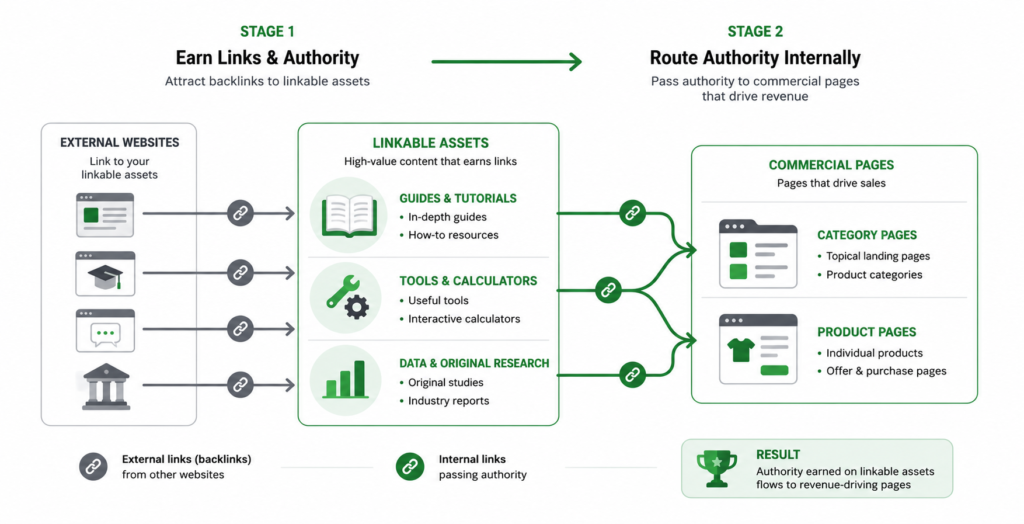
| “The solution to ecommerce link building is not to force links to product pages. It is to earn links to pages that deserve them — guides, tools, data, resources — and then channel that authority internally to the commercial pages that need it. Link building and internal linking are one system, not two.” |
This is why internal linking and link building have to be planned together. You earn authority where it is earnable, then route it to where it converts. A store that treats them separately leaves most of its link equity stranded on blog posts that never point to a commercial page.
What Actually Works for Ecommerce
These are the link building methods that reliably earn links for online stores — ordered roughly from lowest effort to highest, and all of them safe under current Google guidance.
1. Supplier and manufacturer links
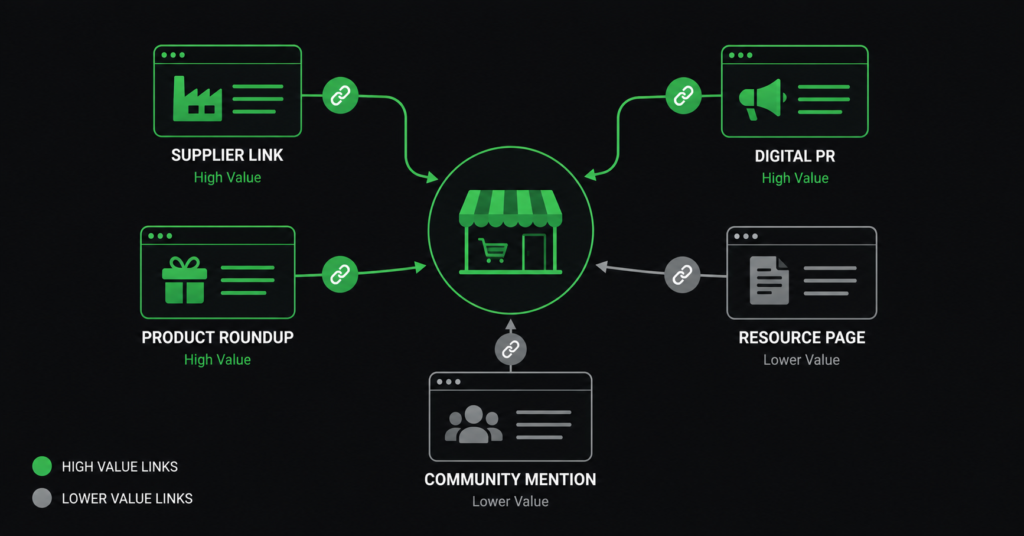
The fastest, most relevant, most underused links available to a store. If you sell products from established brands, many of those brands maintain a “where to buy” or “stockist” page listing authorised retailers. Being listed there is a relevant, authoritative link — and it is usually free, requiring nothing more than an email to your account manager.
Audit every brand you stock. Check whether they have a stockist page. If they do and you are not on it, request to be added. If they do not, ask whether they would list you. This is the highest ratio of link value to effort in ecommerce link building.
2. Digital PR and data-driven content
The most effective way to earn high-authority editorial links to a store is to publish something worth writing about. For ecommerce, that usually means data: a survey of your customers, an analysis of buying trends in your category, a price index, a “what sold out fastest this year” report. Journalists link to data. They do not link to product pages.
A garden furniture store publishing “The 2026 Outdoor Living Trends Report” based on its own sales data has something a journalist can cite. That earns links to the report — and the report links internally to the relevant category pages.
3. Linkable assets: guides, tools, and resources
A linkable asset is a page built specifically to earn links rather than to sell. For ecommerce, the best-performing types are practical tools and comprehensive guides: a size calculator, a material comparison tool, a “how to measure” guide, a maintenance guide, a genuinely useful buying guide that other sites reference.
These sit within your content strategy and do double duty: they attract informational traffic and they earn the links that, routed internally, lift your commercial pages. A tool is often more linkable than an article — “the best mattress size calculator” gets referenced repeatedly; a blog post rarely does.
4. Product roundups and gift guides
Publishers constantly produce “best X” roundups and seasonal gift guides. Getting your product included earns a relevant link and referral traffic. This is genuine outreach: identify roundups that rank for your category, contact the author, and make the case for inclusion — ideally offering something concrete (a sample, exclusive data, a discount code for their readers).
This works best when started months before peak season — gift guides are researched and drafted long before they publish.
5. Resource pages and industry directories
Many niches have resource pages, industry directories, trade association member lists, and “recommended suppliers” pages. These are relevant, stable links that most competitors never pursue. A competitor analysis will show you exactly which directories and resource pages link to competitors but not to you — that gap is your target list.
6. Community and unlinked brand mentions
Genuine participation in communities where your customers gather — niche forums, subreddits, category-specific groups — builds brand signals even when it does not produce a direct followed link. Google increasingly weighs whether real people discuss and recommend a brand. Separately, tools can find unlinked mentions of your brand across the web; reaching out to ask the author to add a link converts existing goodwill into a backlink.
What to Avoid — Especially After the Spam Updates
Google’s recent spam updates have specifically targeted manipulative and scaled link schemes. The methods below range from wasted effort to active risk.
| Avoid these: Buying links from link farms or “1,000 backlinks for $50” services. These are the exact pattern Google’s spam systems detect and penalise. Mass guest posting on unrelated, low-quality sites purely for the link. Post-spam-update, these carry risk and little reward. Private blog networks (PBNs). High risk, and increasingly detected.Exact-match anchor text at scale (“buy running shoes online” repeated across every link). An unnatural anchor profile is a manipulation signal. Reciprocal link schemes and link exchanges at scale. Occasional natural cross-links are fine; systematic exchange is not. |
| The honest reality: link building is slow, and anyone promising hundreds of links quickly is selling the kind of links that get sites penalised. A handful of relevant, authoritative links a month, built steadily, outperforms a thousand toxic ones — and does not put the site at risk. This is one area where shortcuts actively backfire. |
Anchor Text: Keep It Natural
The clickable text of an inbound link tells Google what the target page is about — but at scale, an unnatural anchor profile is one of the clearest manipulation signals. For ecommerce, aim for a natural mix:
| Anchor type | Rough share | Example |
| Branded | Largest share | “MarTraff”, “at StoreName” |
| Natural / generic | Common | “this store”, “here”, “their guide” |
| URL | Common | “storename.com” |
| Partial-match | Smaller | “office chairs at StoreName” |
| Exact-match | Smallest — rare | “ergonomic office chairs” |
You control anchor text less on earned links than on links you build — which is fine. A profile dominated by branded and natural anchors, with exact-match as the rare exception, is exactly what an organically earned link profile looks like. If most of your anchors are exact-match commercial keywords, that is a red flag to Google, not a ranking boost.
How to Know If It Is Working
Link building is slow, so measuring the right things matters — vanity metrics will either mislead you or make you quit too early.
- Referring domains, not total backlinks. 50 links from one site is roughly one signal. One link each from 50 relevant sites is far more valuable. Track unique referring domains over time.
- Relevance and authority of linking sites, not just count. Ten links from sites in your niche beat a hundred from unrelated directories.
- Rankings on the commercial pages authority is routed to, not just the linkable asset. The report earning links is a means; the category page climbing is the result.
- Organic revenue and conversions, the only metric that ultimately matters. Links that lift traffic to pages that convert are worth pursuing; links that lift traffic to pages that do not are a distraction.
| “A backlink is not the goal. A backlink that lifts a commercial page’s ranking, which brings qualified traffic, which converts into revenue — that is the goal. Every link building decision should be traceable to that chain, or it is not worth making.” |
FAQ
How many backlinks does my ecommerce store need?
There is no target number — it depends entirely on your competition. The useful benchmark is the competitor ranking one or two positions above you: how many referring domains do they have, and from what kinds of sites? That gap is your realistic target, not some absolute figure. Chasing a round number like “100 backlinks” ignores that ten relevant links can outperform a hundred irrelevant ones.
Should I build links to product pages or category pages?
Rarely directly to either — most stores earn very few links to commercial pages, and that is normal. Build links to linkable assets (guides, tools, data), then route that authority internally to your priority category and product pages. Where you can earn a direct link to a commercial page — a supplier stockist link, a product roundup inclusion — take it, but do not build your strategy around forcing links to pages people do not naturally link to.
Is guest posting dead for ecommerce?
Mass guest posting on low-quality, unrelated sites for the link alone is a risk, not a strategy — and the spam updates have made that clearer. But a genuine contributed article on a relevant, authoritative site in your niche, offering real value to that site’s readers, is still a legitimate way to earn a link and reach an audience. The difference is relevance and quality, not the format itself.
How long before link building affects my rankings?
Slower than most SEO work. A newly earned link needs to be crawled, and its effect on rankings accumulates over weeks to months as Google reassesses the target page’s authority. Realistically, expect three to six months before a steady link building effort produces visible ranking movement on competitive commercial pages — and it compounds from there. Anyone promising faster is usually selling the risky kind of link.
| Want to know where your store can realistically earn links? An SEO audit covers your backlink profile against competitors — which links they have that you do not, and which are realistic to close the gap on. Get an SEO Audit → No commitment. martraff.com |