
Local SEO: Stop Chasing Keywords You Cannot Win

Here is a mistake that quietly wastes local businesses’ SEO budgets: chasing the big, city-less keyword. A physiotherapy clinic wants to rank for “physiotherapist.” A plumber wants “emergency plumber.” A salon wants “hair salon.” These feel like the valuable terms — high volume, obviously relevant.
They are also almost unwinnable, and winning them would not help much anyway. Search “physiotherapist” with no city attached and look at what ranks: directories, aggregators, and clinics from every city in the country, all mixed together — because Google has no idea which city the searcher is in. A single local clinic cannot out-rank a national directory for a national-feeling term, and the traffic it would bring is mostly people in the wrong location.
This guide covers how local SEO actually works: why geo-targeted keywords beat global ones for a local business, and how to win the searches that bring customers who can actually walk through your door.
Why the Big Keyword Is the Wrong Target
When someone searches a service without naming a city, Google faces a problem: it does not know where they are, so it hedges. The results become a mix of the biggest national players and businesses from everywhere.
Take a real example. Search a query like “book a dermatologist” with no city, and the first page fills with directories and medical aggregators — the Helsi, Doc.ua, Zocdoc-type platforms — alongside clinics from several different cities, all sitting next to each other. Google cannot tell whether the searcher is in one city or another, so it shows a bit of everything.
| The trap: a single local business competing for that city-less keyword is fighting national aggregators with enormous authority AND every competitor from every other city, all at once — for a term where most of the resulting traffic is in the wrong location anyway. It is the hardest possible ranking battle for the least useful possible traffic. |
| “There is no point chasing global keywords for a local business. A user who types a service name without a city could be anywhere — so the top results are aggregators and businesses from every city. The goal of a local business is to find and convert users in a specific geography. Start there: win your own city first.” |
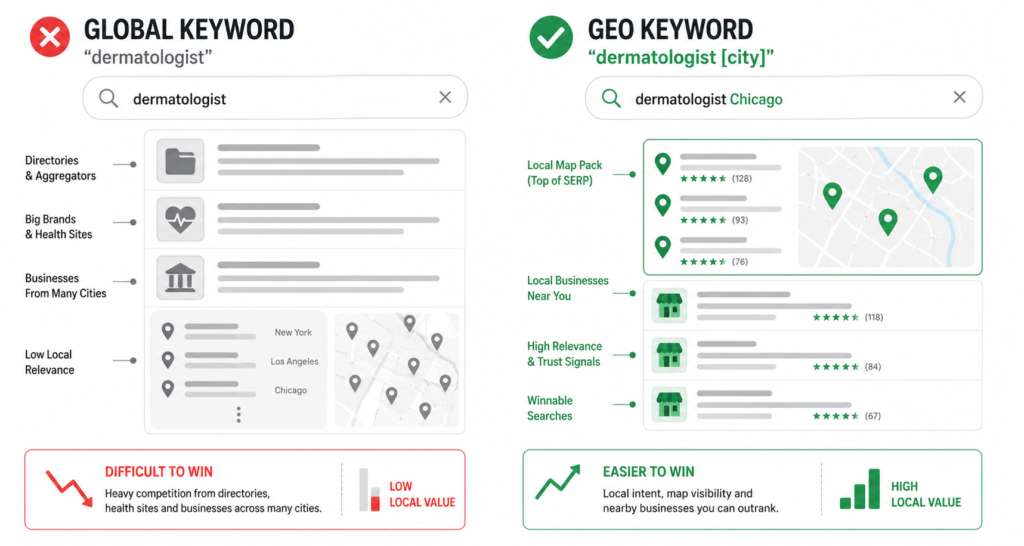
Geo-Targeted Keywords: The Searches You Can Actually Win
Add a city to the same query and everything changes. “Dermatologist [city]” is a completely different search: the aggregators lose their edge because now Google knows exactly where the searcher wants to be treated, and local businesses in that city rise to the top. This is the search a local business can win — and it is the search that brings a customer who can actually book.
This is not a smaller opportunity. It is a better one:
| Global keyword | Geo keyword | |
| Example | “dermatologist” | “dermatologist [your city]” |
| Who ranks | Aggregators + every city | Local businesses in that city |
| Winnable for you | Very hard | Realistic |
| Traffic relevance | Mostly wrong location | Right location, ready to book |
| Conversion potential | Low | High |
| The global keywords come to you anyway: by ranking well for “dermatologist [city]”, your page naturally contains the term “dermatologist” and builds authority on the topic. Over time it can start to surface for the broader term too — from users Google identifies as being in your area. You do not have to choose the global keyword; you earn a share of it by winning the local one first. |
Your Own Data Proves This
This is not theory — a local business can confirm it in its own Search Console. Pull the queries your service pages rank for, and a clear pattern appears: the searches that actually bring you traffic are overwhelmingly the ones with a city attached. The city-less queries that do rank tend to be informational (“what does a dermatologist treat”) or brand-name searches — not the commercial terms you assumed you needed.
Open the Search Console Performance report, filter to your service pages, and read the actual queries. The data will tell you where your winnable traffic is — and it is almost always geo-tagged. Build your strategy around what is already working, not around the vanity keyword you wish you ranked for.
How to Actually Win Your Local Searches
Local SEO has its own toolkit — some shared with regular SEO, some specific to geography. The essentials:
1. Google Business Profile is the foundation
For local search, your Google Business Profile is often more important than your website. It powers the map pack — the block of three local results with a map that sits above the regular listings for local-intent searches. Claim it, verify it, and complete every field: accurate category, hours, address, phone, services, and photos. An incomplete or unclaimed profile is the most common reason a legitimate local business is invisible in the map pack.
2. Consistent NAP across the web
Name, Address, Phone — identical everywhere they appear. Google cross-references your business details across your site, your Business Profile, directories, and citations. Inconsistencies (an old address here, a different phone format there) undermine confidence in which details are correct. Pick one canonical format and use it everywhere.
3. Geo-targeted service pages
Each core service should have a page that naturally includes the city and speaks to local customers — not “physiotherapy” but “physiotherapy in [city]”, written for someone in that area. This is where keyword research for a local business focuses: the geo-tagged service terms, not the global ones. Genuine local content — mentioning the area, local context, real specifics — outperforms a generic service page with a city name pasted in.
4. Reviews on your Business Profile
Reviews are one of the strongest local ranking signals and the single biggest conversion factor in the map pack. A business with 80 reviews at 4.7 stars beats one with 6 reviews at 5.0, both in ranking and in whether someone chooses to call. Ask every satisfied customer, make it easy, and respond to every review — good and bad.
5. Local trust signals and citations
Listings in relevant local and industry directories, mentions in local press, and links from local organisations all reinforce that you are a real, established business in that area. These are the local flavour of the trust signals that support any ranking — weighted toward geographic relevance.
If You Serve More Than One City
A business operating in several cities faces a specific decision, and getting it wrong is common. The instinct is one page — or one site — that lists every location. The better approach is usually the opposite: a dedicated page (or in some cases a dedicated site) per location, each genuinely targeted at that city.
The reasoning is the same as the core insight. Someone searching “dentist [city A]” should land on a page about your City A practice — its address, its team, its local details — not a generic page that mentions five cities and dilutes the relevance for all of them. A page trying to rank for every city ranks well for none.
| A real approach from practice: a clinic operating in two cities put each on its own dedicated local domain, each targeted purely at its own city. When a visitor arrives from “gynaecologist [City A]”, there is no “choose your city” popup and no confusion — the whole site is about City A. Forcing a location choice on a user who already told Google their city in the search is an unnecessary step that adds friction. Match the page to the searched geography. |
The Local SEO Mistakes That Waste Budget
- Chasing global keywords. The central error. Effort spent trying to rank for the city-less term is effort not spent winning the city term you can actually own.
- An unclaimed or incomplete Google Business Profile. The single most common reason a real local business is missing from the map pack.
- Inconsistent NAP. Different addresses or phone formats scattered across the web undermine the local signals you are trying to build.
- Ignoring reviews. Both a ranking factor and the deciding conversion factor — and the easiest to neglect.
- Generic multi-city pages. One page trying to serve every location serves none of them well.
- A “choose your city” popup when the user already searched with a city. Match the page to the search instead of asking again.
FAQ
Should I never target keywords without a city?
Not never — but not as your primary commercial strategy. Global keywords are worth having your pages naturally relevant to, because you can earn a share of them from local searchers over time, and informational versions (“how does physiotherapy work”) can be worth targeting for awareness. What does not work is building your commercial SEO around ranking a single local business for the broad, city-less term against national aggregators. Win the geo-tagged terms first; let the broad ones follow.
Is Google Business Profile more important than my website?
For purely local searches, often yes — the map pack sits above the regular results, and a strong Business Profile can win customers before anyone reaches your site. But they work together: the profile drives the map pack, the website supports it with the content and authority that reinforce your local relevance. Neglecting either weakens the other. Start with the profile because it is faster to influence, but do not treat the website as optional.
How do I rank in the map pack?
The main levers are a complete, accurate Google Business Profile; proximity of the searcher to your location; review quantity and quality; and consistent NAP across the web. Proximity you cannot control, but the rest you can. A fully completed profile with strong, recent reviews and consistent business details across the web covers most of what determines map pack ranking for a legitimate local business.
Does local SEO work for online-only businesses?
Local SEO specifically targets geographic searches, so it applies to businesses that serve a place — a clinic, a trade, a salon, a restaurant, a local service. A purely online business with no geographic service area is not doing local SEO; it is doing regular SEO, competing on the broad terms because it genuinely serves everyone everywhere. The distinction is whether your customers are defined by location. If they are, target the geography. If they are not, the global keyword logic is different.
| Chasing keywords your local business cannot win? An SEO audit shows which searches you can realistically rank for in your area — and where your budget is being spent on terms that will never bring local customers. Get an SEO Audit → No commitment. No generic report. martraff.com |