
How to Write Buying Guides That Rank and Sell
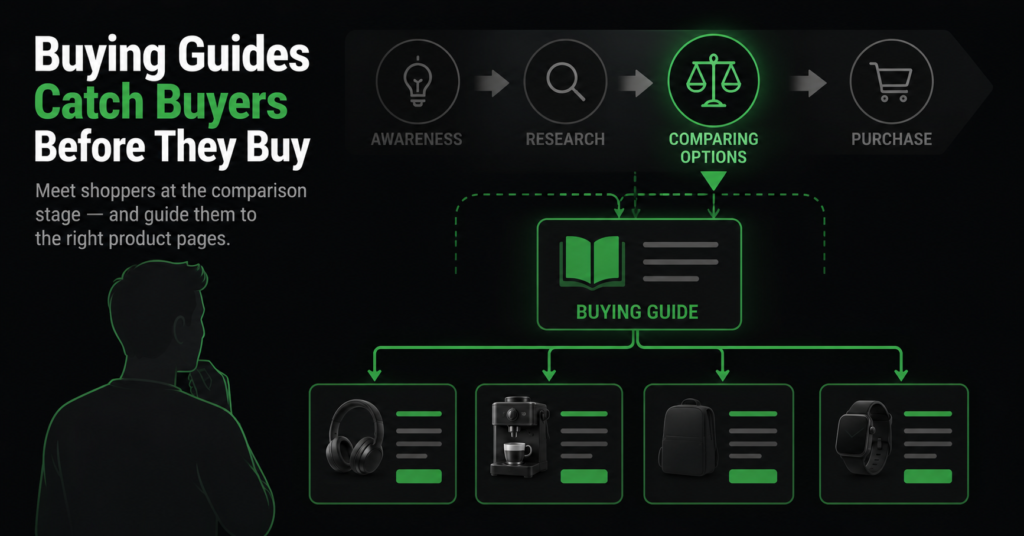
A buying guide catches a shopper at the single most valuable moment in the funnel: they have decided they want to buy something, they are comparing their options, and they have not yet chosen where to buy it. Rank for that search, answer it well, and you are the store that helped them decide — which is very often the store they buy from.
This is what separates buying guides from blog content that brings traffic but no sales. A guide targeting “best ergonomic chair for back pain” reaches someone who is about to spend money. A blog post targeting “how to sit correctly” reaches someone who is not. Same category, completely different commercial value — and most stores publish the second kind while ignoring the first.
This guide covers how to write buying guides and comparison pages that rank, build genuine authority, and route ready buyers to your product pages — the buying-intent content that most competitors never produce.
Why Buying Guides Outperform Ordinary Blog Content
Most ecommerce blog content targets informational keywords with little commercial intent. Buying guides target the commercial-investigation stage — and that difference is everything.
| Content type | Example query | Commercial value |
| Buying guide | “best office chair for back pain” | High — reader is choosing what to buy |
| Comparison page | “Herman Miller vs Steelcase” | Very high — reader is deciding between specific options |
| “Best X under £Y” | “best office chair under £300” | High — reader has budget and intent |
| Generic blog post | “how to improve posture at a desk” | Low — reader may never buy anything |
| “A buying guide is the piece of content that sits closest to the purchase without being a product page. It captures the shopper while they are still deciding — and unlike a product page, it can rank for the comparison and research queries that product pages never will. This is buying-intent content, and most competitors never produce it.” |
This is the content strategy angle most ecommerce stores miss: they either write product descriptions or they write generic blog posts, and they skip the high-intent middle where buying guides and comparison pages live. That middle is where the buyers are.
Finding the Buying Guides Worth Writing
Not every buying guide is worth the effort. The ones that pay off target searches with real commercial intent and enough volume to matter. Where to find them:
- “Best” and “top” searches in your category. “best [product] for [use case]”, “top [product] under [price]”. These are pure buying-intent queries.
- “vs” and comparison searches. When two brands or models in your range are frequently compared, a comparison page captures that decision.
- “how to choose” searches. “how to choose a [product]” reaches someone at the start of a considered purchase — earlier in the decision, but still buying.
- Your own site search and customer questions. The questions customers ask before buying are buying-guide topics. If people email asking “what is the difference between X and Y,” that is a comparison page waiting to be written.
Cross-reference these against keyword research to confirm real search volume and to see what your competitors already rank for. A buying guide that two competitors rank for is proven demand — and a gap you can compete in.
The Structure of a Buying Guide That Ranks
A buying guide has a job to do in a specific order: establish that you understand the decision, help the reader make it, and point them at the right product. Skip any of those and it fails as either SEO or a sales tool.
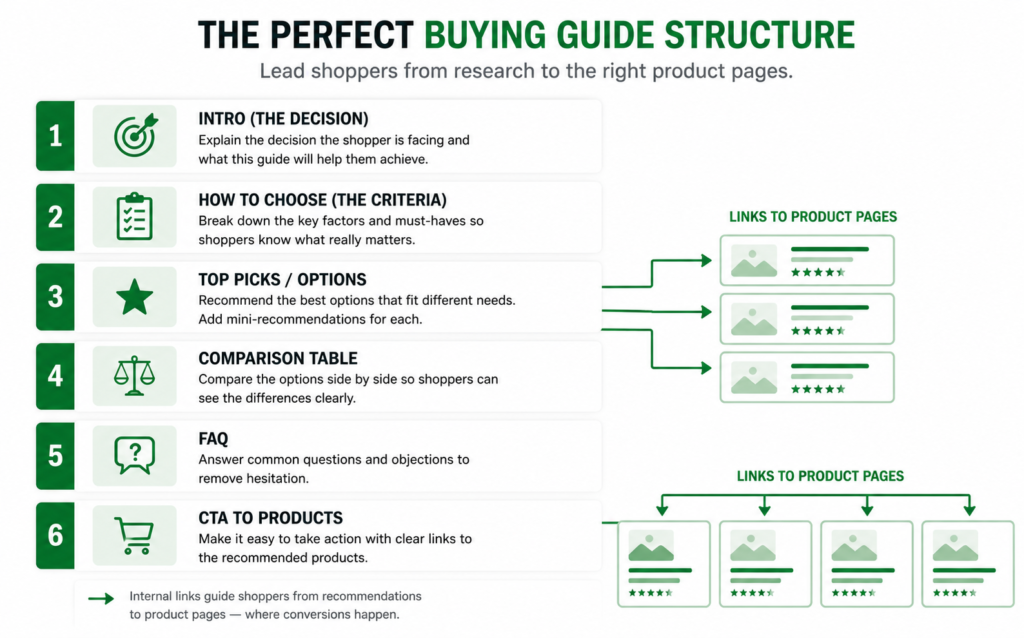
1. Open with the decision, not the product
The first lines should show you understand what the reader is actually trying to decide. Not “we sell great office chairs” but “the right ergonomic chair depends mostly on how many hours you sit and whether your pain is lower-back or upper-back.” This immediately signals the guide is written to help, not to sell — which is exactly what makes people keep reading and, eventually, buy.
2. Explain how to choose — the criteria that matter
The core of a buying guide is the decision framework: the three to five things that actually distinguish a good choice from a bad one for this product. Real criteria, with the trade-offs stated honestly. This is where genuine expertise shows — a guide that takes a position (“for most people, X matters more than Y, and here is why”) reads as authoritative in a way that a hedged list of every possible factor never does.
3. Make actual recommendations
The failure mode of buying guides is refusing to recommend. “There are many great options and it depends on your needs” helps nobody. A guide that ranks and sells commits: this one for most people, this one if you have this specific need, this one if budget is the priority. Specific recommendations, tied to specific products you sell, are what convert a reader into a buyer.
| The honesty balance: recommend genuinely, including acknowledging when a cheaper option is enough or when a product has a real limitation. A guide that only ever says “buy the most expensive one” reads as a sales pitch and loses trust. Honest guidance — including “you do not need the premium model unless X” — builds the credibility that makes the recommendations you do make land. |
4. Include a comparison table
For any guide comparing multiple options, a comparison table is the highest-value element on the page. It lets the reader scan the decision at a glance, it is the part most likely to be pulled into a featured snippet, and it is genuinely useful. Compare on the criteria that matter to the decision — not a spec dump, but the three to five factors the reader actually cares about.
5. Answer the follow-up questions
A short FAQ at the end catches the specific questions that come up right before purchase — “does this need assembly,” “what is the warranty,” “is this suitable for X.” These often match long-tail searches and can earn their own snippet placements while removing the last hesitations before a buyer commits.
6. Route the reader to the right product
Every recommendation should link directly to the product or category page where the reader can buy. This is the internal linking that turns a ranking guide into revenue: the guide earns the traffic and the authority, then routes both to the commercial pages that convert. A buying guide with no links to products is a blog post; a buying guide that routes every recommendation to a product page is a sales channel.
| The two-way value: a buying guide earns links and ranks for research queries your product pages never could — then passes that authority internally to those product pages. It brings traffic at the top and feeds your commercial pages at the same time. One piece of content working both ends of the funnel. |
Comparison Pages: The Highest-Intent Variant
A comparison page — “X vs Y” — is a buying guide narrowed to a single decision between two specific options. It is the highest commercial intent of any content type, because the reader has already narrowed to two choices and only needs help picking.
The rules are the same as a buying guide, with two additions:
- Be genuinely balanced. A comparison page that obviously favours the product with the higher margin loses trust instantly. State honestly what each option is better at. The reader can tell when a comparison is rigged, and a rigged one does not convert.
- End with a clear “choose X if… choose Y if…” The whole reason someone reads a comparison is to be told how to decide. Give them the decision rule explicitly, tied to their situation.
| A note on comparing competitors’ products: the most valuable comparison pages often compare two products you both sell — you win the sale either way. Comparing your product against one you do not stock is harder to do credibly and rarely worth it. Focus comparison pages on decisions within your own range. |
The Mistakes That Make Buying Guides Fail
- Refusing to recommend. The single biggest failure. A guide that will not commit to a recommendation is useless to a buyer and forgettable to Google.
- Thin, generic content. A “buying guide” that is three paragraphs of platitudes ranks for nothing. These guides need genuine depth because they compete against detailed, expert content.
- No links to products. A guide that ranks but does not route readers to product pages captures the traffic and wastes it.
- Obvious bias. Always recommending the most expensive option, or an unbalanced comparison, destroys the trust the format depends on.
- Never updating. Buying guides referencing discontinued products or last year’s models lose rankings and credibility. High-value guides need periodic refreshing.
FAQ
How long should a buying guide be?
Long enough to genuinely help the decision, which usually means 1,500-2,500 words for a competitive topic — but length follows substance, not the other way round. A guide competing for “best office chair for back pain” needs real depth because it is up against detailed expert content. A narrower comparison page might do its job in 800 words. Write until the decision is fully covered, then stop; padding to hit a word count weakens it.
Should buying guides be on my blog or as standalone pages?
Either works, but treat them as commercial assets, not casual blog posts. Many stores place them in a dedicated “guides” or “resources” section rather than the main blog, which signals their purpose and keeps them separate from lighter content. What matters more than location is that they are internally linked from relevant category pages and that they link out to products. The URL structure is secondary to the linking.
Do buying guides actually rank against big review sites?
A specialist store often can outrank generalist review sites for specific, narrower queries — precisely because it has genuine category expertise and can go deeper on the products it actually sells. You are unlikely to outrank a major review site for a broad “best laptops” query, but “best standing desk for a small home office” is winnable for a specialist. Target the specific, intent-rich queries where depth and genuine product knowledge beat broad authority.
How often should I update buying guides?
Review them at least annually, and whenever the products they recommend change — a discontinued product or a new model launch is an immediate trigger. Buying guides decay when they reference options that no longer exist, and both rankings and trust suffer. A guide that is kept current compounds in value; one that is left to age loses the rankings it earned.
| Want buying-intent content that sends ready buyers to your products? We build content strategies around buying guides and comparison pages — the high-intent content that ranks for research queries and routes buyers to your product pages. Get Your Content Strategy → No commitment. No generic report. martraff.com |